Paroodectes
Paroodectes ("near Oodectes") is an extinct genus of placental mammals from clade Carnivoraformes, that lived in Europe during middle Eocene.[2][3][4][5]
| Paroodectes Temporal range: middle Eocene | |
|---|---|
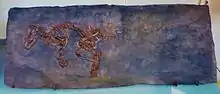 | |
| Fossil of Paroodectes feisti | |
Scientific classification  | |
| Domain: | Eukaryota |
| Kingdom: | Animalia |
| Phylum: | Chordata |
| Class: | Mammalia |
| Clade: | Pan-Carnivora |
| Clade: | Carnivoramorpha |
| Clade: | Carnivoraformes |
| Genus: | †Paroodectes Springhorn, 1980[1] |
| Type species | |
| †Paroodectes feisti Springhorn, 1980[1] | |
| Synonyms | |
|
synonyms of genus:
synonyms of species:
| |
It lived in the rain forests and swamps and it was a prehistoric predator that had the size and the appearance of a cat and was well adapted to climbing, as is apparent from its limbs, joints and shoulder bones. Its long tail gave balance for tree climbing and jumping from branch to branch. Paroodectes probably hunted insects, rodents and small primates in the tree tops.
Only one species of Paroodectes (P. feisti) has been found, and this was at the Messel Pit located southeast of Frankfurt, Germany. The pit was formed during the Geiseltalian Period (or Middle Eocene) about 50 million years ago. The fossil was found by private collector Otto Feist in 1974. It was described in 1980 by Rainer Springhorn who said the following about the species: "The odontological features of the Messel-Miacid are nearest to the new world genus Oodectes from the Bridger Basin (Bridgerian). No direct relationship exists to European species. The structure of the postcranial skeleton shows great conformity with North American Miacinae. Differences result from proportions skull-length/stature and length of vertebral column/length of limbs. A well-developed clavicle is extant. Scaphoid, lunar and central are distinct. Metatarsals are elongated. Hand and foot are adapted to plantigrade locomotion. An arboricole [living in trees] habit is assumed. Some morphologic features are reminiscent of the Viverridae and some Procyonidae."[1]
Phylogeny
The phylogenetic relationships of genus Paroodectes are shown in the following cladogram:[6][7][8][9]
| Carnivoramorpha |
|
†Gracilocyon/Oodectes clade †Vulpavus clade | ||||||||||||||||||||||||||||||||||||||||||||||||||||||||||||||||||||||||||||||||||||||||||||||||||||||||||||||||||||||||||||||||||||||||||||||||||||||||||||||||||||||||||||||||||||||||||||||||||||||||||||||||||||||||||||||||||||||||||||||||||||||||||||||||||||||||||||||||||||||||||||||||||||||||||||||
(Carnivora [sensu lato]) | ||||||||||||||||||||||||||||||||||||||||||||||||||||||||||||||||||||||||||||||||||||||||||||||||||||||||||||||||||||||||||||||||||||||||||||||||||||||||||||||||||||||||||||||||||||||||||||||||||||||||||||||||||||||||||||||||||||||||||||||||||||||||||||||||||||||||||||||||||||||||||||||||||||||||||||||||


See also
References
- Springhorn, Rainer (1980). "Paroodectes feisti, der erste Miacide (Carnivora, Mammalia) aus dem Mittel-Eozän von Messel". Paläontologische Zeitschrift (in German and Latin). 54 (1/2): 171–198. doi:10.1007/BF02985887. S2CID 128857759.
- J. J. Hooker (1986.) "Mammals from the Bartonian (middle/late Eocene) of the Hampshire Basin, southern England." Bulletin of the British Museum (Natural History) 39(4):191-478
- Robert L. Carroll (1988.) "Vertebrate Paleontology and Evolution." W. H. Freeman and Company, New York, Paroodectes
- McKenna, Malcolm C.; Bell, Susan K. (1997). Classification of Mammals Above the Species Level. New York: Columbia University Press. ISBN 978-0-231-11012-9. Retrieved 16 March 2015.
- Solé, Floréal (2014). "New carnivoraforms from the early Eocene of Europe and their bearing on the evolution of the Carnivoraformes". Palaeontology. 57 (5): 963–978. Bibcode:2014Palgy..57..963S. doi:10.1111/pala.12097. ISSN 1475-4983. S2CID 129314381.
- Flynn, John J.; Finarelli, John A.; Spaulding, Michelle (2010). "Phylogeny of the Carnivora and Carnivoramorpha, and the use of the fossil record to enhance understanding of evolutionary transformations". In Goswami, Anjali; Friscia, Anthony (eds.). Carnivoran evolution. New views on phylogeny, form and function. Cambridge University Press. pp. 25–63. doi:10.1017/CBO9781139193436.003. ISBN 9781139193436.
- Solé, Floréal; Smith, Richard; Coillot, Tiphaine; de Bast, Eric; Smith, Thierry (2014). "Dental and tarsal anatomy of Miacis latouri and a phylogenetic analysis of the earliest carnivoraforms (Mammalia, Carnivoramorpha)". Journal of Vertebrate Paleontology. 34 (1): 1–21. Bibcode:2014JVPal..34....1S. doi:10.1080/02724634.2013.793195. ISSN 0272-4634. S2CID 86207013.
- Solé, Floréal; Smith, Thierry; De Bast, Eric; Codrea, Vlad; Gheerbrant, Emmanuel (2016). "New carnivoraforms from the latest Paleocene of Europe and their bearing on the origin and radiation of Carnivoraformes (Carnivoramorpha, Mammalia)". Journal of Vertebrate Paleontology. 36 (2): e1082480. Bibcode:2016JVPal..36E2480S. doi:10.1080/02724634.2016.1082480. ISSN 0272-4634. S2CID 87537565.
- Tomiya, S.; Zack, S. P.; Spaulding, M.; Flynn, J. J. (2021). "Carnivorous mammals from the middle Eocene Washakie Formation, Wyoming, USA, and their diversity trajectory in a post-warming world". Journal of Paleontology. 95 (Supplement S82): 1–115. Bibcode:2021JPal...95S...1T. doi:10.1017/jpa.2020.74.