Falcatodon
Falcatodon ("curved tooth") is an extinct genus of hyainailourid hyaenodonts of the polyphyletic tribe Hyainailourini within paraphyletic subfamily Hyainailourinae, from the Early Oligocene (Rupelian) of the Faiyum Oasis depression in Egypt.[1]
| Falcatodon Temporal range: Early Oligocene | |
|---|---|
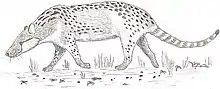 | |
| illustration of Falcatodon schlosseri | |
Scientific classification  | |
| Domain: | Eukaryota |
| Kingdom: | Animalia |
| Phylum: | Chordata |
| Class: | Mammalia |
| Order: | †Hyaenodonta |
| Superfamily: | †Hyainailouroidea |
| Family: | †Hyainailouridae |
| Subfamily: | †Hyainailourinae |
| Tribe: | †Hyainailourini |
| Genus: | †Falcatodon Morales & Pickford, 2017[1] |
| Type species | |
| †Falcatodon schlosseri Holroyd, 1999[2] | |
| Synonyms | |
|
synonyms of species:
| |
Description
Morales and Pickford (2017, p. 344) diagnose Falcatodon as follows: "Medium sized Hyainailourinae, differing from Metapterodon by the reduction of the protocone in the upper molars (M1 – M2), which is located in a very anterior position. It differs from Hyainailouros by the more sectorial morphology of the upper molars, with more advanced fusion of the paracone-metacone with, nevertheless, a groove separating the cusps visible in the M1. Lower molars sectorial with reduced talonid and without a metaconid. It differs from Isohyaenodon, Sectisodon and Exiguodon, by the lesser reduction of the protocone in the upper molars which, above all, retain a stretched out subtriangular occlusal outline."[1]
Classification and phylogeny
Taxonomy
Falcatodon was originally described as a new species of Metapterodon, M. schlosseri by Holroyd (1999), who nonetheless recognized that Eocene and Oligocene hyainailourids he assigned to Metapterodon might prove generically distinct. Subsequent study demonstrated that Falcatodon is not only distinct from Metapterodon but also closely related to Isohyaenodon.
Phylogeny
The phylogenetic relationships of genus Falcatodon are shown in the following cladogram:[3][4][5][6][7]
| †Hyaenodonta |
|
|||||||||||||||||||||||||||||||||||||||||||||||||||||||||||||||||||||||||||||||||||||||||||||||||||||||||||||||||||||||||||||||||||||||||||||||||||||||||||||||||||||||||||||||||||||||||||||||||||||||||||||||||||||||||||||||||||||||||||||||||||||||||||||||||
See also
References
- Jorge Morales; Martin Pickford (2017). "New hyaenodonts (Ferae, Mammalia) from the Early Miocene of Napak (Uganda), Koru (Kenya) and Grillental (Namibia)" (PDF). Fossil Imprint. 73 (3–4): 332–359. doi:10.2478/if-2017-0019. S2CID 31350436.
- P. A. Holroyd (1999.) "New Pterodontinae (Creodonta: Hyaenodontidae) from the late Eocene-early Oligocene Jebel Qatrani Formation, Fayum province, Egypt." PaleoBios 19(2):1-18
- Borths, Matthew R.; Stevens, Nancy J. (2017). "Deciduous dentition and dental eruption of Hyainailouroidea (Hyaenodonta, "Creodonta," Placentalia, Mammalia)". Palaeontologia Electronica. 20 (3): 55A. doi:10.26879/776.
- Matthew R. Borths; Nancy J. Stevens (2019). "Simbakubwa kutokaafrika, gen. et sp. nov. (Hyainailourinae, Hyaenodonta, 'Creodonta,' Mammalia), a gigantic carnivore from the earliest Miocene of Kenya". Journal of Vertebrate Paleontology. 39 (1): e1570222. Bibcode:2019JVPal..39E0222B. doi:10.1080/02724634.2019.1570222. S2CID 145972918.
- Floréal Solé; Bernard Marandat; Fabrice Lihoreau (2020). "The hyaenodonts (Mammalia) from the French locality of Aumelas (Hérault), with possible new representatives from the late Ypresian". Geodiversitas. 42 (13): 185–214. doi:10.5252/geodiversitas2020v42a13. S2CID 219585388.
- Solé, F.; Morlo, M.; Schaal, T.; Lehmann, T. (2021). "New hyaenodonts (Mammalia) from the late Ypresian locality of Prémontré (France) support a radiation of the hyaenodonts in Europe already at the end of the early Eocene". Geobios. 66–67: 119–141. Bibcode:2021Geobi..66..119S. doi:10.1016/j.geobios.2021.02.004. S2CID 234848856.
- Averianov, Alexander; Obraztsova, Ekaterina; Danilov, Igor; Jin, Jian-Hua (2023). "A new hypercarnivorous hyaenodont from the Eocene of South China". Frontiers in Ecology and Evolution. 11. doi:10.3389/fevo.2023.1076819. ISSN 2296-701X.