Galecyon
Galecyon ("polecat-dog") is an extinct genus of placental mammals from extinct order Hyaenodonta, that lived in Europe and North America (found in the Clarks Fork and Powder River basins of Wyoming) during the early Eocene.[9][1]
| Galecyon Temporal range: early Eocene | |
|---|---|
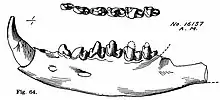 | |
| lower jaw of Galecyon mordax | |
Scientific classification  | |
| Domain: | Eukaryota |
| Kingdom: | Animalia |
| Phylum: | Chordata |
| Class: | Mammalia |
| Order: | †Hyaenodonta |
| Genus: | †Galecyon Gingerich & Deutsch, 1989[1] |
| Type species | |
| †Galecyon mordax Matthew & Granger, 1915 | |
| Species | |
| Synonyms | |
|
synonyms of genus:
| |
Description
Galecyon had robust canines and short, deep jaws. Prior to 2015, little was known about its post-cranial skeleton.[1] However, following the discovery of more complete fossils, it is now known to have been a primarily terrestrial animal weighing between 5.2 and 7.9 kg (11 and 17 lb), lacking the adaptations for climbing found in some of its close relatives.[10]
Phylogeny
The phylogenetic relationships of genus Galecyon are shown in the following cladogram.[11][12][13][14][15]
| †Hyaenodonta |
|
|||||||||||||||||||||||||||||||||||||||||||||||||||||||||||||||||||||||||||||||||||||||||||||||||||||||||||||||||||||||||||||||||||||||||||||||||||||||||||||||||||||||||||||||||||||||||||||||||||||||||||||||||||||||||||||||||||||||||||||||||||||||||||||||||||||||||||||||||||
See also
References
- Gingerich, Philip D.; Deutsch, Harvey A. (1989). "Systematics and evolution of early Eocene Hyaenodontidae (Mammalia, Creodonta) in the Clarks Fork Basin, Wyoming". 27 (13). Museum of Paleontology, University of Michigan: 327–391.
{{cite journal}}: Cite journal requires|journal=(help) - Shawn P. Zack (2011.) "New Species of the Rare Early Eocene Creodont Galecyon and the Radiation of Early Hyaenodontidae" Journal of Paleontology, 85(2):315-336.
- F. Solé, E. Gheerbrant and M. Godinot (2013.) "Sinopaninae and Arfianinae (Hyaenodontida, Mammalia) from the Early Eocene of Europe and Asia; evidence for dispersal in Laurasia around the Paleocene/Eocene boundary and for an unnoticed faunal turnover in Europe." Geobios 46:313-327
- W. D. Matthew and W. Granger (1915.) "A revision of the Lower Eocene Wasatch and Wind River faunas." Bulletin of the American Museum of Natural History 34(1):1-103
- T. Smith and R. Smith (2001.) "The creodonts (Mammalia, Ferae) from the Paleocene-Eocene transition in Belgium (Tienen Formation, MP7)." Belgian Journal of Zoology 131(2):117-135
- A. V. Lavrov (1999.) "Adaptive Radiation of Hyaenodontinae (Creodonta, Hyaenodontidae) of Asia." in 6th Congress of the Theriological Society, Moscow, April 13–16, p. 138 [in Russian].
- E. Delson (1971.) "Fossil mammals of the early Wasatchian Powder River local fauna, Eocene of northeast." Bulletin of the American Museum of Natural History 146(4)
- L. Van Valen (1965.) "Some European Proviverrini (Mammalia, Deltatheridia)." Palaeontology 8(4):638-665
- PaleoBiology Database: Galecyon, basic info
- Zack, S. P.; Rose, K. D. (November 2015). "A postcranial skeleton of Galecyon: evidence for morphological and locomotor diversity in early Hyaenodontidae (Mammalia, Hyaenodontida)". Journal of Vertebrate Paleontology. 35 (6): e1001492. doi:10.1080/02724634.2014.1001492. S2CID 86247155.
- Borths, Matthew R; Stevens, Nancy J (2017). "Deciduous dentition and dental eruption of Hyainailouroidea (Hyaenodonta, "Creodonta," Placentalia, Mammalia)". Palaeontologia Electronica. 20 (3): 55A. doi:10.26879/776.
- Matthew R. Borths; Nancy J. Stevens (2019). "Simbakubwa kutokaafrika, gen. et sp. nov. (Hyainailourinae, Hyaenodonta, 'Creodonta,' Mammalia), a gigantic carnivore from the earliest Miocene of Kenya". Journal of Vertebrate Paleontology. 39 (1): e1570222. Bibcode:2019JVPal..39E0222B. doi:10.1080/02724634.2019.1570222. S2CID 145972918.
- Floréal Solé; Bernard Marandat; Fabrice Lihoreau (2020). "The hyaenodonts (Mammalia) from the French locality of Aumelas (Hérault), with possible new representatives from the late Ypresian". Geodiversitas. 42 (13): 185–214. doi:10.5252/geodiversitas2020v42a13.
- Solé, F.; Morlo, M.; Schaal, T.; Lehmann, T. (2021). "New hyaenodonts (Mammalia) from the late Ypresian locality of Prémontré (France) support a radiation of the hyaenodonts in Europe already at the end of the early Eocene". Geobios. 66–67: 119–141. Bibcode:2021Geobi..66..119S. doi:10.1016/j.geobios.2021.02.004. S2CID 234848856.
- Averianov, Alexander; Obraztsova, Ekaterina; Danilov, Igor; Jin, Jian-Hua (2023). "A new hypercarnivorous hyaenodont from the Eocene of South China". Frontiers in Ecology and Evolution. 11. doi:10.3389/fevo.2023.1076819. ISSN 2296-701X.