Do you know of any software out there that will allow me to play in different musical temperaments (e.g. Well temperament and Meantone temperament)? I'm especially interested in software that accepts MIDI input.
Asked
Active
Viewed 2.0k times
42

-
I found this question by nearly asking a very similar one. I'd like to be able to hear the same piece of music in a bunch of different temperaments without having to program it myself or buy expensive software -- ideally somebody already has a collection of MP3s or something. Should I ask that separately or just leave this comment here? – Monica Cellio May 23 '11 at 14:33
-
1Also check discussion at http://music.stackexchange.com/questions/3103/software-for-microtonal-midi – gavenkoa Jul 14 '11 at 20:02
-
Does anyone know such an app for iOS? – thSoft Jan 12 '14 at 12:25
10 Answers
12
Logic Pro has built-in controls for using different temperaments. Check out the link below:
http://documentation.apple.com/en/logicpro/usermanual/index.html#chapter=43%26section=6%26tasks=true
It allows you to either select a pre-configured tuning system, or customize your own. MAX/MSP is another solution, but if you don't have programming experience, using this as an option might be significantly more trouble than it's worth. However, you could
Here are some other links I found, but cannot personally vouch for:
http://www.cycling74.com/forums/topic.php?id=7392 (If you have MAX, you could use this file to convert MIDI input to specific frequencies).
http://emusician.com/tutorials/emusic_playing_cracks/ (article describing various software programs suited for alternate tunings)

cotroxell
- 780
- 4
- 7
8
The MIDI program Timidity can be adjusted to any tuning you want, though it requires a little bit of work.
Update:
Timidity supports playing just intonation very easily:
   -Z file, --freq-table=file
          Cause  the  table of frequencies to be read from file.  This is useful to define a tuning different from 12-equal temperament.  If ``pure'' is specified, TiMid‐
          ity++ plays in trial pure intonation.

          -Zpure[n(m)], --pure-intonation=[n(m)]
                 Play in trial pure intonation by Key Signature meta-event in the MIDI file.  You can specify the initial keysig by hand, in case the MIDI file  does  not
                 contains  the meta-event.  Optionally, n is the number of key signature.  In case of sharp, n is positive.  In case of flat, n is negative.  Valid values
                 of n are in the interval from -7 to 7.  In case of minor mode, you should put `m' character along with -Zpure option.
To make your own, arbitrary tunings, see this.

Geremia
- 570
- 3
- 16

Willie Wong
- 1,514
- 16
- 23
-
1see also: http://music.stackexchange.com/questions/12566/what-file-format-does-timiditys-z-or-freq-table-option-require – Dave May 06 '16 at 19:22
-
1Timidity also allows you to send specific audio frequencies with each note. If you use a tuning with more than 12 notes in an octave and you use tuning tables then you reduce the overall octave range you have available (eg, using 128-EDO means you only get one octave). But if you send the exact audio frequency you want with each note then you are not limited in your octave range. You do this with sysex commands which makes it trickier but it does give you tremendous power and allowing for something like 196608-EDO over 10.666 octaves. – bfootdav May 08 '16 at 18:17
-
For just intonation, does it adjust the intonation dynamically? If not, it's not really just intonation. – phoog Jul 08 '19 at 15:33
-
@phoog: I don't understand your comment. I thought traditionally just intonation simply means tuning with rational frequency ratios. Dynamically adjusted intonation is something different. Can you elaborate for me? – Willie Wong Jul 09 '19 at 12:55
-
@WillieWong you can't tune a fixed diatonic scale in just intonation because the rational frequency ratios don't add up. For example, if you are tuning in C major, and your C-to-E ratio is 5:4, then you cannot have a 3:2 fifth for all of the chords C major, G major D minor, and A minor. If three of those fifths are at a 3:2 ratio, the fourth will be at 40:27. It's not pretty. – phoog Jul 09 '19 at 13:04
-
1@phoog: I agree it is not pretty, but isn't that exactly what just tuning is supposed to be? I guess I am asking: "I think of just intonation as, for example, [this](https://en.wikipedia.org/wiki/Just_intonation#Diatonic_scale); what do you mean when you think of just intonation?" – Willie Wong Jul 09 '19 at 13:29
-
@phoog: are you _requiring_ just intonation to be also transpositionally invariant? With a fixed tuning, yes, the two are not compatible. But I don't think most people require transpositional invariance when they talk about just intonation. – Willie Wong Jul 09 '19 at 13:34
-
Historically, nobody ever tuned keyboards that way. Early keyboards for monophonic music were probably tuned in Pythagorean tuning (i.e. 3-limit just, with 7, 8, or 9 pitch classes), but by the time the third began to be consonant, people would have been tempering the scale. It's not like they were playing music with sour fifths because they didn't know better. "Just intonation" describes how an ensemble of instruments with varying pitch can tune, not how a keyboard can be tuned. I'm not talking about transposition, but about the ability to play all the consonant intervals in a single key. – phoog Jul 09 '19 at 13:47
-
Let us [continue this discussion in chat](https://chat.stackexchange.com/rooms/95915/discussion-between-phoog-and-willie-wong). – phoog Jul 09 '19 at 14:36
5
Midi actually has a 20-year old ratified specification extension just for this. Any synth that supports that extensions should support those temperaments (although you might need an appropriate midi interface too).
The wikipedia page for the extension page lists a number of soft-synths that support the extension.


4
Mutabor allows you to use arbitrary tunings and works on a couple of platforms. It accepts MIDI input from keyboards and files. On Mac I've had some trouble getting it set up, and the translation to English is not done yet, but it has great potential...

sventechie
- 1,153
- 8
- 12
4
- Denemo (music score editor. free.) supports a few temperaments.
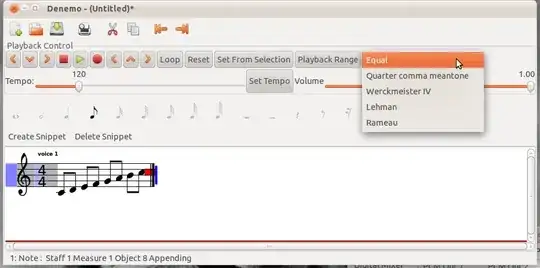
- Some Synth plugins (vsti...) lets you choose the temperament. Ideal, if you want to play live with a midi keyboard. Edirol Orchestral was one, but I think it's discontinued.

Ananth Pattabiraman
- 909
- 7
- 9
2
http://www.TallKite.com/alt-tuner.html
Alt-tuner is a midi effect for your Digital Audio Workstation, very powerful. You can sweep the whole spectrum of meantone (1/3 comma, 2/7 comma, 1/4 comma, 1/5 comma, 1/11 comma = 12-ET, 0 comma = pythagorean) and you can even do this with a foot pedal as you are playing, via midi learn. It also does well-temperament, any kind. It does just intonation with commatic shifts, called tapnotes. It does ADAPTIVE just intonation, which adjusts all the pitches very slightly (2-3¢) as you play, for a better sound than quarter-comma meantone, which has fifths flat by 5.5¢, and min 7ths and maj 9ths flat by 11¢.
You can also switch back and forth between all these tunings with foot pedals as you play - as to Monica Cellio's comment above - no need for mp3s, just play and listen!


2
Pianoteq. You should really look at this physical-modeling piano virtual instrument plugin . Not only does it support all the historical temperaments, it models many kinds of harpsichords, fortepianos, pianos, and other instruments. It sounds excellent and is light on system requirements, and it's available for Mac, PC and Linux.
1
Korg and Yamaha synths each support a fairly large number of different temperaments. Other makes may as well, these are just the ones I have owned. I'm surprised the companies don't advertise this feature.

nasonmusic
- 11
- 1
-
I had a Roland digital piano that supported this feature as well, though I've since sold it. – Kyle Strand Jul 13 '13 at 06:40
-
Actually most digital pianos and synths support a fairly **small** number of temperaments! For example, the popular Casio Privia series supports 16 temperaments, but only one meantone (when at least two would be needed, see https://en.wikipedia.org/wiki/Meantone_temperament) and only two well temperaments (when at least five would be needed, see https://en.wikipedia.org/wiki/Werckmeister_temperament and https://en.wikipedia.org/wiki/Kirnberger_temperament and https://en.wikipedia.org/wiki/Well_temperament). Kawai supports different total number, but the very same three well and meantone ones. – Davide Oct 27 '17 at 17:02
0
Every virtual organ software that I know of can handle multiple temperaments:
- Hauptwerk (proprietary)
- GrandOrgue (open source)
- jOrgan (open source)

thSoft
- 315
- 1
- 8
-1
According to wikipedia, "A microtuner or microtonal tuner is an electronic device or software program designed to modify and test the tuning of musical instruments (in particular synthesizers) with microtonal precision, allowing for the design and construction of microtonal scales and just intonation scales, and for tuning intervals that differ (or not) from those of common Western equal temperament." See:
http://en.wikipedia.org/wiki/Microtuner
"Hardware microtuners" listed there includes "ORIENTAL / WORLD SCALE MIDI CONVERTER", "FSU Dynamic Microtuning Box", and "H-Pi Instruments Tuning Box TBX1".
"Software microtuners" listed there includes "chelles et Modes (Mac & PC)", "alt-tuner", "L'il Miss' Scale Oven (Mac)", "microtuner Max/MSP object", "Scala (Windows, Linux, Mac)", "Tobybear MicroTuner VST plugin (Windows)". "Tune Smithy (Windows)", and "Mutabor".

