23

In the staff, would one write enharmonic notes with # or ♭? Does it matter which you'd use and why?

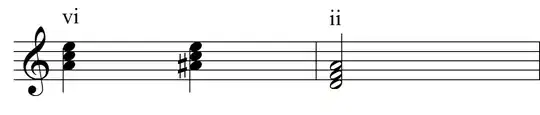
For example: In the key of C Major, would it be better to write this passage with an A#, as it is, or B♭?

enter image description here

In short, what rules should one follow when facing this problem?

bzrr
  • 595
  • 1
  • 4
  • 11
  • 3
    Capital Roman numerals depict major and lower case depict minor.Playing this from the dots, to me now sounds like Amin. moving through C dom.7th to Dmin. If this is what the composer intended, the A# needs to be Bb, the flattened 7th of C. – Tim Oct 11 '13 at 18:15
  • Here's a fun video explaining the use of # and b ["Why do we use E#?"](https://youtu.be/BupInYdyZck) – Christopher Arensky Feb 01 '16 at 04:44

4 Answers4

39

There are a few general rules.

  • Most accidentals should be of the type found in the key signature. For example, in G Major, use G# -- not Ab. In F# major, use A# instead of Bb.
  • If the accidental is in a chromatic scale, use sharps ascending and flats descending
  • In any other scale, use the accidental that typically goes with the scale. For example, Bb and Eb in a Bb major scale instead of A# and D#.
  • In a chord, use the normal accidentals so it is recognizable. For example, Eb in a Cm chord instead of D#. In the example from the question, prefer A#. An A# dim chord is usually spelled A# C E. A Bb dim chord is usually spelled Bb Dbb Fb, which is a lot more unusual than an A# dim chord.A musician will bore easily recognize A# dim.
  • Of the enharmonics, prefer C#, Eb, F#, Ab, and Bb when no other rules apply. For example, in C major, prefer F# instead of Gb. This is assuming no other rules apply and neither accidental is easier to read than the other.

The reason for these enharmonics is the number of key signatures they are naturally found in. C# is found in 6 key signatures, while Db is only found in four. So, C# is the primary name for that enharmonic. D# is found in four, while Eb is found in 6. You can find a complete list here.

However, if one accidental makes a passage a lot easier to read, prefer that one over the one specified in these rules. For example, E D# E would be preferred to E Eb E♮.

Basically, these are general guidelines and have plenty of exceptions.

American Luke
  • 7,319
  • 8
  • 45
  • 91
  • 5
    Great answer here - just want to add (at the risk of confusing someone) it's also important to keep in mind the nature of the instrument you're writing for (saxes are more used to seeing sharps / brass are more used to seeing flats.) A very small but important point. – jjmusicnotes Oct 11 '13 at 00:35
  • 1
    Also, if you're writing music more on the edges of tonality, you want to avoid mixing flats and sharps within the same chord or measure. Stick to one type and it'll be easier for the player to read. – NReilingh Oct 11 '13 at 03:17
  • 1
    Great answer. The basic philosophy is that you want to use the one that will be easiest for the musician to read. These rules should help you get there. – Ben Miller - Remember Monica Oct 11 '13 at 03:43
  • I would add that it also depends on the interval. Let's take F# as key signature with its 6 sharps. If you take a major 6th interval, you will need a D#. However if you have a full-diminished chord, you need a diminished 7th, which will give you Eb. (And then I haven't even mentioned extreme intervals like diminished octave which gives you F instead of E#.) – András Hummer Oct 11 '13 at 09:06
  • @American Luke. An accidental is actually a note that is not contained within the key signature ! Think you meant # or b.Having said that, it's a great answer. I'd just add that if a standard note from a particular key has been changed, e.g. in key C, an Fmin. appears, with a G#/Ab note. As the A will be the note changed, it will appear as Ab, not G#. – Tim Oct 11 '13 at 10:37
  • @jjm. I'm interested in the reasons why saxes( in Eb and Ab) use more sharps, whereas brass (in Bb or C or Eb) use more flats. – Tim Oct 11 '13 at 12:57
  • 1
    @Tim - because of the transposition, saxes, though pitched in Bb and Eb, tend to be put into sharp keys - especially Eb saxes. Brass players are comfortable reading flats from the band world where Bb, Eb, and Ab are the "standard" band keys; even Db is quite comfortable as well. If you want to hear something scary, ask a beginning band to play in E major. – jjmusicnotes Oct 11 '13 at 14:07
  • @jjm . Thanks, I meant Bb, not Ab for Sax. But still can't work out why trumpet / Bb and tenor sax / Bb shouldn't both be happy/unhappy in #/b keys.My bigband didn't like E, true, but as I was on guitar, I loved it... I think the brass thing is that to flatten any given note, you press down one more valve, dropping the sound by a semitone - not so easy on saxes, clarinets etc. – Tim Oct 11 '13 at 16:00
  • @American Luke. Thanks, makes more sense. However, I think we've both answered a different question from the one the OP's morphed into !! – Tim Oct 11 '13 at 16:04
  • Yeah. I wrote it out at first, but I re-wrote that sentence and didn't check to see if it made any sense. I'm not sure what the OP's trying to ask now. – American Luke Oct 11 '13 at 16:13
  • @American Luke. Put a young head on old shoulders.How the heck do I make a natural sign ?!?! – Tim Oct 11 '13 at 17:11
  • @Tim Copy-paste or `♮`. – American Luke Oct 11 '13 at 17:37
  • Edited the post. I think is ok now. – bzrr Oct 11 '13 at 17:59
  • 1
    Another thing to note is on chromatic instruments which have parts associated with particular pitches (e.g. organ pipes and reeds, piano strings, actuating levers, etc.) it is common to always use the "sharp" forms of pitches to identify them. For example, if the bottom note on a pipe organ rank is C, the fourth pipe from the bottom would be described as D# (rather than Eb). – supercat Oct 18 '13 at 17:05
  • @Tim alto sax player here. What jjmusicnotes said, and also, most of the "black keys" on a sax are more similar to the "white key" just below. For example, the fingering for D# is the same as D, with one extra key pressed, rather than being the same as E with one less key pressed. I think that's probably part of why sharps feel more comfortable for us. – Tyler Dec 08 '13 at 02:59
  • 1
    This answer skates round one of the first accidentals a beginner will encounter, the sharpened 7th in a minor scale. And it doesn't follow the "match the key signature" rule. The sharpened seventh note of e.g. G minor is F#. Not Gb. Also beware of the "make it easier" argument. There's "clever easy" and "dumb easy". Writing the middle note of a G# major chord as C natural instead of B# is "dumb easy". – Laurence Nov 25 '16 at 16:38
  • A# C E is not a A# dim chord! That would be A# C# E. The more likely interpretation is a C7 with missing 5th: C E (G) Bb. So, the correct answer to OP would be Bb, not A#. (Not that I think OP cares 5 years later, but it might confuse other readers.) – Hjulle Jun 12 '18 at 05:10
  • I don't think the C is sharp. Not that anyone cares five years later :P – American Luke Jun 14 '18 at 03:36
10

Truth is, it doesn't really matter... but in general, you should write it so it is easily understood. Some helpful tips for making it easy to understand are:

If you are going up, it's easier to read a sharp (C up to D# instead of C up to Eb)

If you are going down, it's easier to read a flat (C down to Bb instead of C down to A#)

Use accidentals of the same key (key of G uses sharps, key of F uses flats)

Avoid mixing sharps and flats together (A# with Gb is awkward to read)

No unison enharmonics (don't write a B# and a C♮ in the same measure)

No reversed enharmonics (don't write a B# and a Cb in the same measure)

No inversed enharmonics (don't write a Cb and a C♮ in the same measure)

No contradicting accidentals (don't write Db and D# in the same measure)

Use the least amount of accidentals (reading A#, B, A# is easier than reading Bb, Cb, Bb)

Put every note on a letter if you can (Instead of writing C, B, Bb, G, Gb, F, Eb, C; it's better to write it as C, B, A#, G, F#, E#, D#, C because each note is assigned to a letter)

Follow music theory if it applies (sharps for augmented steps, flats for diminished steps)
moon
  • 159
  • 1
  • 3
2

In addition to American Luke's answer. Each key has its own key signature, as in, Gmaj. =F# only. Gmin. has Bb and Eb. So, using your example, in key of F#, the A notes would already be sharpened by virtue of the key signature, which will contain a sharp sign on the A space (treble clef).

An important factor is that once you've started a tune using one or the other, it USUALLY makes sense (and is often easier to read) if you continue to use the same. However, technically this is not always the case. Take the tune in,say, G maj. using one # all through. To use a chord of Cmin., the E will need to be flattened, 'cos that's exactly what has happened to it. It wasn't a D that was sharpened, so in a 'sharp' key, one would have to use a flat for that note.

Another point to help you is that in ANY key, there will be a note (from its scale) for EACH letter of the musical alphabet. Thus, in spelling, for example, Bb, the notes would be Bb, C, D, Eb, F, G, A, Bb. Thus, the Eb couldn't possibly be D# as there is already a D there.Otherwise, writing on the stave would become a mess with naturals cancelling bs and #s all over.

Tim
  • 183,051
  • 16
  • 181
  • 444
  • 1
    Please bear in mind this is an answer to the UNEDITED original question, not particularly an answer to the EDITED one. – Tim Oct 11 '13 at 16:11
2

As the OP's question has now gone on a different tilt, here is a new answer...

Taking your point of writing a C note in the key of F# : A## (or Ax) would give the enharmonic B, so wouldn't work.Cb is unnecessary, as this would make B also. The way to show C is to write C natural (can't find the qwerty key for this !), as it is a C note that you want played.If the note came from, say, an augmented 4th interval such as F# to B,augmented, the note would be shown as B#. Hope this answers the 'new' question.

Tim
  • 183,051
  • 16
  • 181
  • 444