4

I want to close a rectangular vertically mounted pipe with a piece of flat PVC plastic. I will use the pipe for growing herbs on the wall outside my house, so it needs to be non-toxic.

I was thinking of using glue or cement for that. Does anyone know any non-toxic glue or cement to do the job?

Or maybe someone have a mechanical idea without using glue?

Niall C.
  • 20,709
  • 17
  • 90
  • 131
Juila
  • 65
  • 1
  • 1
  • 4

4 Answers4

6

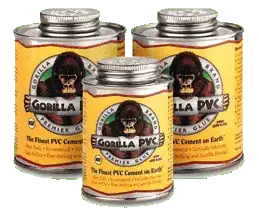
Gorilla glue makes a non-toxic PVC cement.

enter image description here

Bryce
  • 10,586
  • 12
  • 64
  • 107
shirlock homes
  • 57,962
  • 3
  • 83
  • 166
  • I'm not sure that it's non-toxic. [Gorilla](http://www.gorillapvc.com/) shows that it contains NMP, which causes birth defects in California. But, I think that the toxic parts of PVC cement will evaporate enough over the course of a few hours that this is a non-issue, and any PVC primer and cement is safe to use. Note that you will want to use CPVC and not PVC if it will be exposed to UV light (such as sunlight) – Pigrew Mar 02 '13 at 21:24
0

You should replace PVC by other material like PP or HDPE, PE, glass, wood...

Pure PVC is non toxic, but normal PVC can contain toxic chemical to increase lifetime, reduce cost making...

PVC, uPVC water pipe is food safe but it's usually contain heavy metal that can go out when under heat, pressure and long time using.

Even food safe PVC under sunlight (contain Ultra Violet Ray) will be oxidized and release toxic chemical.

For PP, HDPE, PE You can use solder welding and adjust to the right temperature to join without glue

Glass, ceramic glue: 100ml cow milk + 100ml vinegar and then blend well. In other cup, we fill 2ml water and put in ½ egg-white then blend it. And then pooling the water egg-white solution into the milk cup, blend and add 2g lime and blend. Using this glue by apply on surface, then join and fixing, wait until the glue nearly dry and heat it on flame. Done when the glue dried.

Wood: milk glue, nail

phnghue
  • 101
  • 1
0

Purchase the PVC cement for potable water plumbing. Ask a salesperson in the plumbing department. Given the hub-bub above, one does need to use PVC pipes rated for potable water, i.e. Schedule 40. You might find PEX easier to work with.

  • I think you shall address the OP's question then make an alternate suggestion to make it a "complete answer". – r13 Jun 06 '21 at 18:11
0

PVC pipe is not inherently safe for drinking water, even before you cement it. See http://chej.org/2013/09/pvc-pipes-bringing-toxic-lead-to-drinking-water/ and http://water.epa.gov/drink/contaminants/basicinformation/vinyl-chloride.cfm

PVC pipes can leach both lead and vinyl chloride. CPVC pipe adds chlorine (another toxic) to the mix, compared to regular PVC. PVC contaminates other plastics if mixed in during recycling.

All plumbing materials leach something into the water: do your research. The glue is likely not the biggest concern after installation.

Bryce
  • 10,586
  • 12
  • 64
  • 107
  • 3
    That's not how chemistry works. The "C" in CPVC does not mean there is chlorine just hanging out in the mix, ready to be leached into your water. The chlorine becomes part of the molecule. The statement "PVC contaminates other plastics if mixed in during recycling" is so general that it means nothing (What does "contaminate" mean? What are "other plastics"? etc.). While I agree that PVC may not be safe and people should do their own research, this answer seems to be more scare-mongering than informative. – Zach Mierzejewski Nov 21 '16 at 14:42
  • Reference "Recycling of PVC and Mixed Plastic Waste By Francesco Paolo La Mantia" January 1996. "Investigation of factors affecting the accumulation of vinyl chloride in polyvinyl chloride piping used in drinking water distribution systems." Pubmed 21420710. – Bryce Nov 22 '16 at 07:23
  • "Toxicity of vinyl chloride and poly(vinyl chloride): a critical review." JK Wagoner, Pubmed 6360677. – Bryce Nov 22 '16 at 07:29
  • And data on lead from http://www.pvc.org/en/p/lead-stabilisers (the PVC industry association). In short: lead is used, and it's bad, and it may be phased out. – Bryce Nov 22 '16 at 07:31