< Page:Elementary Principles in Statistical Mechanics (1902).djvu
This page has been proofread, but needs to be validated.
AVERAGES IN A CANONICAL ENSEMBLE.
69
or, since
and
It appears from this equation that the differential relations subsisting between the average potential energy in an ensemble of systems canonically distributed, the modulus of distribution, the average index of probability of configuration, taken negatively, and the average forces exerted on external bodies, are equivalent to those enunciated by Clausius for the potential energy of a body, its temperature, a quantity which he called the disgregation, and the forces exerted on external bodies.[1]
which gives
we have also
and by (140),
From these equations we get by differentiation
and
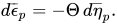
The differential relation expressed in this equation between the average kinetic energy, the modulus, and the average index of probability of velocity, taken negatively, is identical with that given by Clausius locis citatis for the kinetic energy of a body, the temperature, and a quantity which he called the transformation-value of the kinetic energy.[2] The relations
| (183) |
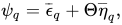
| (183) |

| (184) |

For the index of probability of velocity, in the case of canonical distribution, we have by comparison of (144) and (163), or of (145) and (164),
| (185) |
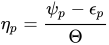
| (186) |
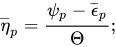
| (187) |

| (188) |

| (189) |
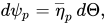
| (190) |

This article is issued from Wikisource. The text is licensed under Creative Commons - Attribution - Sharealike. Additional terms may apply for the media files.