< Page:Elementary Principles in Statistical Mechanics (1902).djvu
This page has been proofread, but needs to be validated.
THERMODYNAMIC ANALOGIES.
173
with more than two degrees of freedom, the average values in the ensemble of for the two parts are equal to one another and to the value of same expression for the whole. In our usual notations
if , and .
and they are combined to form a third system with energy
we shall not have in general
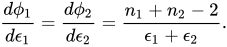
Thus, if the energy is a quadratic function of the 's and 's, we have[1]
where , , , are the numbers of degrees of freedom of the separate and combined systems. But
If the energy is a quadratic function of the 's alone, the case would be the same except that we should have , , , instead of , , . In these particular cases, the analogy

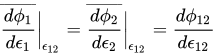


This analogy with temperature has the same incompleteness which was noticed with respect to , viz., if two systems have such energies ( and ) that


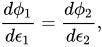









- ↑ See foot-note on page 93. We have here made the least value of the energy consistent with the values of the external coördinates zero instead of , as is evidently allowable when the external coördinates are supposed invariable.

This article is issued from Wikisource. The text is licensed under Creative Commons - Attribution - Sharealike. Additional terms may apply for the media files.