< Page:Elementary Principles in Statistical Mechanics (1902).djvu
This page has been proofread, but needs to be validated.
MAXIMUM AND MINIMUM PROPERTIES.
135
It appears from the definitions of and that (436) may also be written
or
where the integrations cover all phases. Adding the equation
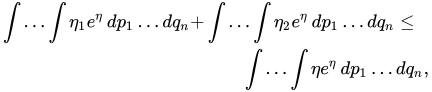
which we get by multiplying (438) and (439), and subtracting (437), we have for the proposition to be proved
Let
The main proposition to be proved may be written
This is evidently true since the quantity in the parenthesis is incapable of a negative value.[1] Moreover the sign can hold only when the quantity in the parenthesis vanishes for all phases, i. e., when for all phases. This makes for all phases, which is the analytical condition which expresses that the distributions in phase of the two parts of the system are independent.
Theorem VIII. If two or more ensembles of systems which are identical in nature, but may be distributed differently in phase, are united to form a single ensemble, so that the probability-coefficient of the resulting ensemble is a linear function


| (440) |

| (441) |

| (442) |
![{\displaystyle \mathop {\int \ldots \int } _{\rm {phases}}^{\rm {all}}[(\eta -\eta _{1}-\eta _{2})e^{\eta }+e^{\eta _{1}+\eta _{2}}-e^{\eta }]\,dp_{1}\ldots dq_{n}\geq 0.}](../../I/ac89fef619ff960c8d1920ed628f25ba80f16d90.svg)
| (443) |

| (444) |



- ↑ See Theorem I, where this is proved of a similar expression.
This article is issued from Wikisource. The text is licensed under Creative Commons - Attribution - Sharealike. Additional terms may apply for the media files.