132
MAXIMUM AND MINIMUM PROPERTIES.


| (428) |

| (429) |

| (430) |
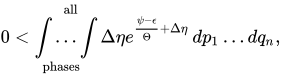
If we should substitute for the energy in the preceding theorems any other function of the phase, the theorems, mutatis mutandis, would still hold. On account of the unique importance of the energy as a function of the phase, the theorems as given are especially worthy of notice. When the case is such that other functions of the phase have important properties relating to statistical equilibrium, as described in Chapter IV,[1] the three following theorems, which are generalizations of the preceding, may be useful. It will be sufficient to give them without demonstration, as the principles involved are in no respect different.
Theorem IV. If an ensemble of systems is so distributed in phase that the index of probability is any function of , , etc., (these letters denoting functions of the phase,) the average value of the index is less than for any other distribution in phase in which the distribution with respect to the functions , , etc. is unchanged.


- ↑ See pages 37-41.