Physical Laws
I think there is a sentence or paragraph embedded in my old Physics textbook from early 1980s, by Haliday and Resnick, that expresses the following main ideas. I am paraphrasing from memory. During a natural process there are some physical quantities that change and other physical quantities that remain the same. We use the constant physical quantities to solve for changes in the other physical quantities when given sufficient initial information to complete the solution.
The more things change in physics, the more they remain the same!
Galileo
https://faculty.wcas.northwestern.edu/infocom/Ideas/galileo.html
Galileo realized that no one really understood motion at all ...
Galileo discover truths about motion that had completely eluded everyone since the time of Eudoxus, over 2000 years before. Among his discoveries:
In the absence of air friction, all things fall at exactly the same acceleration, regardless of mass, size, shape, or composition.
In the absence of friction, anything set into linear motion will stay in motion forever.
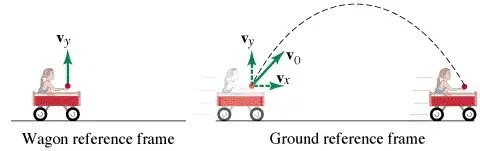
If one combines the two principles above, then it must be true that an object dropped from a moving platform (or tossed in the air) does not fall directly towards the Earth, but in fact moves along a curved path such that it remains abreast of the (still moving) platform.
From the viewpoint of a person on a moving wagon, a ball tossed in the air goes straight up. But from the viewpoint of a person on the ground, the ball moves in an arc such that it always remains above the moving wagon.
These laws constitute the basis of what is today called Galilean Relativity. They explained how it was that the Earth could move without anything "pushing" it -- in so many words, Aristotle had it exactly backwards. Once in motion, the Earth (or anything else) will continue to move forever unless some force intervenes to stop it. Friction stops everyday objects, but there is nothing to stop a planet in its orbit. Furthermore, once an object acquires a velocity, it keeps it. A ball dropped from the Leaning Tower of Pisa already shares any velocity that the Tower has as the Earth rotates. As the ball drops, the Tower, the Earth, and the ball all move together. Their "absolute" motion cannot be measured. Only the ball's relative motion with respect to the Earth and the Tower can ever be detected.
Or to phrase it another way, to say that something is "moving" is almost meaningless. You can only say that something is moving with respect to something else. This is the essence of Galilean Relativity. One way of thinking about relativity is this: if you are placed inside a closed box, with no way of detecting anything outside the box, then there is NO experiment you can do inside the box, NO measurement you can possibly make, which will tell you if you are moving (at a constant velocity) with respect to anything outside the box or not. Everything inside the box shares your velocity, and measurements on those can only tell you how you are moving with respect to them -- not how they (and you) are moving with respect to something else. This is very different from the physics of Aristotle, who held that objects had an absolute tendency to move straight towards the center of Earth, no matter what the circumstances.
Galileo defines speed as change in position (displacement) specified with respect to a reference frame divided by the change in time specified with respect to a clock. He describes acceleration as the change in speed divided by the change in time. Galileo took discrete measurements. We could put his specified discrete values into difference tables to understand or teach his math models.
Newton "stands on the shoulders of giants", such as Kepler and Galileo, and defines momentum as the mass of a body times its velocity with respect to an imposed frame of reference. He defines force, the tendency to change momentum, as mass times acceleration for a "free body" where this means net force causes acceleration with respect to an arbitrarily imposed non-accelerated frame of reference. If forces are in equilibrium then the net force is zero and the body does not change momentum.
Specified momentum has no absolute "true value" because a change in reference frame or change in standard mass units of measure will give a different specified value. Velocity is displacement (change in position in space) over a period of time. This is motion or no motion in the frame of reference. There is a scientific theory which holds that momentum is conserved on the macroscopic and microscopic levels for particle interactions. This is implied in Newton's third law: for every action (force) there is an equal and opposite reaction (the reactive force).
As I understand the math models and solutions, the main idea is that all physical changes involve efforts to measure changes in momentum over time in a region or regions of space whether on a macroscopic or microscopic level. An electron transition in an atom in the Sun emits EM radiation via the loss of quantum energy, and then later, an atom in the earth or some other distant body absorbs the same amount of quantum energy. Electromagnetic waves are emitted and detected as changes in momentum and energy states of microscopic particles in the context of action at a distance. Gravity is a macroscopic change in momentum in the context of action at a distance. Macroscopic friction and loss of mechanical or electrical or magnetic energy are accounted for by the the transfer of heat at a microscopic level that tends to transfer thermal energy from a system to its surroundings. This model does not violate the principles of conservation of momentum or energy because heat, work, and energy are equivalent.
If we did not have the concept of macroscopic motion, I do not think we would have developed the concepts of thermodynamics, quantum energy state transitions, and action at a distance due to radiation or even entanglement, although there is only abstract math in modern quantum theory.


