14

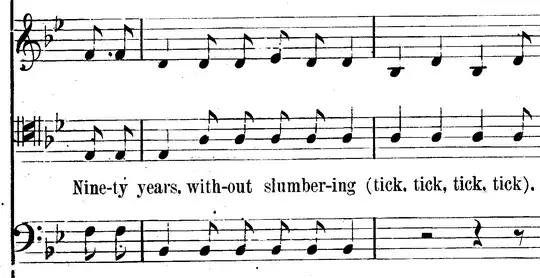
I recently came across this score by Henry Work called "Grandfather's Clock". And i was a bit confused at first regarding this clef in the chorus. It seems to be a D clef.

I was wondering if this clef was popular at the time, or was used for any particular instrument?

garyF
  • 516
  • 3
  • 9
  • 1
    Note: that's the tune (with possibly one note changed) used in the music box of a classic Fisher-Price toy clock popular in the 1970s. I learned the clock hands with it. – Euro Micelli May 10 '18 at 17:34
  • 2
    You can tell by the music that this is a C clef, not a D clef. – user207421 May 11 '18 at 04:19
  • The only clefs I know are C, G, and F. I've never seen a D clef- does anyone know of any? This is pretty obviously (as the answers show) a C clef printed one note too high. – Scott Wallace May 11 '18 at 10:21
  • 2
    @EuroMicelli Assuming that this is the lower three parts of a four-voice mixed chorus arrangement, the melody is altogether absent from the image. – phoog May 11 '18 at 14:45
  • 1
    @phoog That's true, which means that we're seeing alto, tenor, and bass, with the tenor notated in a fashion that was often used prior to 1900 and occasionally afterwards .... – Kevin_Kinsey May 11 '18 at 19:07

7 Answers7

11

Common notation for tenor voice prior to 1900, especially if older than that. See, for example, this TTBB arrangement of Cornell's Alma Mater at Wikipedia.

Kevin_Kinsey
  • 934
  • 5
  • 8
  • 2
    Agreed, and it just looks like the clef on the piece in the question is printed just a little higher on the staff than it should be. – Ben Miller - Remember Monica May 10 '18 at 15:52
  • 1
    @BenMiller "a little higher on the staff"? It's in the wrong place (i.e., the normal fourth-line-middle-C tenor clef position). Whether this is a mistake or a convention that didn't take hold is perhaps unknowable. – phoog May 11 '18 at 14:42
  • It's also reversed left-to-right. – Kevin_Kinsey May 11 '18 at 19:08
  • @phoog: Looking through some pieces published by C. M. Cady around 1876, the only ones I've found where a tenor part doesn't use a treble clef are Grandfather's Clock and other Henry Clay Work songs published after it, and in all of the latter songs the clef is printed half a space lower. My guess is that Henry Clay Work's handwritten score used a tenor clef, and the engraver didn't know what it meant. Ironic that Work's most famous song has a misprint, but at least one of his other songs (not sure of the publisher) has a lyric that was likely misread by the engraver... – supercat Aug 07 '20 at 19:12
  • (specifically "Vainly would my sadden'd soul rejoin" (should likely be "rejoice" to rhyme with the next line "voice") so I don't know whether Mr. Work's handwriting might have been hard to read. – supercat Aug 07 '20 at 19:17
  • @supercat I find it highly unlikely that a music engraver would be unfamiliar with tenor clef. I rather suspect some mix-up -- one person did the clefs and another the notes, or something like that. It's very easy to [misread handwriting](https://www.theguardian.com/books/2020/aug/02/ernest-hemingway-published-works-littered-with-errors-study-finds). There's also the example of *What is Our Life* by Gibbons. The words disagree with those I've seen in literary sources ("searching sun" vs. "scorching sun," among others). – phoog Aug 07 '20 at 23:11
  • Also, if the manuscript had tenor clef, we might expect more errors in the engraved part since all the noteheads would be placed differently from how they were in the written source. – phoog Aug 07 '20 at 23:15
  • @phoog: Of the music I examined from that period that was published by C. M. Cady, all pieces that weren't by H. C. Work that had tenor parts used a treble clef down an octave, and later pieces by H. C. Work that used a tenor clef positioned middle C an octave above its treble-clef location. Works' earlier peices were published by Root & Cady--probably the same Cady as C. M. Cady, but perhaps the former firm had someone who replaced tenor clefs in Work's handwritten music with a treble clef, but that person wasn't working for C. M. Cady, and the person who was tried to reproduce... – supercat Aug 08 '20 at 22:27
  • ...the tenor clef, but didn't properly interpret where Work was trying to put it. If there were any earlier vocal pieces published by C. M. Cady that used a tenor clef, or any other pieces--earlier or later--that placed the center of the clef on a "D", such evidence might support or contradict my proposed theory, but my theory is the best I can figure for the evidence I've found. – supercat Aug 08 '20 at 22:29
9

I’m not familiar with this particular clef. However, judging by the context, this is equivalent to a treble clef lowered by an octave for the tenor voice part.

In choral music today, this is usually represented by a treble clef with an 8 below it, sometimes called an octave clef:

octave clef

  • 3
    Maybe this is just a weird conflation of two different meanings of "tenor clef?" Since the clef you're talking about is used for tenor voice parts, it could be called a "tenor clef", but, at least these days, the primary meaning of "tenor clef" is the C clef on the fourth line of the staff. Maybe at the time of the example, those two things were more interchangeable (meaning, in this context, the C clef isn't a C clef at all)? – Pat Muchmore May 10 '18 at 13:13
  • 3
    @PatMuchmore: Or it could just have been some hapless typesetter's assistant who got confused between "tenor clef" and "vocal tenor clef" and put the wrong one in. – Michael Seifert May 10 '18 at 14:01
  • 1
    I've amalgamated this question and the comments in my answer below. But I hope @Ben Miller will edit his answer to do the same, then we can all vote for it and I'll delete mine. – Laurence May 10 '18 at 14:21
  • 1
    Upvoted because, of all the answers, this is the only one which addresses the point, which is how the music notation should be interpreted. Yes, as other answers point out, the clef printed is a version of the tenor clef (C clef with C on the 4th line up), but, as Pat Muchmore and Michael Seifert suggest, this is a mistake. – Rosie F Sep 18 '18 at 16:04
6

This is very speculative and I hope someone can give a more reliable answer.

At some stages in the history of printed music, printers may have only had accidentals available on lines; if an accidental was required on a space, for example low F# in treble clef, they would put it on one of the neighbouring lines instead (reference - see footnote on page 4).

Perhaps the same thing was true of clefs in your example, and the "D clef" is actually a C clef which the printer was unable to print correctly on the space below. This would make the part treble clef (presumably sounding an octave lower), which seems right. The general shape is similar to that of some variant C clefs which are relatively rare today (image).
David
  • 268
  • 1
  • 8
  • 1
    Hmm… this seems plausible. Or maybe just a printer's mistake to put it a bit higher up. Because i'm sure i can see a C clef here: https://dolmetsch.com/stebbinsmalechorus.gif. It has the exact same shape, but placed on the space instead of a line. – garyF May 10 '18 at 10:06
  • 4
    @garyF This is defnitely a C clef, and it’s not at all uncommon to put on the second line from the top. When it is, it’s called “tenor clef” and is quite common in music for cello, trombone and bassoon. The name of the clef just means that whatever line the clef is on should be read as middle C. – Pat Muchmore May 10 '18 at 11:06
  • 5
    @PatMuchmore as ben miller pointed out nicely to me, If it were a correct tenor clef, the flats would be in the wrong place, and the notes would be wrong. – Carl Witthoft May 10 '18 at 12:37
  • 1
    @CarlWitthoft OH WOW, you’re totally right, I completely missed that! This is indeed a mystery why they would use this when it’s identical to a standard treble clef. How very strange… – Pat Muchmore May 10 '18 at 12:47
  • I highly doubt this is the case because non-diatonic notes are used all the time and would have to be placed on any line or space. – Heather S. May 10 '18 at 21:02
  • 1
    @PatMuchmore In https://en.wikipedia.org/wiki/TTBB#/media/File:Far_Above_Cayuga%27s_Waters_1906.png and https://dolmetsch.com/stebbinsmalechorus.gif (links provided by other answers/comments), there is a clef mark just like this except that it appears to be centered on the second _space_ from the top, which should be C according to the key signatures. So the note names end up the same as in the treble clef, but all the notes are an octave lower, hence not the same clef. – David K May 10 '18 at 22:02
  • @HeatherS. I don't think that's a valid objection as my source was referring to this issue only in respect of accidentals, not in respect of notes. I acknowledge that the application to clefs is purely my own speculation. – David May 10 '18 at 23:46
  • @DavidK I've seen the more modern C clef form used in this way too. The diagonal-stroke C clef is just a C clef, though; to see the same form in a viola part (on the center line) or a trombone or cello part (as shown above, but actually indicating that middle C is on the fourth line), would be unremarkable. – phoog May 11 '18 at 15:31
  • After considering the other answers, i feel this one answers it the best (and was first). It is most probably the printer's mistake. And in this new age where we can't blame printers for typesetting errors anymore (they just take our PDFs; we type them), i have to be extra careful to cross every "T" and _double_ dot the rare "I" (as in "naïve"). – garyF Jun 28 '18 at 13:47
5

This is most likely a C-clef, and not a D-clef.

In the History section on the Wikipedia article on clef, there is an indication that an older way of writing the C-clef assumed a "ladder like form". In the sample you have provided, the clef is indicating the third space on the staff (and not the fourth line) is Middle C. This is obscured by the stylistic slanting of the clef.

Wikipedia also has another example of this clef in its article on TTBB choral music, which appears to have held onto this form of writing the C-clef longer than other genres.

nicholas
  • 159
  • 2
  • 1
    It's surely a C tenor clef, but the notes and key signature are correct for the G-clef-octave-lower-than-treble tenor clef, which is why it's puzzling. – phoog May 10 '18 at 14:59
  • @phoog I would say it's surely _not_ a C tenor clef, but rather a different C-clef variant that says the second space from the top is middle C, as demonstrated in the TTBB example linked from this answer. – David K May 10 '18 at 22:05
  • @DavidK the historical meaning of that sign is that C is on the fourth line from the bottom, which is why it's centered on that line. That people may have started using it for a different purpose in the 19th century probably bespeaks an environment in which "proper" c clefs were falling out of use and notation hadn't yet been standardized for what we might now call "modern" tenor clef. But that doesn't change the fact that the example above had already enjoyed a life of hundreds of years denoting 4th-line-middle-c tenor clef. – phoog May 11 '18 at 12:51
  • 1
    @phoog notwithstanding that in the past there may have been 4th-line middle C clef's, the example in the OPs question shows a 3rd-space middle C. Note the position of the B-flat on the key signature. – nicholas May 11 '18 at 13:23
  • @Nicholas I agree that the staff has a third space middle C (and I've also seen a more modern-style C clef centered on the third space on at least one occasion). My point is that the clef is a C clef centered on the fourth line, which, again, is why the example is confusing, because the clef shows one thing and the notes and key signature are doing another. In the TTBB image you link to, the clef is centered on the space, which is far less confusing. – phoog May 11 '18 at 14:42
  • @phoog Can we say that the _intent_ was to put middle C on the third space, but (due to an error somewhere in the process, either by the writer of the part or in the transcription by the printer) the clef was printed centered on the fourth line? In other words, it is a "musical typo" in which the intended clef (the one found in the TTBB image) was replaced by a C tenor clef, which is simply the wrong clef for the music written on that staff. Because I agree that _what is actually printed_ is the sign for a C tenor clef. – David K May 11 '18 at 21:54
  • @DavidK: So far as I can tell, the publisher, C. M. Cady, only used that clef in Henry Clay Work's songs, and in Work Songs I checked that were published before Grandfather's Clock, tenor parts were noted with a treble clef (as was C. M. Cady's convention for other composers' songs). In Work songs after G.C., the tenor clef was printed correctly. – supercat Aug 07 '20 at 19:20
1

My understanding is that the C clef was a mobile clef prior to being in a fixed location. It designated where the C (below middle C) was located. Much the same as the G clef designated where the G above middle C was located. If you go far enough back to where the staff was split away from 16 lines, there needed to be a clue to what notes would be represented on the particular staff. Alas, my understanding may be entirely wrong.

Randy
  • 11
  • 1
  • All three clefs were originally mobile, and the c clef continues to be mobile today, as it commonly appears on both the third and fourth lines. – phoog Oct 01 '19 at 05:11
0

As can be looked-up in the Havard Dictionary of Music, the C clef has some very different appearances (middle three of first picture), and the middle one matches your example. I would not pay to much attention to the placement, which seems somewhat high.

guidot
  • 10,215
  • 1
  • 21
  • 51
0

This was the original sign of the tenor clef, that defines that the middle C (C4) is on the 4th line. The tenor part is transcript to G - but the notation is an octave to high. the soprano voice is missing (cut), we see at the sheet copy that it is a SATB setting, where the tenor voice originally was set in a C-clef and now it is transcript in a G-clef, that's why the C-clef is written between two brackets. Irritating is that it's not a G clef with an 8ve below the clef as the tenor must be transposed an octave down.

Albrecht Hügli
  • 25,410
  • 1
  • 21
  • 58