11

This is a snippet from "Ride across the river", from Dire Straits. Notice the distorted guitar sound at the beginning; is that sound a result of two close notes (e.g. a semi-tone or tone apart) played together, just a distortion pedal or both?

Snippet (starting at 2min40s of the full soundtrack)

Original song (roughly at the same point)

P.S. I'm not quite asking for the exact notes, since I'll not try to play that particular song. I'm just interested in how to obtain this "growly" effect.

Edit:

Just for information: I tried it at home with my keyboard and managed to find the notes. They're [F# A], [E G] in that order.

which is actually part of a VII - VI cadence (chords D - C) on the Em tonality.

I also noticed the "growl" effect of playing two notes with the overdrive distortion and the absence of that when playing just one note.

user45266
  • 12,289
  • 2
  • 27
  • 78
Alexandre
  • 330
  • 1
  • 13
  • 2
    There is a bend up and down on one string with a finger on a higher string with slight distortion being played on what sounds like the neck pickup. Would suggest finding a tab of the song to see the specific notes. – JacobIRR Apr 06 '18 at 21:19
  • Relevant meta question [**here**](https://music.meta.stackexchange.com/questions/2963/our-on-topic-page-currently-says-that-identifying-a-technique-is-off-topic) (though +1 from me - this is an interesting question with good answers, IMO) – Нет войне Apr 07 '18 at 00:04
  • I edited out (and replaced with note names) the ABC code, since it has been having some issues rendering correctly recently. I couldn't get the image to load correctly at all on my screen, even after reading https://music.meta.stackexchange.com/questions/3737/abc-shows-up-scrambled-on-first-loading-correct-only-after-page-refresh. If this is fixed, feel free to rollback to the original rendering. – user45266 Aug 22 '21 at 03:54

2 Answers2

12

Interesting effect indeed!

Obvious thing first: don't use a pick when playing Knopfler parts! His tone is very much dominated by the particular way he plucks the strings with his fingers, often snapping them down on the fret board. Here, like often in his soloing, he's playing a double stop; he usually does this with the thumb and index finger, almost pinching together and dragging up the neighbouring strings and letting go of them. (Watch some videos of his solos; the right hand position looks really strange but works very well for this kind of stuff.)
This particular note has the characteristic attack largely shadowed because the tone is faded in à la steel guitar; note sure if he does this with the volume pot like Jeff Beck or with a volume pedal.

Now as for what he's actually playing at that particular spot... what I hear there is

X: 1
M: 4/4
K: Em
L: 1/4
V:C name="Guitar" clef=treble-8
z3 ([^d a] | [e g]

Which is essentially a 0 - resolution, i.e. pretty classical dominant-tonic (except the bass and synth actually go to C instead of em, but that fits just as well to the E and G). The tricky bit is that the slurs are actually glissandi, i.e. bends – in counter-movement! Quite tricky, uncommon and certainly very effective. This can be done by playing the D♯ on the D string 13th fret with the ring finger and the A on the G-string 12th fret pre-bent (pulled, not pushed) one whole step with the middle finger, then releasing the G-string bend and simultaneously bending up the D♯ to E. It's just one movement.
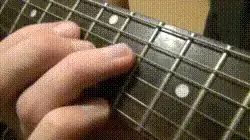
View of how this contra-bending can be done.

Finally, again rather obvious, you need some overdrive to actually make it “growl”. Not a hard distortion, rather something tubescreamer-ish. Distortion on such a double stop creates intermodulation frequencies, i.e. basically tones that aren't really played on the guitar. Thus, as David Bowling comments, it's also possible that he actually just plays the simpler

X: 1
M: 4/4
K: Em
L: 1/4
V:C name="Guitar" clef=treble-8
z3 ([a c'] | [g c']

(which, at least when bent up rather than down, is quite a staple of bluesy solo playing), and the lower “counterpoint” voice is just imagined by my ears, being used to classical voice-leading.
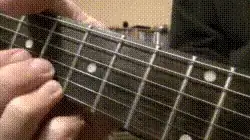
Simpler down-only bending variant

leftaroundabout
  • 34,776
  • 66
  • 147
  • Yes, I also think it's very interesting. It makes me remember saxophone's "growl". Actually, that's exactly what I intended to ask for: how to make this "growly" sound with the guitar. – Alexandre Apr 06 '18 at 22:43
  • I think that the volume swell and use of fingers over a pick are crucial elements to the sound. But, and maybe this is because I just listened to this on crappy laptop speakers, it sounds to me like you have the wrong double stop. To me it sounds like there is a high C5 that remains unchanged throughout, with the G bent up to the A and released. I am not hearing the bottom two notes you have, not that they don't sound good here. –  Apr 06 '18 at 23:00
  • @DavidBowling I'm not sure about it, you may be right – it's not very clear to hear what notes there are because the overdrive creates additional intermodulation frequencies. Perhaps my ears just _want_ to hear that **ⅶ⁰** - **ⅰ** counterpoint... – leftaroundabout Apr 06 '18 at 23:03
  • Well, you're right that it _sounds_ good and makes sense there. I am pretty sure that high C is there, but you are also right that the gain makes it tricky to isolate the actual notes. +1 in any case. –  Apr 06 '18 at 23:07
  • @leftaroundabout Do you think he turns the overdrive off for the next line? It doesn't have the same "growly" effect, so I'm just curious about how much of that is due to intermodulation frequencies and how much is due to overdrive. – Alexandre Apr 06 '18 at 23:17
  • 1
    @Alexandre no, I think he has the same overdrive on the entire song, but it doesn't get growly when not playing double stops because there are no frequency differences that could interfere with each other. – leftaroundabout Apr 06 '18 at 23:20
  • Playing multiple notes can also feed the drive more, so it's normal for single notes to sound less distorted than a chord. This happens because when the input sound gets louder it clips more, but it depends on how you have the effect chain set up. – Radiodef Apr 07 '18 at 01:31
  • @Radiodef yeah, but this is much less important than the intermodulation aspect. Single notes into distortion always remain just _single notes_ (all harmonics are multiples of the original fundamental) no matter how brutally you clip the signal. Whereas even gentle overdrive on a quietly-played chord produces frequencies that weren't in the guitar signal at all. – leftaroundabout Apr 07 '18 at 09:08
4

From trying to work it out myself I found that playing Eb on the G string and Ab on the B string while bending up about a quarter step on both gives me the right notes. The tone is a combination of the distortion/overdrive and heavy reverb that permeates the whole song. Then bend the note back down and end on a Eb/G major third. The next line continues on the C above.

I also found that for the particular tone on that note you need to pick very lightly to reduce pick attack, preferably with the side of the pick or scraping the string lightly with your fingers to bring out some of the harmonics.

Tama
  • 1,835
  • 6
  • 12
  • You only need to pick lightly if you're using a pick. Knopfler doesn't (most of the time anyway) – mkorman Aug 23 '21 at 09:32