0

enter image description here

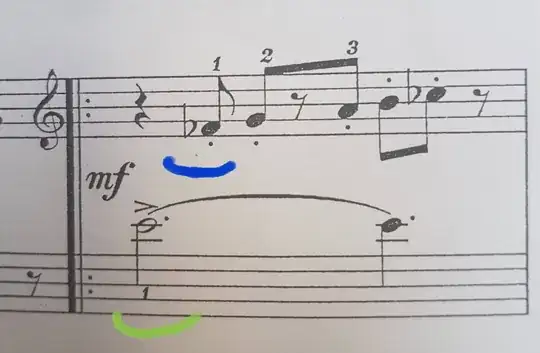
This is a piano sheet. The second line is in bass clef. The blue one and the green one are same. How should I play this two?

Should I pick up my left hand and play the blue one?

guidot
  • 10,215
  • 1
  • 21
  • 51
  • 5
    O.k., so what's the key signature? – Tim Mar 01 '18 at 14:49
  • What do you mean "the blue one and the green one are [the] same"? – Richard Mar 02 '18 at 04:02
  • But lets say its in c major key - if the note in the trebble is Fb and in the bass cleff is E how would you play it? I also seen scores like that with same notes it is not clear how would you play similar note that apear in both cleffs simultanesly – LoveIsHere Mar 02 '18 at 08:28
  • 1
    @LoveIsHere This "lets say" is quite pointless here. I would give an answer to that case (as this scenario is very common in organ music actually), but I don't want to answer so unclear question, and I doubt that E and Fb appear simultaneously. – yo' Mar 02 '18 at 08:32
  • @LoveIsHere - it's certainly not in C, and there's no point in surmising. If the OP needs an answer, the question needs to provide relevant information - which is lacking right now. – Tim Mar 02 '18 at 10:36
  • @Tim I thought you could address that. It was definitely not surmising it was raising a very relevant question. maybe I will address this in a new question. – LoveIsHere Mar 02 '18 at 11:33
  • @LoveIsHere - 'let's say it's in C major key *is* surmising! It's most likely in Db, but why guess. It's up to the OP to help out here. – Tim Mar 02 '18 at 11:43
  • You could just have said to put it in a new question. and write it more kindly. – LoveIsHere Mar 02 '18 at 13:16
  • 1
    @LoveIsHere - the way I see it is that when a question is asked, as much relevant information as is needed should be provided by the poser. Here, it's insufficient. – Tim Mar 02 '18 at 15:49

3 Answers3

3

Without the key signature, it's not a total certainly, but it appears that the treble clef note is Fb, which is in fact the white key to the left of F,a.k.a. 'E', while the bass clef note is either E or Eb. If it's Eb, then it's a different note, and will be held on. If it's E, then I can't think why the r.h. note would need to be written as anything but E, certainly not Fb. It rather depends on the key signature though...

Tim
  • 183,051
  • 16
  • 181
  • 444
  • The signature almost certainly has flats, since otherwise it wouldn't make sense to notate both a B and a C flat for the right hand. – Kilian Foth Mar 02 '18 at 07:15
2

I also notice the C-flat later on in the bar, which is enharmonically equivalent to a B natural. Since it is preceded immediately by a B, it is almost certain that there is at least a B-flat in the key signature. But as the response above says, it would be awkward if the E in the left hand was not a flat, because it would otherwise not be technically playable. So I am pretty certain that there should be an E-flat in the key signature as well. Also accounting for the double bar which indicates this bar is the beginning of a section or theme, I think the key would be either B-flat major or E-flat major, but it could also be a modulation to D-flat minor (which has a F-flat), but as before, I cannot guarantee a firm response until you tell or show us what the key signature is.

Andrew Lau
  • 308
  • 1
  • 8
2

I suspect it's in 5 flats. Then it all makes perfect sense.

Jomiddnz
  • 5,019
  • 12
  • 18
  • Because the last four notes in RH spell a natural E-flat minor scale - which has six flats including C-flat, but not F-flat; the F-flat there is merely an enharmonic respelling of E-natural to avoid clashing with the E-flat in LH. – Andrew Lau Mar 02 '18 at 17:11