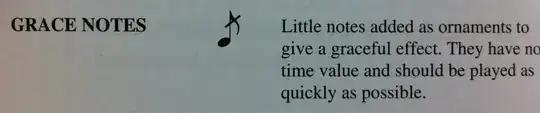
Thanks for your good question. I didn't realize that there was so much to a grace note.
I culled the following from the article Embellishments – The Grace Note – Part 24f.
I think you should read the whole lesson as it really covers it all but here is what appears to answer your question.
The Grace Note – Movement, Placement and Duration
When describing the simple grace note, it is important to point out that the principal note is the note which ends the grace activity or movement, filling the total duration of a beat within a measure of music.
Some Reference Material
The number of beats and the note shape needed to fill one beat within
a measure of music is determined by the time signature. In 4/4 time,
there are four beats in a measure and a quarter note gets one beat,
for example.
The duration of a beat is determined by the tempo set for the music. Tempo is time related and the tempo r̲a̲t̲e̲ is assigned to music by the composer. The tempo rate is measured in beats per minute.
Following our example of the 4/4 time signature, if a tempo of 120
beats per minute is chosen, the four quarter notes are performed at
the same r̲a̲t̲e̲ as if there were 120 quarter notes in a single measure
of music. The 4/4 time signature specifically designates that there
are only four beats in a measure. With a designated tempo of 120 bpm,
the speed or rate at which the four quarter notes are performed is
thus established.
Timing and the Grace Note
The auxiliary note embellishes or ornaments its principal note. Also,
the grace note gets its time from the principal note’s duration or
time value, which is determined by its shape and the tempo of the
music. In our examples, the principal note is shown as a quarter note
which normally fills the timing of the beat. When a grace note is
applied to the principal note they share the timing of the relative
beat. In this way both the auxiliary note and the principal note are
played on the same beat. The number of beats within the measure does
not change and the timing or tempo of the beats is not altered either.
The main point is the following.
The principal note’s duration is divided between the auxiliary note and the principal note. The grace note gets only a fraction of a beat and the remaining fraction of the s̲a̲m̲e̲ beat is allocated to the principal note. Its actual duration is determined by both tempo and note shape.
Also, a grace note’s duration is somewhat flexible. Depending upon the
ornament type and which type of grace note is in use. The fraction of
the beat assigned to it can be determined either at the discretion of
the performer, if rhythmically correct, or as determined and written
into the score by the composer. If designated by the composer, then
the simple grace note’s duration is to be performed as written and
still, its duration is relative to the type of grace note in use and
the choices made by the performer, if given an artistic license to do
so.
Some of the grace ornaments are made up of more than one grace note.
In these cases, the number of notes appearing in the ornament alters
both the note shape used for the included notes but the duration of
the embellishment is not changed.
Collectively all of the grace notes in these types of ornaments are
played sharing the total beat duration with their relative principal
note. An example would be the acciaccatura. This idea will be explored
further in our presentation on the acciaccatura grace ornament.
If left unmarked, the grace note and its duration remains a
non-specified fraction of the beat and of no predetermined duration
other than the fact that it shares the same beat and timing with its
principal note. To a degree the grace note is flexible and subject to
personal and/or performance preferences. Some additional distinctions
need to be made.