In some pieces, there is a pedal designation along with staccato. How should this be played?
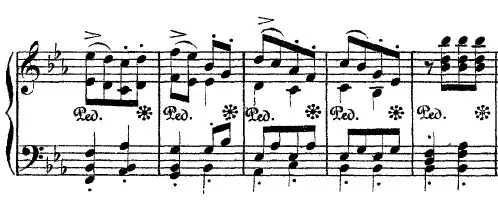
In some pieces, there is a pedal designation along with staccato. How should this be played?
Great question.
The notation here seems pretty explicit. I would simply play them as if you weren't holding the pedal down, i.e., keep your finger motion the same as it would be if there was no pedalling. Note that this is "OK". The sustain pedal is not for legato, it's for sustain; playing staccato whilst pedalling will give you a unique effect, one that appears to be desired in this instance.
You could also try half-pedalling on each staccato note. This will help it sound more like normal staccato notes without totally breaking the sustain. Use your judgment.
A very common issue; this occurs a lot in the works of Mendelssohn as well. Some professional pianists seem to ignore the composers' pedal marks in passages like these, and some observe them. It seems like in these cases the composer was thinking of an orchestral analogue, so in the RH of that piece it looks like the phrase marking he would have written for strings. Consequently one should think of, and try to reproduce, the accentuation that those markings would produce in orchestral instruments, but if following the pedalling, there will be no actual staccato.
It may be that these composers imagined that the sound of staccato played within a pedal was different to the sound of legato played within a pedal, which I don't believe it ever was on any piano, given the same key velocity. In the case of Mendelssohn it seems as if he often just intended the staccato mark, or indeed short notes like isolated semiquavers, to mean "play these notes lightly", and he was not thinking about sustain, as he so frequently marks pedal over the silences. Sometimes these pedal marks occur only in the last bars of his pieces, but suggesting they should actually have been pedalled throughout, as in Op. 67 no. 2.
As has been commented already, since our instruments have more sustain than early 19th C ones, our results will always be different, and discretion needs to be used. I think there is no right answer.

When Liszt wrote that music, the pedals didn't work as well as they do now, and hitting a short note with the pedal down sounded differently than holding the key down with the pedal.
I'd hold the pedal about half-way.


