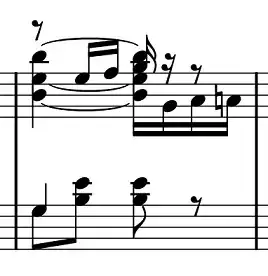
- why the first note on the bottom part has two legs?
You're supposed to imagine that there are two parts in the left hand that happen to land on the same G on the first beat. If this piece was sung, for example, one voice might be singing G, Eb, Eb, and the other G, Bb, Bb.
On the piano you'll probably end up playing it exactly as you would if that G didn't have the extra "leg".
- why is it specified again that the high g (top part) is a sixteenth note?
There's a separate melodic line here that goes Eb, F, G while three other voices sustain Bb, Eb, and a higher Bb. And again they probably could have left off that extra "leg" without changing how you'd play this.
- how do i play the top part, i mean, should i keep my fingers fixed on the first chord and only play the f and g (followed by g ab a) or i have to play the notes on the chord again even if are part of a legato?
You don't play the notes of the chord (the Bb, Eb, Bb) again on the second beat, you just sustain those. You do play the Eb in that inner Eb-F-G melody. And you'll have to hold that Eb even after you play the F.
What you're trying to do is give the illusion that you are simultaneously (1) sustaining that Bb-Eb-Bb chord, and (2) playing the Eb-F-G line. Clearly that's impossible since your piano only has one Eb key, but you do the best you can.
This isn't necessarily a bad transcription or anything, piano music is often written like this to show how a sequence of notes is made up of separate melodies layered on top of each other. That can help you figure out the logic of the music, even when it doesn't literally change the note durations. In this case I think the notation in the bottom part is a little pedantic, but the way they bring out the inner melody in the top part is helpful.