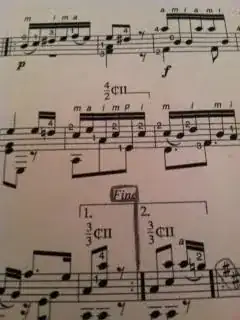
Okay, after quite a bit of thought I think I have worked this out. However, before answering, two things: firstly, I have to say, I haven't seen this notation before and it doesn't seem very helpful; secondly, the other answer and comments helped me work this out.
Also, it is worth pointing out for other readers, that this passage of music has the key-signature of A Major, as this isn't shown in the picture.
The clue is in the 4/2 marking in your picture. A common way to play this A major shape is to use a first finger barre that presses down fret 2 on strings 3 and 4 only, with the second finger pressing down the C# at fret 2 on string 2. (This avoids what I call the A-Chord-Problem, where it is difficult to keep fingers 1, 2 and 3 all close to fret 2, which I describe in this answer.) As I say, it is common to use this two-string-barre to play this chord shape, particularly in classical guitar music. So, I'm pretty sure the 4/2 half-barre notation used here means "extend a barre over four strings (i.e. strings 1-4) but only press down the top two of these four strings".
This would mean that 3/3 and 2/2 would also make sense. In the example above the 3/3 barre fits with this explanation too: you would do a half-barre over strings 1-3, in order to play the A and C# at fret 2 on strings 2 and 3. Although you don't need to play fret 2 string 1 here, it still makes sense to press it down, as it is harder not too! Hence the 3/3 marking.
Like I say, I think this notation is unhelpful; much of the information would be fairly obvious from the fingerings and position markings alone. The extra information merely "clutters" the part.
Here is the same passage, from an older edition that I found at IMSLP:
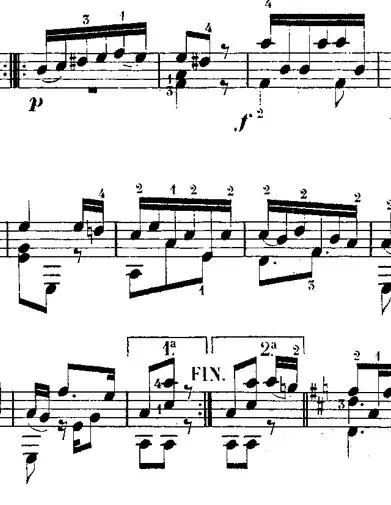
This seems to have the same fingerings, and is therefore identical, apart from the barre markings. I would say that the fingerings make it perfectly clear how to play this passage, and that the barres would be implicit, and most guitarists would work them out while playing the passage. And anyway, as @Tim points out, fingerings are only suggestions anyway. To give an example; whether you use a barre in the A major bar discussed above, or whether you lift finger 1 from the A on string 3 to the E on string 4 is largely a matter of taste. It depends upon whether you want the full arpeggio to ring here, or whether you would like a little more definition in the bassline, which lifting the A would achieve.
And this gets to the very heart of how one should approach the study of pieces such as these: if one is simply using them for a bit of sight-reading practice, then don't worry too much about the different ways in which any particular fingering affects the sound of a passage. If on the other hand one is really studying such a piece, it is always worth considering: whether you agree with any given fingerings; how the fingering affects the sound of the passage; and also considering whether there are other fingerings that would make it easier to play a passage or make the music sound different (there are often very many!)
The simpler an editor's markings are, the more it encourages consideration of different fingerings, and so ways to play a passage. From my experience as a classical guitarist and teacher, I'll end with just two more points about fingerings and editorial markings: firstly, good fingerings and editorial markings make it far easier for students and experienced guitarists alike, to play pieces; secondly, the quality of fingerings and editorial markings varies greatly - some are great, and some are not good at all, even from well known publishers.