Polychords, Roman numerals, and Functional Analysis
Roman numerals, in the context of functional analysis, are an analytical language, not a chord-naming symbol. As such, they don't follow the conventions of chord-naming systems. C/F is meaningful as a chord name (whether slash chord or polychord), but its functional meaning is undefined. I/4 and I/IV are not part of the language of functional analysis (except I/IV as a secondary-chord indication). In the context of functional harmony, polychords, specifically, have no meaning as such, rather they would be labeled as a single chord according to their overall harmonic function, and that would depend on context.
Using the F/G example:
F/G Polychord
Example 1
Consider a piece of music in C major. We encounter an F major chord, which is tied with a G major chord being added underneath the tied portion, followed by a C major chord.
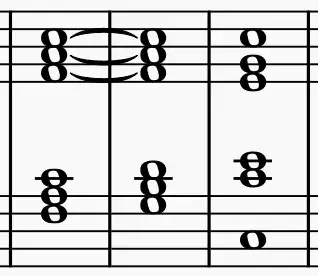
Analytically, the chords would be labeled IV - V742 (or V974) - I. This notation is understood to mean that the seeming polychord is "just" a V7 chord with suspensions from the previous IV chord.
Example 2
But now consider a piece in which there is a sustained G chord with a variety of chord changes above it, including an F major chord. This is as close as functional harmony would come to an explicit polychord. The Roman numerals would be given according to the upper-voice chord progression with another notation indicating a G major pedal chord. (Or course the notations might change as in Example 1 should notes from the G major chord actually be functional parts of those upper chords.)
F/G Slash Chord
In this case, it is likely the Roman numeral will correspond to the F chord, with the G being interpreted either as a pedal tone or a suspension, depending on context. It also could be interpreted as an incomplete G7 chord with suspensions (as in Example 1, above). Less likely it would be considered an F chord with a non-harmonic G. For instance, consider the progression F - F/G - F. In this case, the G would probably just be seen as an ornamental upper neighbor and not as part of the harmony.
Polychords in Polytonality
One could imagine a polytonal piece in which, say, one set of voices was in F major while another set was, simultaneously, in G major. Polytonal music
analysis may borrow ideas and notations from functional analysis, but the stretching of the language's meaning would be clear in that context.
Two analytical options for polytonality — provided each tonal part was well-enough behaved in functional terms:
- Use two separate analysis, one for each part.
- In the specific case where two simultaneous chords play the same role at the same time within their respective keys, one could perhaps "invent" a notation where a single, "big" Roman numeral is used. Something along the lines illustrated below.
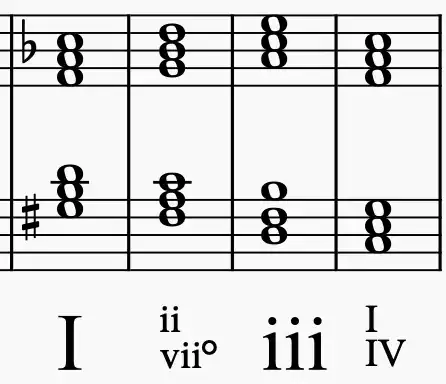
In this setting, a polychord-type notation would have meaning, but at present there is no such established notation.

 (with a fraction).


