7

I'm doing some work on a 12-string acoustic guitar, and am planning to replace the nut and saddle. I need to raise the action a little bit for the E and B strings, and also want to change to a slightly heavier gauge, so I'll need a nut with slightly wider slots; the low E string doesn't quite fit in the slot as it is, and heavier strings will make this problem worse.

How much does nut and saddle selection affect tone? I like the tone of the GraphTech ones I have -- it's definitely better than the plastic nut and saddle that came with the guitar. But are there options for anything better?

enter image description here

The self-lubricating factor of Tusq material is very subtle, and though the tone is good, am I better off looking at a bone nut and saddle? Are there issues particular to 12-strings? (The tone on this guitar is quite good, although a little muddy.)

The guitar's pickup is a soundhole-mounted Fishman, so there's no undersaddle pickup to interfere with the acoustic sound.

Goodbye Stack Exchange
  • 4,555
  • 4
  • 32
  • 60
  • I don't know that the specifics of the 12-string make a real difference to this question. The tone difference should be the same with 6 or 12 strings. Maybe the question should be changed? – Dave Jacoby Mar 13 '11 at 04:01
  • 1
    @VariLogRant - If I'm wrong about this, someone please correct me, but 12-strings do tend to be lacking in bottom-end tone, due to over half of their strings being unwound (I think) so transmission of low frequencies to the top is even more important than on a 6-string. (If I knew what wood this guitar is made of, then that would be even more relevant information.) – Goodbye Stack Exchange Mar 13 '11 at 06:27
  • If that is a picture of the guitar above, I'd say you have a solid spruce top. And urah, maybe there are some problems unique to 12-strings, I'm sure there are many who have the same questions about how nut and saddle material affect the tone of their 6-string guitars. – Dave Jacoby Mar 13 '11 at 15:54

1 Answers1

8

The nut and saddle simply act as conduits for the vibration of the strings to the body of the guitar--so their effect on the tone of the instrument is pretty small. Other people may tell you different though ;). An acoustic guitar lives and dies by the geometry of the instrument--and the majority of the sound is projected from the sound hold and the top as the body of the guitar acts as a natural amplifier. A better nut and saddle, if anything, will get you much better tuning stability and maybe a little better transfer of vibration from the strings to the top through the bridge and saddle; that could net you a little better sustain from sympathetic vibrations.

To give you some context, all of my electric guitars are equipped with bone nuts--which really cleaned up all my tuning stability issues and squeezed a tiny bit more sustain out of my Les Paul. I couldn't really notice a huge difference in tone based on the upgrades--which was from the cheap-o stock plastic nuts.

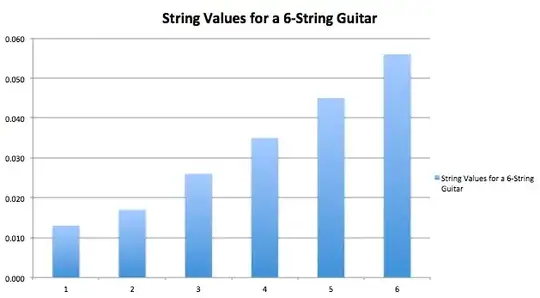
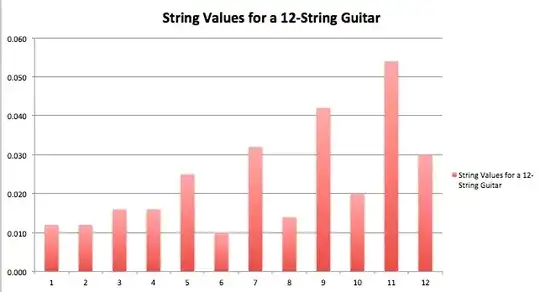
It also sounds like you are struggling with the lack of bass on your 12-string. Going to a lower gauge string set is a really good step in this direction, but a 12-string guitar is going to naturally sound brighter than a standard 6-string acoustic. Why? Well take a look at these two graphs:

12-string string values 6-string string values

Forgive me for getting all nerdy on you :D. Basically what you should take away from this graph is there are roughly 3 times the number of smaller gauge strings on a 12-string than on a standard acoustic assuming the cutoff is below the low D (0.036). The ratio is 3:9 for those of you math aware. So, from this you can see that the smaller, higher voiced strings have nearly thrice the presence--which will get you three times the highs. Note that I did these calculations using a medium set of Elixer Acoustic Phosphor Bronze and a medium set of Martin 12-String Phosphor bronze.

So there you have it :D.

Jduv
  • 11,455
  • 7
  • 42
  • 80
  • The guitar does have problems staying in tune, so I'll price out bone nuts and saddles. I think that the tone problems are here to stay, although they're fairly minimal. – Goodbye Stack Exchange Mar 13 '11 at 06:30
  • Also, I'd heard that a guitar's sound comes chiefly through the vibration of the top, and not through the soundhole. However, thinner-bodied guitars are definitely softer and more tinny-sounding, so I'm not certain that's true. – Goodbye Stack Exchange Mar 13 '11 at 06:32
  • The top certainly provides a very large proportion of the tone of the guitar, I'd say 80% - 90% if I had to assign it a number. Note that I only said that the majority of the sound is projected from the sound hole, I didn't say it generated the tone of the instrument :D. The geometric configuration of the instrument allows the top to vibrate freely--along with the strings and other pieces of the instrument, thus generating your tone. – Jduv Mar 13 '11 at 13:37
  • For a given purpose, that being the tuned-snare in the singer's hands, the bright nature of the 12-string works well, and I don't see 12-strings out there in other contexts. Yeah, Leo Kottke, but otherwise, not so much. – Dave Jacoby Mar 13 '11 at 21:29
  • It's an old question, maybe you don't visit any more, but I'm sceptical about your extra sustain on any guitar - apart from open strings - with respect to having a bone (or brass, or whatever) nut. Once the string is fretted, there's no vibration behind it going to that nut, so how is a difference made - or even proven? – Tim May 15 '18 at 08:19