I have often heard/read people mentioning a "death cap" when talking about older Fender amps.
Is this a capacitor?
What does it do?
Why is it called the death cap?
I have often heard/read people mentioning a "death cap" when talking about older Fender amps.
Is this a capacitor?
What does it do?
Why is it called the death cap?

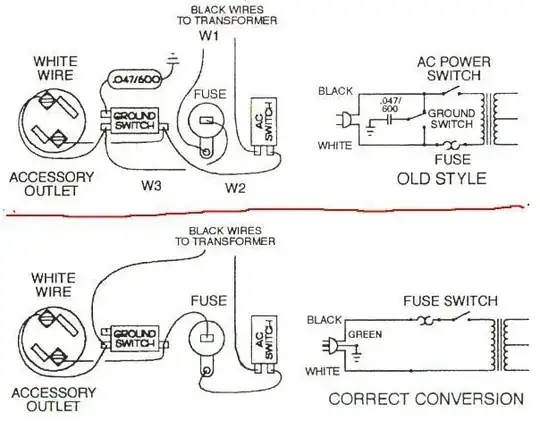
On older, two prong power cord Fenders, there's a 0.047 uF cap that you can switch in across one of the power leads and ground. It filters out some high frequency noise on the line. If the cap fails it can result in your amp's chasis, and your guitar, being connected directly to the mains. Possibly resulting in death.
Here's a diagram for converting a 2-prong Fender to a 3-prong setup with a fuse, getting rid of the cap in the process.

All caps should be properly discharged, but that's not why it's the death cap. As said above, when it fails you're really rockin' with fire. In fact, I believe the history of rock n roll is rich with anecdotes of guitarists electrocuting themselves on stage. As a passive consumer of these rock myths, I always felt it added a certain romantic quality to the music. But, nah...a cheap amp from yesteryear can, and has, killed. The Death Cap!

The above is wrong.. although it adds a ground to an otherwise ungrounded unit. Many old tube radios and amps, the chassie itself is part of the circuit. The "death cap" is a large capacitor in the amps circuit that can store thousands of volts like a battery even when unplugged. Touching the connections to it can result in a very unpleasant shock. It must be safely discharged before repairs can be made.

