13

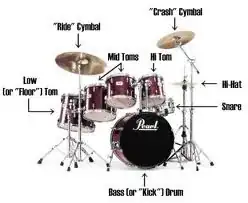
Today I was practicing for a drum performance in school and I didn't know the positions of the crash cymbal and ride cymbal were different from the usual drum set up. I only realised the mistake halfway through the practice when the sound produced was weird.

How do I differentiate between the "Crash Cymbal" and "Ride Cymbal", which look so similar in appearance assuming you do not know the position of it in the drum set?

I am open to other answers which would allow me to differentiate between the two.

enter image description here

Glorfindel
  • 3,612
  • 5
  • 21
  • 36
Computernerd
  • 1,457
  • 3
  • 15
  • 22
  • 3
    About the position, a ride cymbal is usually placed lower than the others cymbals : its allow us to hit the 3 parts (edge/bow/bell) easily at a high tempo. Its the hit-hat big sister. – JoeBilly Mar 02 '14 at 00:00
  • Be prepared! I'd suggest turning up to class a few minutes early to familiarise yourself with the supplied kit. Then you can see where which cymbals are available, and you can adjust if someone else has changed the height and angle of the toms, changed the snare tuning, adjusted the height of the hi-hats, and so on. – Brian THOMAS May 02 '17 at 12:00
  • ride is bigger than the crash –  Feb 28 '19 at 05:42
  • Related: https://music.stackexchange.com/questions/41554/difference-between-a-ride-and-a-crash-ride-cymbal?rq=1 – Todd Wilcox Oct 28 '22 at 16:17

7 Answers7

14

The purist, jazz drummer in me will tell you there is no difference. You can place a cymbal wherever you want and play it however you want regardless of what word the manufacturer decided to print on it. You can ride a crash and crash a ride. "Crash" and "ride" are just divisions we've made based on how well they produce certain kinds of sounds. So really the only distinctions you can make are based on sound. Do you like the way it sounds when you crash it? Then crash it. Do you like the way it sounds when you ride it? Then ride it. But crash and ride don't have to be different cymbals - just different play styles. I often run an 18" "crash/ride" on the left and a thicker 20" "ride" on the left but I crash and ride both of them interchangeably depending on the music. So which one is my ride cymbal? Both. Which is my crash cymbal? Both. They just crash and ride in different ways and at different intensities. I also have a 17" "dark crash" that I like to ride in smaller venues and stuff. It's small and light and opens up at a pretty low volume. So it works pretty well in small, intimate spaces and playing lightly with light sticks. Alternatively, it makes an excellent crash cymbal in sort-of medium-loud live music or in the studio where volume doesn't really matter so much. So I feel it has pretty diverse applications.

Idk, that's a pretty philosophical approach to a simple question, but I legitimately feel the boxes we place on ourselves - you can only crash and crash and ride a ride - are limiting and inhibit our creativity and musicality. So go, crash your rides and ride your crashes. Experiment. Find what sounds good and let that be the ultimate measure of what a cymbal is. Size, thickness, position, even the label on the cymbal - no one in the audience or listening to your record is going to know or care about these trivialities - only sound matters.
Sheldon
  • 359
  • 2
  • 3
  • 5
    Note that the question contains this: "I didn't know the positions of the crash cymbal and ride cymbal were different from the usual drum set up. I only realised the mistake halfway through the practice when the sound produced was weird." I think the question asker, Computernerd, would disagree with you. This person already rode a crash and crashed a ride, then didn't like what s/he heard. – Dekkadeci May 03 '17 at 12:37
  • Dekkadeci, Good observation. It sounds like Computernerd is already doing the right thing - trusting their ear. In that sense the question is already somewhat self-answering. "I only realized the mistake halfway through the practice when the sound produced was weird." followed immediately by: "How do I differentiate between the "Crash Cymbal" and "Ride Cymbal", which look so similar in appearance?" If it sounds weird, then it mustn't be your preferred setup. Differentiation achieved. – Sheldon May 04 '17 at 14:14
13

Hit both the cymbals once .

The "Crash Cymbal" should produce a loud, sharp "crash"

The "Ride Cymbal" should produce a sustained, shimmering sound

Sample of Crash Cymbal sound

Sample of Ride Cymbal sound

Computernerd
  • 1,457
  • 3
  • 15
  • 22
5

As @Meaningful Username pointed out, the ride is usually heavier than the crash. It is also typically larger than the crash (ride usually 20 inches in diameter and crash mostly 14 to 18 inches).

If you hit the center region of a ride, it produces a bell-like sound.

Menglan
  • 313
  • 1
  • 4
4

More often than not the word "crash" or "ride" is printed somewhere on the cymbal in question. A ride usually is thicker and heavier than a crash.

Meaningful Username
  • 6,697
  • 3
  • 29
  • 49
2

To add to what's here:

Ride cymbals will not be very loud when struck (comparitively), but will have overtones that last for much longer than crash cymbals.

Crash cymbals, for the most part, are meant to accent the beat - be loud when hit, then fade quickly.

If you hit both very hard, across the edge of your stick, listen to see what is still ringing many seconds later.

Jason P Sallinger
  • 1,464
  • 14
  • 31
  • Actually, ride cymbals sound louder when played loud as they are bigger than crashes. Most often, crashes are 16 to 19 inches, rides are 20 to 22 inches, and hi hats are 13 to 15 inches big. –  Jan 29 '19 at 13:03
0

There are already some great answers here, but in general, a ride cymbal will be wider than a crash cymbal, and will also have a larger, more pronounced bell in the center. There are exceptions, of course.

-1

What makes Crash and Ride cymbals different is their sound, hence function. Putting it a little bit black and white:

  • a Crash asks for attention, i.e. is fine for certain accentuation ("LISTEN, here's something new ! ...")
  • a Ride you love listening to for a longer period of time ("what a nice contrast to the drums ...")

"Sound" depends on many circumstances, like:

  • the cymbals design, see other posts here
  • how you hit it (chopping vs. caressing)
  • where you hit it (bow, bell, rim)
  • hitting device, i.e. the contact point and its material (sticks, brushes, broomsticks, mallets, fingers ...)
  • the band/orchestra (i.e. its floor of frequencies, loudness, noise)
  • the room (broom closet vs. hall/outdoors)

etc. Which implies, as was already stated here, that you can:

  • "abuse" a Ride as a Crash (hit harder)
  • being gentle to the Crash for a Ride (softer stick control)

Like almost all things on the drumset it's subjected to the drummers preference, what she or he deems a good sound.

MS-SPO
  • 766
  • 14