7

As far as I know, a basic rule of 4-voice music is:

-The two intervals between the upper 3 voices should not be wider than an octave, and when moving on to the next chord, each voice should proceed as close as possible and the parts with the same note to next chord should stay there.

Of course, it explains that if this is difficult to do so due to the progress of Harmony, there can be moves for the sake of the melody.

But I'm particularly curious about this part:

The two intervals between the upper 3 voices should not be wider than an octave"

The reason for the rule is not properly explained. In some places, they say 'because the sense of harmony is low', but this seems to be an insufficient explanation for proper understanding.

So, I'd appreciate it if someone could explain the reason for the rule so that I can understand it.

guss2222
  • 109
  • 8
  • 3
    What's your source for this rule? Voicings where the tenor and soprano are a tenth apart are not particularly rare. – phoog Sep 11 '22 at 07:19
  • 3
    @phoog It doesn't matter if the tenor and soprano is spread more than an octave. The gap I'm talking about is that tenor and alto, alto and soprano, that is, the gap between each of the three voices should not be more than an octave. The source is a book on the theory of harmony in Korea. – guss2222 Sep 11 '22 at 08:28
  • Oh I see, I misunderstood. That makes more sense. – phoog Sep 11 '22 at 10:31
  • You say the rule is not properly explained. But how does the book explain it? – Michael Curtis Sep 13 '22 at 23:48
  • @MichaelCurtis There is no explanation as to why. That's why I asked the question. – guss2222 Sep 14 '22 at 05:46
  • @guss2222. I seriously doubt there is no explanation, but you must be reading the text to narrowly. You're focused on one _sentence_ and can't see the forest for the trees. Even general context would help. Is the rule intended only for vocal part writing? Is it given as guidelines for harmonization exercises? – Michael Curtis Sep 14 '22 at 13:36

3 Answers3

5

I would say there are two main reasons: one is acoustical and the second is the ranges of the SATB parts.

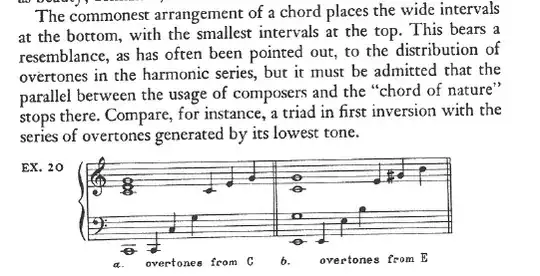
In Harmony, Walter Piston makes the point that close voicing with a large gap between bass and tenor mirrors the "chord of nature" and harmonic series.
enter image description here

The commonest arrangement of a chord places the wide intervals at the bottom, with the smallest intervals at the top. This bears a resemblance, as has often been pointed out, to the distribution of overtones in the harmonic series, but it must be admitted that the parallel between the usage of composers and the "chord of nature" stops there.

That isn't a direct explanation, and even Piston finds it dubious, but clearly spacing SAT with wider than an octave between adjacent parts is very unlike the chord of nature.

When you consider the comfortable ranges of the voices it's kind of hard to actually get the adjacent SAT voice spacing wider than an octave without the parts becoming awkward, moving into the extreme ends of the various ranges. In other words, if you write in a comfortable range for each part, you shouldn't have trouble with adjacent voice spacing exceeding one octave. The spacing "rule" can be viewed as a sort of backwards way to train one to write parts within comfortable ranges.

One way to break this rule is to push the alto down and the soprano up, the result being the three lower voices clustered together in a fairly low range, and if those voices are too low the sound may get "muddy." I think of that as another acoustical reason for the spacing rule.


There is a problem with questions that ask "why?"

I decided to add one more explanation.

I suspect the OP is expecting some kind of innate to sound or quasi-scientific answer to the question of "why" there are voice spacing guidelines. As Feynman points out in the linked video you can never answer persistent questions of "why?" The key question of voice spacing is "how?" And that leads to what I think is a third kind of explanation: procedural.

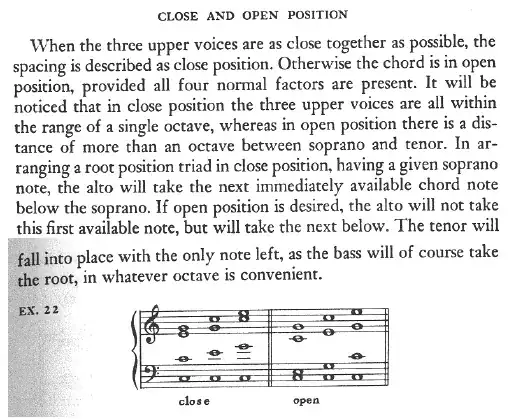
In Harmany, Piston explains close and open position simply by showing the inversion of the middle voice of the three close position triads to the lower octave generates the basic open spacings.
enter image description here

If open position is desired, the alto will not take the first available note [below the soprano], but will take the next below. The tenor will fall into place with the only note left, as the bass will of course take the root, in whatever octave is convenient.

Procedurally inverting the alto will result in open position chords where the adjacent spacing of SAT will never exceed an octave. Piston's ex. 22 can be regarded as a chart of standard, desirable close and open chord spacing.

When writing an actual harmonization, both horizontal and vertical aspects are balanced. A harmonization is not only leading individual voices, it's also about a good vertical blend of voices. Swapping pitches between voices, inverting voices, are common approaches to getting a good balance. That means altering the linear direction of a part for the sake of a good vertical balance is normal when writing a harmonization. In Piston's text "good" vertical balance is exemplified in ex. 22.

There is yet another type of reason for this rule: pedagogical.

I've tried to get the OP to flesh out some detail from their text rather than focus on a single sentence, because I suspect they are misreading the intended meaning.

In Piston's Harmony (I focus on this text, because it is the one I have with the most elaborate discussion of voice spacing, my other texts cover it with only a sentence or single paragraph) he states:

Intervals wider than the octave are usually avoided between soprano and alto, and alto and tenor...

Notice he includes the word "usually." Through out the text Piston makes clear there are no hard and fast rules. Artistic consideration can always override a rule of thumb or general procedure.

Bach's 371 Vierstimmige Choralgesänge is a good cure for harmony problems. It only took me scanning to the 5th or 371 to find an example of Bach "violating" two "rules" or part writing. He exceeded one octave between soprano and alto, and he crossed the alto and tenor!

BWV 267, An Wasserflussen Babylon

enter image description here

Why do harmony textbooks say the spacing between adjacent SAT voices shouldn't exceed one octave (and don't cross voices) even when Bach did it? Because it's rare when master composers do otherwise. From a pedagogical perspective if the teacher doesn't give students such guidelines, the student will write horribly spaced voicings.


So, if that is summarized, I would say the reasons are:

  • acoustical clarity
  • moderating the range of individual parts
  • procedural, open spacing derived from inversion
  • pedagogical, students follow the rule not actual composers
Michael Curtis
  • 53,281
  • 2
  • 42
  • 147
  • 1
    Superb answer. And your "problem with questions" can be added to about 3/4 of all questions posted in this forum. But that aside. – Victor Eijkhout Sep 14 '22 at 16:13
  • 1
    The Bach example is quite interesting, because although he does break the rule in terms of the alto and soprano exceeding an octave distance, he also maintains the rule in the sense that "adjacent" parts do not exceed an octave: the tenor and soprano after the crossing. – Aaron Sep 14 '22 at 17:08
  • One way to break this rule is to push the alto down and the soprano up, the result being the three lower voices clustered together in a fairly low range, and if those voices are too low the sound may get "muddy." I think of that as another acoustical reason for the spacing rule. <--- I don't understand why this is the only way. Lowering the tenor and upping the alto and soprano can extend it more than an octave. Am I misunderstanding something? – guss2222 Sep 15 '22 at 03:00
  • I didn't say "only way", I said "one way." But the particular point there is not only about the wide space between voices, but pushing 3 voices, the ATB, into a too low and muddy range. It's just one of many problems avoid by following the general spacing rule of thumb. – Michael Curtis Sep 15 '22 at 15:23
  • Oh, I see. And you gave a lot of reasons, but from my point of view, it seems to me that the only real proof is the overtone problem in the bass. That's not to say that other reasons are useless. – guss2222 Sep 16 '22 at 04:20
  • "Real proof?" Music is not law, science, or math. Music is art. Nothing needs to be proven. In part that is the reason I linked to that Feynman video. Also, the overtone explanation is very tenuous, even Piston indicates that. In my opinion the most objective explanation is the one about vocal ranges. – Michael Curtis Sep 16 '22 at 12:59
  • I think you're taking my words too far. The "real proof" I'm talking about doesn't mean that it applies to all of the music. It's just that, among those that can explain the reasons for the rules and restrictions mentioned in the main text, it is a structured explanation without being verbose. – guss2222 Sep 16 '22 at 16:27
3

It’s not a rule as in you may never violate it. It’s only a "rule" as in European composers from a certain period of time never violated it. So if you want to compose music that sounds like the music of those composers, or you just want to understand some of the thought process they went through when composing, you’ll want to follow that rule.

That said, as musical instruments, most human voices have a fairly narrow range. Combine that with advantages of the sound quality of those close harmonies and you have some solid musical reasons besides history to at least practice and understand such writing. If and when you break that "rule", your music will be better if you are aware that you’re breaking the "rule" and why you’re making that exception.

Todd Wilcox
  • 53,618
  • 6
  • 108
  • 185
  • 1
    "European composers from a certain period of time never violated it": Which period in time? I would be surprised if there is a period in which a counterexample could not be found. For example, a root-position chord with the tenor an octave above the bass, the alto a fifth above the tenor, and the soprano a sixth above the alto (a tenth above the tenor) is fairly unexceptional. – phoog Sep 11 '22 at 07:16
  • @phoog Of course. I only used the word "never" because I didn’t want to get too pedantic about music theory being descriptive and nothing being absolute, etc, etc. Oh also, is the asker asking about there not being more than an octave between tenor and soprano, or not more than an octave between tenor and alto and separately not more than an octave between alto and soprano? I was thinking of the latter. – Todd Wilcox Sep 11 '22 at 12:58
  • 1
    Apparently the latter. Even as much as an octave between adjacent upper voices is a bit odd. – phoog Sep 11 '22 at 20:53
1

In addition to @ToddWilcox' apt remarks: there are some interesting cases of extreme instrumental voicings, for example in some of Duke Ellington's stuff with a clarinet (or alto sax) and baritone sax a 10th apart, and so on. It does have a specific sound! :)

paul garrett
  • 789
  • 6
  • 7