9

I am reading Reger's book of modulations, and his analysis does not seem to me to be the most consistent. This example (No. 72, from a minor to F♯ Major) comes across as particularly odd:
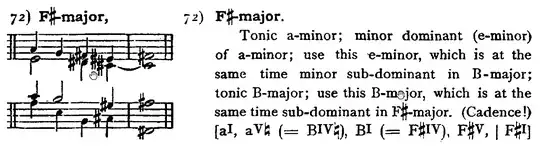
Excerpt from Reger

Here is the weird bit compared to a (IMO) less convoluted alternative.

Alternative analysis

Why would he assign a minor dominant and a minor subdominant in a major key when he could have used only basic key-based triads? In case you're wondering: In several other examples, he doesn't mind pivoting on the first chord.

Do you think he probably didn't care that much, or is there some deeper logic to consider here? Do you prefer the alternative?

Pladask
  • 91
  • 2
  • Do all the examples that pivot on the first chord come *after* this example in the book, or does at least one of those come before? – Dekkadeci Jan 27 '22 at 12:58
  • Great point that I forgot to mention! Many of them come before. – Pladask Jan 27 '22 at 13:02
  • Could you add one of Reger's one-chord modulations for comparison? – Aaron Jan 27 '22 at 13:13
  • 1
    With pleasure! Just to make sure: Do you mean modulations where the first chord is also a pivot chord? – Pladask Jan 27 '22 at 13:34
  • 2
    Here's one (No. 32, from C Major to d minor): https://i.imgur.com/g3a6Akq.png – Pladask Jan 27 '22 at 13:45
  • @Pladask - That No. 32 example looks pretty inexplicable - it perplexes me how Reger thinks C - Gm - Dm/A - A - Dm goes to F major for any period of time when this is more easily explained as C major: I - v = D minor: iv - i6/4 - V - i. – Dekkadeci Jan 27 '22 at 15:16
  • If going from `Am` to `F#`, wouldn't the leading tone dim. 7th chord be the simplest and most direct? `Am G#o7 C#7 F#`. Maybe that isn't the point of the book? – Michael Curtis Jan 27 '22 at 15:35
  • @Dekkadeci Fewer steps, for sure. No. 32 makes sense if you want to make a point out of avoiding altered chords when possible. However, as shown in the first example I posted (No. 72), this is clearly not the case with Reger. – Pladask Jan 27 '22 at 15:36
  • @MichaelCurtis Reger uses diminished 7 chords many times, but never in that way as far as I can see. G♯o7 is not native to C♯ or F♯, and enharmonics are extremely carefully avoided in this book, so I suppose translating it to E♯o7 (viio7 of F♯) is out of the question. Anyway, to be clear, I'm questioning Reger's analysis, not the actual modulation. – Pladask Jan 27 '22 at 16:26
  • @Pladask, this book is new for me, but now I see the point about avoiding enharmonics in the introduction. Your analysis does seem simpler. I'm probably just prejudiced against a _root position_ minor `v`, sort of modal, which is how the `Gm` in no. 32 sounds to me. Your label of `Em: i` avoids that, at least on paper. – Michael Curtis Jan 27 '22 at 16:53
  • 1
    From reading the introduction to the book, it seems to me that Reger is trying to give illustrations of various methods of modulation. One always needs more ways to go from one chord to another. There are some other books like Frank Shepard's "How to Modulate" from a few years later that do similar things. – ttw Jan 11 '23 at 15:15
  • Echoing @ttw here that I don't get the idea Reger is showing the *simplest* or *clearest* methods to modulate, but rather a glossary of ideas. Also, I think the notes/chords chosen are the point rather than his explanation. TTW, you should reframe your comment as an answer! – nuggethead Feb 09 '23 at 21:05

1 Answers1

0

I’m a long time professional musician, not an academic .. my only experience is with Schönberg's “theory of harmony”. Arnold takes much longer to modulate (generally) than Reger. My experience says: let’s not overlook the supremacy of the melodic - in modulation. While it’s handy to have a composer lay out harmonic logic to go from here to here ... fine. But my experience says the lines within your SATB are critically important - to modulate you have to hear the lines. That is not always so easy. Logical harmonic structures? sure, but music is essentially deeper than logic. If logic were the ruling factor - math majors would be the best composers ... and they are not. Music is more than any one of its aspects.

Glorfindel
  • 3,612
  • 5
  • 21
  • 36