I know there are related previous discussions (I had asked one here, which , interestingly, was also a Bar "13"), but they concerned one individual key overlap. In this case, left hand plays a mordent, and the D and Eb are overlapped more than once. How to play it? I'm attaching the urtext and also one that spells out the mordent.
-
2Note, Bach's "inventions" aren't specifically written "for piano"; they aren't even *strictly* written for keyboard; they're just 2-part counterpoint. Granted, he probably *was* thinking primarily of keyboard, and I'm guessing, of single-manual at that. But many harpsichords and organs could play this with the left hand on a different manual, and thus a different voice or register. – Andy Bonner Jan 13 '22 at 14:04
-
1@AndyBonner the pieces are from the _Clavier-Büchlein vor Wilhelm Friedemann Bach._ They're definitely keyboard pieces. This passage suggests very strongly that this one is intended for a double manual instrument. Why would you guess that he was thinking of a single manual? He had five harpsichords when he died, surely there was one with two manuals for his son to practice on 30 years earlier, – phoog Jan 14 '22 at 00:08
3 Answers
To get one thing straight: What you are talking about is not a mordent but a trill, which basically means:

Then when Bach wrote this instruments (like big Harpsichords) often had two manuals. The reason for this is to allow for some tonal differentiation. On a big harpsichord one can get two manuals which allows to pluck the strings in different positions for different sound as well as using different sets of strings with different length (with one set sounding an octave above).
As a result of this crossing parts can be much easier on a two manual harpsichord than on a modern piano, as each hand has its own manual.
But if you only have one manual you need stop sounding notes for new notes which then just requires the right articulation and timing (and on a modern piano touch) to convey the melody.
- 12,346
- 1
- 9
- 31
I own the Alfred edition of the Inventions, and it has notes on bar 13...
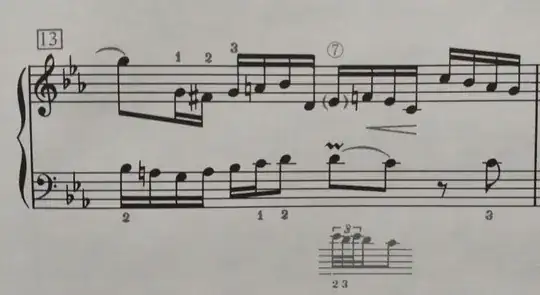
The embellishment is a trill not a mordant.
Alfred solves the "problem" with parenthesis around the R.H. Eb4 to show it will not be played literally, as the L.H. will play it on the down beat. After that initial Eb4 in the L.H. the rest of the notes for the two hands do not form unisons.
Alfred adds this footnote:
Consecutive unisons result from beginning the trill on the upper note, but the performance of the ornament as a Schneller does not solve the problem (if indeed there is a problem other than the fact that the composition was written to be played on an instrument with two manuals.) The realization shown here is possible. The Schneller is impossible to perform in this measure.
The Schneller is explained in the introduction to the edition, and is basically an upside down mordant, an embellishment using the upper neighbor tone.
- 53,281
- 2
- 42
- 147
Just play the ornament. The repetition of the Eb won't interrupt the overall melodic flow of the upper voice.
The other repetitions — the Ds at the end of beat 2, the RH Eb on the "and" of 3, and the Cs at the end of beat 3 — can all be played as written, with LH first and RH following.
As one example of many, here is Glenn Gould's recording (timed to m. 13). It can be clearly heard that he plays the ornament, but there's no felt interruption in either voice.
The same can be heard in Andras Schiff's recording.
- 70,616
- 10
- 97
- 243


