Please have a look at my harmonization. I am having difficulty labelling the V chords in this harmonization. I have labelled them as V chords with a 6-5 suspension. Would this labelling be correct since they resolve to I chords? When would these V chords be seen as something else? like maybe iii6 chords?
-
Well, technically a suspension must be “suspended” from a previous chord, so it can’t start a piece. Not saying it ain’t a V, just that it would be an upper neighbor tone. – Andy Bonner Sep 23 '21 at 11:20
-
Is this in the middle of the piece? – Dekkadeci Sep 23 '21 at 12:13
-
As I look more, I realize the second (cadential) chord can't be called a suspension either; its F# isn't coming from an F# in the previous chord. I *would* with total confidence analyze it as a V, though, because, well, cadence! (Also, to call it a iii, you'd have to explain the big ol' E in the tenor.) – Andy Bonner Sep 23 '21 at 12:17
-
Dekka the note before the F# is a D in the previous bar so you are right it is not a suspension because a suspension needs to be held from the previous bar as a common tone or be introduced by step right? – armani Sep 23 '21 at 13:15
-
Andy then the E in the second one does mean it cant be a iii6 but what about the 1st one? Arent these just cadential 64 chords? I know the 4th isnt there but still. – armani Sep 23 '21 at 13:18
-
Perhaps you need to post the preceding context as well. I was shying away from saying definitively that the first one was *not* a iii because it might make sense at the start of a phrase. If it's in fact another cadence, then all the more reason to call it a V as well. (But is it? How many phrases, and how many cadences, are we dealing with here?) – Andy Bonner Sep 23 '21 at 14:21
-
It sounds like a cadential V64 to me.... anyone please tell me why they think I am wrong :) – armani Sep 23 '21 at 14:38
-
@armani - If it were a cadential V6/4, then it either has scale degree 2 on the bottom (a more naive reading) or it's what quite a lot of places would label a I6/4 chord and would therefore have scale degrees 1 and 3 in it. Your claimed V6 in your claimed V6-5 has only scale degrees 5, 7, 3 and sometimes 2 in it, and it always has scale degree 5 on the bottom. I can't call that a V6/4 chord, ever. – Dekkadeci Sep 24 '21 at 12:27
-
Ok so then what? – armani Sep 24 '21 at 17:54
-
Related: [What is a "Slovenian Cadence?"](https://music.stackexchange.com/q/80362/21766) Like Athanasius, I *strongly* recommend *not* calling these iii6 chords. – Richard Sep 29 '21 at 22:01
2 Answers
Some people would label these as (incomplete) V13 chords. Others would label them with a symbol like Vsub6, indicating that a sixth above the bass is substituted for the 5th above the bass. (However, in your second example, you actually have both, so maybe Vadd6?)
It's clearly a dominant function chord, and they are quite common, even without the 6-5 resolution. That is, lots of cadences will go directly from a Vsub6 to I.
One thing you should not label these is iii6. That's not their function. They're just one variety of altered dominant chord, which are less commonly seen in Roman numeral analyses (even though they exist in a lot of classical harmony, especially in romantic period music).
- 12,142
- 20
- 49
The difference is the root. V has root A and iii has root F♯. I know what is obvious, but then put it in context with moving to a I chord. The bass is playing the dominant and then the next is a I. That sets up a choice of either a strong progression of V to I or a weak progression of iii to I. The simple things is to call it V to I and whatever happens with F♯ and E above is decorative.
If the next chord was some other modal region chord, like vi, the label iii might make sense as a passage in the modal region. But that doesn't happen here.
The name of the melodic, non-chord tone device will depend on the exact line, but there is a name for most everything. Your bar 2 to 3 occurrence can be called an appoggiatura. If you get all picky about NCT definitions, the first bar is tricky, because there is no approach, but I think appoggiatura would be an OK label. If you swapped the melodic order to E F♯ D you could call it an escape tone pattern.
It sounds like a cadential V64 to me.... anyone please tell me why they think I am wrong :)
Well, it's wrong, because there isn't a fourth above the bass.
But, I think your comment helps make the point about the chord being a dominant and not a mediant. If you omit the C♯ so that it were just bass A and F♯ above you would essentially have melodic descent MI RE DO above a bass A to D (the first iteration the bass moves to F♯ for an imperfect cadence to I6) and that melodic descent over that SOL to DO bass is the essential framework of a cadential 6/4.
Hearing that in the outer voices sort of confirms this is dominant to tonic harmony.
In notation I think of it like this: from the outer voice skeleton of...
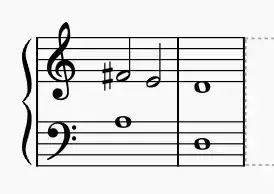
...common practice conventions would lead you to hear...
...therefore if you fill in the harmony this way...
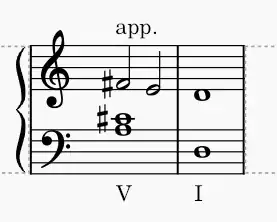
...you would say the basic harmonic framework is still V I and the F# is an appoggiatura - or some other NCT - resolving down to the chord tone E.
- 53,281
- 2
- 42
- 147
-
@armani, I added some notation examples. Sometimes it's easier to say with music notation than words. – Michael Curtis Sep 30 '21 at 19:20
-
Thanks Michael. I am still hearing a cadential V64 effect... cant help it :) Although I hear what you mean about the 4th – armani Oct 01 '21 at 21:45


