6

Did Iannis Xenakis write any music with intentions beyond absolute music? For example, music paired with other forms of art?

For example, Terretektorh (diagram pictured below) illustrates that Xenakis indicates for the piece to be played within and amongst the audience. Would anyone be able to elaborate on this piece or suggest any others? Here is a performance of Terretektorh.
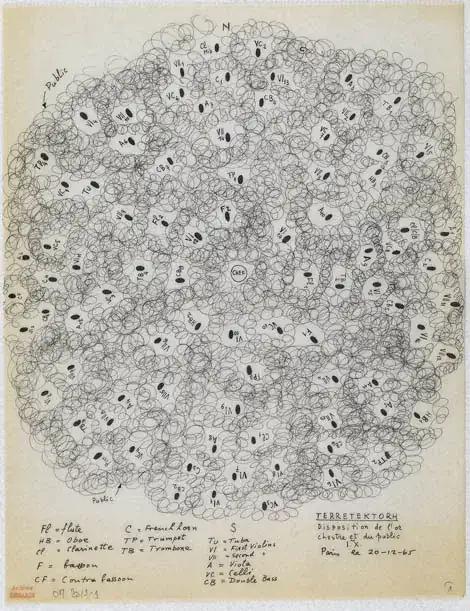
enter image description here

Since everyone can perceive music differently, my question is not only about how musicians interpret a composer's intentions, but also how composers expect the public to perceive their work.

It would be helpful is someone could provide any specific stylistic ideas Xenakis had about his (or some of his) music.

EDIT: The question is intended to make emphasis in Xenakis' expectations as how the public consumes some of his compositions. In Terrektorh he expects the public to be around the musicians but ultimately it can be seen as a request for the musicians to be inside the public. Incidentally the public will be around the musicians. I would be interested to see if he made some demands or suggestions that are specific to how the public should consume some music of his. A ridiculous example: Ask the public to listen to this music while taking breakfast, or something like that.

Another request he could have made that is not very specific to the musicians performing the piece is if Xenakis asks certain composition to be listened while looking at certain painting, or some sculpture, any other form of art going beyond the music. It might probably be interesting if examples are given from other composers but I was interested specifically if Xenakis did this sort of requests.

  • 5
    This is very interesting! I'm not totally sure what is being asked here beyond detailed information about [Xenakis's catalogue](http://en.wikipedia.org/wiki/List_of_compositions_by_Iannis_Xenakis), which isn't really a great question. Perhaps the scope could be broadened a bit to apply to composers and composition in general? – NReilingh May 29 '13 at 20:20
  • @NReilingh good point. Consider, for example, Vaclav Nelhybel / Antiphonale for Brass Sextet and Band. As to audience expectation, I fear that will lead to flame wars about when to applaud and similar topics :-) . – Carl Witthoft May 30 '13 at 13:04
  • @NReilingh - I find this question to be fairly broad as it is. The question speaks more to public perception and the composer's artistic aesthetic than a pure catalog analysis. That said I think the question is also specific enough to illicit some good, educated answers (I plan on answering myself at some point :) ) without dissent into opinionated discussion. – jjmusicnotes May 30 '13 at 15:52
  • @jjmusicnotes It's possible that my difficulty is purely mechanical--the question should probably be edited at least for grammar and wording. – NReilingh May 30 '13 at 16:39
  • 1
    @jjmusicnotes One would hope the educated answers were legally permissible (illicit -- elicit) :-). Signed, your local musical grammar nitpicker. – Carl Witthoft May 30 '13 at 18:20
  • @CarlWitthoft Excellent! Care to have a go at the question above with the community edit function? `:-)` – NReilingh May 30 '13 at 18:44
  • @CarlWitthoft - haha, yes, very astute - I realized my error after I posted my comment, but for some reason was unable to edit it, and I was too lazy to delete and re-type the comment. :) That said, a case could be made for my syntax as Xenakis was an interesting fellow... – jjmusicnotes May 30 '13 at 19:39
  • In my question I intended to make some emphasis in Xenakis' expectations as how the public consumes some of his compositions. In Terrektorh he expects the public to be around the musicians but ultimately it can be seen as a request for the musicians to be inside the public. Incidentally the public will be around the musicians. I would be interested to see if he made some demands or suggestions that are specific to how the public should consume some music of his. I don't remember if I gave some ridiculous example, like ask the public tolisten tothismusicwhiletakingbreakfast,orsomethinglikethat. – Anna Taurogenireva Jun 02 '13 at 09:21
  • Another request he could have made that is not very specific to the musicians performing the piece could be if Xenakis asks certain composition to be listened while looking at certain painting, or some sculpture, any other form of art going beyond the music. It might probably be interesting if examples are given from other composers but I was interested specifically if Xenakis did this sort of requests. I went recently to a conference about Xenakis and Math but didn't get to ask this question to the experts on Xenakis. (A not-musician-mathematician -->) – Anna Taurogenireva Jun 02 '13 at 09:38
  • What? The musicians in that performance are not scattered among the audience. How can that be authentic? Furthermore, since when does Ricky Martin conduct? :) – Kaz Jun 11 '13 at 00:47
  • It is true there are a few people outside, but if you look carefully you can see there is some public among the musicians. For example at 1:01 you can see them. – Anna Taurogenireva Jun 11 '13 at 01:25

1 Answers1

6

Did Xenakis compose music intended for settings where other art forms were an integral part? Certainly. Look up Polytope de Cluny and Persépolis for a start (8 track electroacoustic works with light show).

The question of his intentions is thorny and I do not wish to speculate about them. However, you can find in Formalized Music a description of Duel, a kind of game where two conductors compete against one another. Is that a concept beyond absolute music? Probably one can argue that it is.

Xenakis' famous description of a political demonstration with a crowd shouting slogans, ending with a brutal confrontation, which you can find in the first pages of Formalized Music, clearly relates to his use of stochastic principles of organization in his compositions. Does that make them program music? Not necessarily.

oberdada
  • 713
  • 1
  • 4
  • 9