7

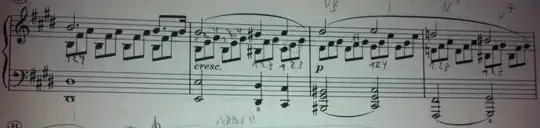
This is an except of bars 47-50 from Beethoven's "Moonlight" sonata, from the Henle edition.

enter image description here

In bar 49, in the middle of the second triplet, there is a fingering of 2-1 (pressing with finger 2 and switching to 1 while pressing), which I don't understand. Why do they suggest that?

Aaron
  • 70,616
  • 10
  • 97
  • 243
iddober
  • 6,552
  • 13
  • 46
  • 66

2 Answers2

10

They are assuming you are using finger 4 on the top D#.

The reason to switch from 2-1 is that if you ended up with 3rd finger on the G# and 4th finger on D# above, it is too far of a stretch. If you are playing the high D# with 5th finger it won't feel so uncomfortable, but then you can't connect the melody notes with finger legato. The finger switch allows a move from 4 to 5 in the melody to make it legato. You can obviously overcome the difficulty with pedal, but in my opinion, this piece is often ruined by overzealous pedaling.

ecline6
  • 2,091
  • 15
  • 24
  • 2
    Cue the discussion of the composer's pedal instructions.... – Mark Lutton May 03 '13 at 20:50
  • @Mark: heh, see my answer ;) – nonpop May 03 '13 at 21:03
  • And finger 4 on D# or not, if you play 1 2 3 on those triplets and you're getting ready for the next 1 on E, you then have 1, 2 and 3 clustered together on E, F# and G#, which makes it hard to reach the E with 5 gracefully. – terpsichore May 04 '13 at 03:31
  • A good answer overall (+1), but I want to add that there is a difference in sound between pedal legato and finger legato. – 11684 May 05 '13 at 10:03
1

I don't think it has to do with legato, at least not in the way ecline6 suggested, because if you're using 4th finger for the top d#, the f#-d# stretch would still be a problem (at least it's for me), and the switch should be marked on the first beat instead of the second. In fact, the only working fingering for using 4th on d# I can think of is to use 1-1-2 for the triplets.

Instead, I think the reason is that if you play g# with the 3rd finger and want to keep the triplets legato, you might have tension in your hand when you play the e octave. With the switch that doesn't happen. Still, it seems to be unnecessarily complicated. Just use the pedal and make sure you don't swallow or accentuate the g#.

Btw, the reason people use lots of pedal is probably because that's what Beethoven wrote! In the beginning it says sempre pp e senza sordini, which means all the time very quiet and without dampers (i.e. with the pedal down). On a modern piano you have to change the pedal at least partly every now and then, though, since the sound is longer. You actually get a pretty cool effect if you, for example, don't switch the pedal at all during the first two measures.
nonpop
  • 6,090
  • 1
  • 28
  • 39
  • You can make the switch to 4 on the d# on the same 8th as the 2-1 switch or the 8th after. Typically the 4-5 switches would not be marked. Maybe it's just my hand (fairly large) but I don't have trouble making the triplets legato either way, though for a smaller hand, the reach from g# to d# may be too far. The decay while pedaling on today's pianos is more than significantly longer than in Beethoven's time. A more realistic effect is to 1/2 or 1/4 pedal throughout. However, you can get some odd tonal characteristics when doing that. – ecline6 May 03 '13 at 22:07
  • Sempre senza sordini means "use the pedal throughout the piece". It does not mean "leave the pedal down forever without changing." – terpsichore May 04 '13 at 03:29
  • @ecline6: I still think that fingering is overly complicated but yeah, you can make it work that way. – nonpop May 04 '13 at 08:58
  • @terpsichore: That's very much up to debate, as is the tempo which here is a funny combination of *adagio* and *alla breve*. – nonpop May 04 '13 at 08:59