I've heard this bass line in a number of songs, including Billy Joel's "Piano Man", "One Day More" from Les Miserables, and "Rambling Through the Avenues of Time" by Flight of the Conchords. It's certainly a useful line: downward moving major scale, with a simple II-V-I at the end, and it's used in a variety of styles. Does this bass line (and maybe the associated chord progressions) have a name?
-
1It's also in the chorus of "I Want You Back" by Jackson 5. – jdjazz Feb 13 '22 at 03:15
4 Answers
A descending walking bass line, four in a bar. Walking bass happens when the notes are going up or down in a scalar fashion. They don't continue ad nauseum, because when there's a change of harmony, they'll often jump to the root, and then continue.
Walking like this means there's usually two notes from the prevalent chord played. Good players will make those on 1 and 3 when possible. A nice touch is to use the ♭9 of the next chord on beat 4 (or 4&) of the bar leading to it, as with the second to third bar on the same chord would mean finishing bar 2 on root, then starting bar 3 on root again.
It's the intro to Nina Simone - My Baby Just Cares For Me.
- 183,051
- 16
- 181
- 444
Yes, it's called the Romanesca, and it's a melodic-harmonic formula going back to the 16th century.
https://en.wikipedia.org/wiki/Romanesca
The bass line of the Romanesca takes either one of the two following forms. The older one goes as such, and the pattern can be remembered by the formula "down a fourth and up a second"

The newer one is the one you posted.
If you approach this from a voice-leading perspective though, you will see that if you transfer the newer bassline melody (the one you have posted) to another voice above, say the soprano, you can play the older bassline I just provided underneath and there you get your harmonic pattern. This can be heard most prominently right at the beginning of the Canon in D Major by Johann Pachelbel.
This video explains it much better than I could over here.
- 49
- 3
-
-
Yes, but the bassline they posted is very clearly a Romanesca. I was commenting upon that. – nahorov Feb 14 '22 at 17:45
-
Not really. If you read the Gjerdingen chapter about the Romanesca, you will see a mere descending bass line does not make a Romanesca. – Michael Curtis Feb 14 '22 at 18:07
-
It's possible to harmonize a descending scale in the bass as a series of 5/3 6/3 chords, like I V6 vi iii6 IV I6...
Generically you can call that a harmonic sequence which is when you transpose a harmonic pattern several times. The pattern is I V6 and it gets transposed to vi and IV.
Specifically you can call this sequence...
- a
5-6sequence in reference to the figured bass symbols5/3for the root position chord and the6/3of the first inversion chord of the initial pattern. - a falling thirds sequence in reference to either the sequence pattern transposing by descending third or the possibility of harmonizing the bass in thirds with an upper voice, like the soprano here...
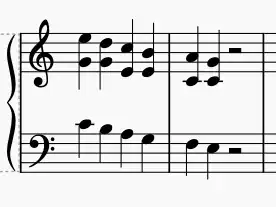
You could also harmonize most of that example link according to a rule of the octave harmonization as something like I V6 V64/V V V4/2 I6 vii06.... There are slight variations between rules of the octave from different teachers.
But, the "problem" comes when looking at some of the songs you mention.
The lead sheets I found show Piano Man as progression C G/B F/A C/G F C/E D7 G....
And One More Day as C C/B Am Am/G...
Both have a descending scale in the bass, but neither of those is harmonized as a falling thirds sequence or rule of the octave.
It doesn't make sense to me to use a name of a particular progression, sequence, bass, etc. when the particular song isn't an example.
The most generic way to describe your example is simply a descending bass. That may not be a catchy name, but it is the simplest way to describe the thing that unifies all these examples, and it is exactly what your example is. A common usage in harmony texts is: "how to harmonize a descending bass."

- 53,281
- 2
- 42
- 147
It's often called the "lament bass." It's common in classical and pop music. Both diatonic and chromatic descents occur and there are various harmonizations. One version is common in Flamenco music. Some examples: "Hit The Road Jack" Ray Charles "Dido's Lament" Henry Purcell "32 Variations in C Minor" Ludwig van Beethoven It's been a popular construct for the last few centuries.
- 24,207
- 1
- 31
- 76
-
1I considered that, but that's more along the lines of 8, b7, 6, 5, and chords tend to follow each note. It's the Spanis - Sequence. But that's usually a bar apiece. OP asks about a continuous bassline, moving four times a bar - and often in a minor key - maybe hence 'lament'..? – Tim Sep 11 '20 at 14:31
-
3The lament is usually chromatic rather than diatonic. This one is more often called just a "walking" bass. – Kilian Foth Sep 11 '20 at 15:29
-
2I agree mostly with Tim's comment, though it doesn't necessarily have to be one bar per note. But the "lament bass" is mostly associated with a descending tetrachord pattern that spans 8 down to 5 in the scale. – Athanasius Sep 11 '20 at 16:14
-
2This is not the bass line to Hit The Road Jack and other such tunes. That bass line is C Bb Ab G TO back up my position, simply play the bass line that is being asked about and then play the one I have presented. They aren't the same and you will immediately recognize which one is Hit The Road Jack, – Kevin Yeates Feb 13 '22 at 00:31
-
That's correct. these are not the same though most discussions I've seen do lump "descending" bass lines together. I prefer to think of "Hit the Road Jack" as being "diatonic" while the Purcell piece (and some others) are "chromatic. The Romanesca (both major and minor) seems to be sort of a class in iteslf. All can be modified to some extent. – ttw Feb 13 '22 at 03:55
-
1@KilianFoth for a diatonic instance of the lament bass, see the _Lamento della Ninfa_ of Monteverdi. The lament _is,_ however, always minor, whereas this is major. – phoog Feb 13 '22 at 20:46
-


