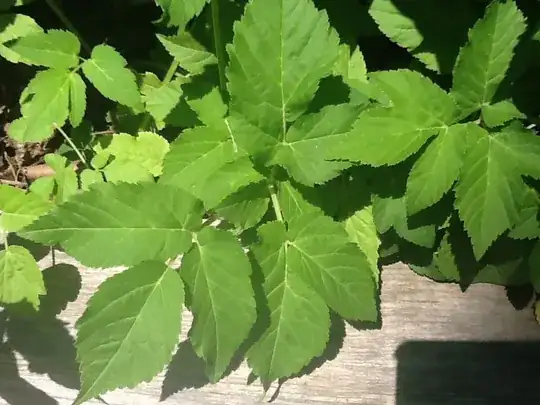
This plant is commonly known as goutweed (Aegopodium podagraria). Here in the Netherlands it is also called "tuinmansverdriet" (Gardener's Sorrow), and for good reason. I too have this stuff in my garden — a present from the previous home owner — and it's very hard to eliminate.
In my father's garden we got rid of it fairly effectively by excavating the top 30 cm of the soil with a pitchfork (instead of using a spade, in order to prevent cutting up the roots too much) and sifting it all; but even then the weed came back here and there, because even small parts of the root continued to grow.
Currently I'm trying to root it out area by area in my own garden, keeping close track of the locations where I've dealt with it previously, trying to dig out any new growth that surfaces, and (as a minimum) picking off the leaves as soon as I can where uprooting it is impossible due to the presence of other plants nearby.
Once the soil is loose, it is also easier to remove new plants that grow from leftover root fragments.
It seems as if the plant can be at least be contained in this manner, but I doubt if I will be able to completely get rid of it like this, especially around shrubs. You can eliminate it by constantly picking off all its leaves (almost every plant will die eventually if you do this), but it's a really tough plant and this method will take a long time.
So if you are unable or unwilling to get down on your knees once or twice a week, you might need to use a herbicide, as has been suggested in the other answers. If you do this, glyphosate (Roundup) should work, but it is likely that it will grow back at least once after being treated with Roundup.
Covering the soil, as @jmusser suggested, might also work, but my understanding is that you need to leave it covered for at least two years for the plant to die off completely. This was something I was unwilling to do, so I haven't tried this control method.
As long as you are stuck with this weed, try to make the best of it. The plant isn't too unattractive in appearance, and has pretty white flowers. It is also edible, and is actually quite tasty. It can substitute for spinach when cooked and parsley when raw, and it contains lots of minerals and vitamins — though I think it would be wise not to eat it if you have used herbicide on it.
Another tip: if you dig out this plant, don't try to compost it. That would be a very good way to end up with a garden full of it.
Update
As I said, I had the same problem as the questioner, and although digging out small patches seems to work, I couldn't get rid of all of it with all the bushes (plus a hosta) still remaining in my garden. Since I certainly don't want to use Roundup, I did what my dad had done before: digging up the whole border, I removed the plants and bushes I had there and threw them all out.
Fortunately, the infested area measured only about 10 m2. I decided to sift all the soil, though I could just have discarded it and replaced it with new soil instead. It would not have been that expensive to replace, but removing soil is a tough job in itself, and I felt this would also be wasteful. So I sifted it using a piece of netting (or you can buy a soil sieve), removing at least the largest of the roots and other parts of the weed. I actually felt pretty zen after two days of sifting. :D
I put back the by-now-finely-sifted soil, and added compost in order to maintain the loose consistency of the soil. I knew I had not removed all the roots. Small ones passed through the sieve, and sifting the soil again through a finer mesh would have taken too much time and still wouldn't have solved the problem completely. So I knew the remaining fragments would grow back; but having an empty garden full of loosened soil will allow me to easily dig out any new shoots that emerge.
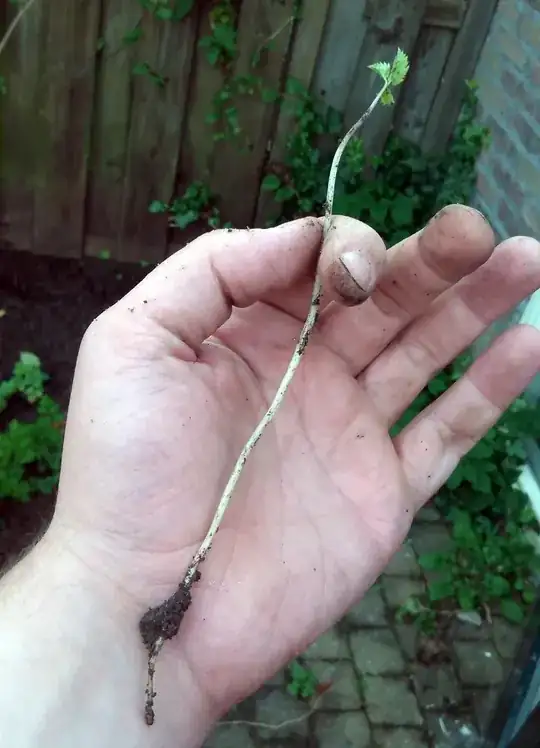
It's easy to recognise the plant. If it emerges from a seed, its first leaves are round seed leaves, but a piece of existing root that grows into a new plant exhibits the typical jagged-edged leaves right from the start.
So now I am able to spot these plants easily, and to dig them out as soon as I do. And that's how, less than two weeks after sifting the soil, I was able to dig up the plant in the picture. Only its first two centimeters consist of pre-existing root. The white stalk is all new (underground) growth, with only the green leaf showing above the surface of the soil. This is proof of the tremendous growing power of this weed, but if I just keep digging out any new sprouts for a couple of months it should be gone completely. Only then will I put in new plants. If I put them in now, the goutweed will certainly come back in places where I can't properly get at it to root it out.
It sounds like a lot of work, but it's not that bad, and not that arduous. You can do the sifting sitting on a chair or stool, and you can take as much time as you like, only doing small bits at a time. For me, the hard part was digging out the existing plants, but you may be able to get some help with that task.