6

I have a very large slab patio on the back of my home in Southern MN that has pulled away from the house about 6-8" due to freeze/thaw heaving. The previous owners have filled the gap with river rocks, which gives it an "ok" appearance, but it doesn't do anything to keep water getting in between the foundation and this slab and shoving it out. What can I use to seal such a large opening?
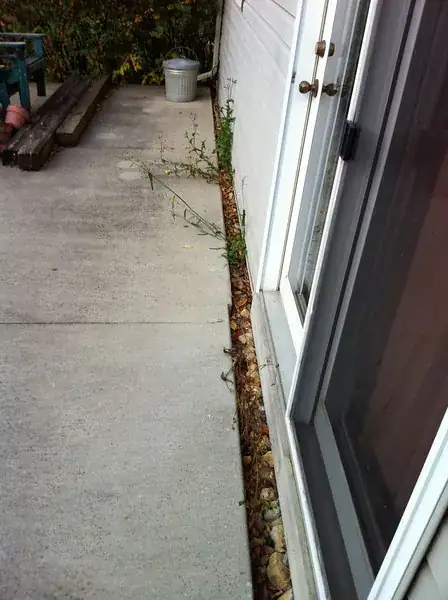
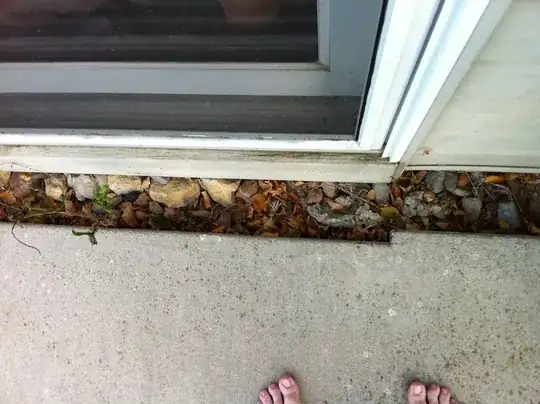
side view top view

The slab is at least 4" thick through out, as that's how deep the contraction cuts are. I suspect in reality it's at least 6" deep throughout. The far side away from the house is between at least 10" thick on the south end and over 20" thick on the north. I suspect the original plan was for this slab to also support a deck, as there are the remains of steel pins along the top edge of the far side, and there is some suspicion that the master bedroom window directly above the door seen here was originally going to be a walk out door. That plan was thankfully never implemented by the original builders.

The house sits on clay atop sandstone and this back edge is basically at the top of a hill side, from the edge of the slab the back yard slopes away at a 40 to 60 degree slope for about 20', then continues to slope away at a shallower angle for at least another 80' to the creek out back in the woods.

I have a couple of estimates to remove the slab, put in a retaining wall and pave the area with pavers instead of a single monolithic slab - which pretty much everyone has said is the wrong answer for this location. Those are very expensive jobs that I can't afford at this time. Hence the desire to see what I can do to lessen the impacts and give me time to be able to afford to have the pros in to do the right thing.

cabbey
  • 960
  • 3
  • 8
  • 18
  • Location is Southern MN. I'm curious if the code there requires footers below the frost line for patio slabs, and there weren't any installed... – Karl Katzke Oct 01 '11 at 22:50
  • 1
    If the code does, this is yet another place where they violated code when they built this house. (I've lost count of them. – cabbey Oct 02 '11 at 00:09
  • I should also add, part of the reason it has shifted so far is it's at the top of a hill... water flow and gravity are trying to pull it down said hill. Previous owners fixed the drainage issues and slowed it's movement substantially. – cabbey Oct 02 '11 at 00:11
  • Can you add pics? That would help clarify the problem in our heads. – The Evil Greebo Oct 05 '11 at 18:17
  • 4
    Get a experienced builder in. not some DIY advice. You need allot of work to sort that out-- just filling it wont help- it was build incorrect to start of with. Most likely remove it- or remove it and rebuild it properly. The truth is harsh sometimes. You will spend money each year on that trying to fix it.. until eventually its beyond repair and you have to remove it. – Piotr Kula Oct 06 '11 at 12:20
  • I'm 99% certain that slabs don't require any sort of footer in MN. In fact, floating slab buildings are built quite regularly (with proper bases, of course) – DA01 Oct 10 '11 at 20:19
  • Jeez Loise! Can we have picture of the OTHER side of the slab.. what is happening there? There could be one or 2 DIY fixes in this situation.. but they will require drilling,digging,concreting.. are you ready? – Piotr Kula Oct 10 '11 at 22:21
  • Also how thick is the slab and more or less what kind of soil do you have. clay or turf'ish? – Piotr Kula Oct 11 '11 at 13:58
  • 1
    I think a retaining wall is definitely going to be necessary. Sounds like your hill is sliding away. Pavers have a lot of benefits over concrete (namely they look better and won't crack) but you'll still have issues with them drifting apart if the earth movement isn't first halted. – DA01 Oct 12 '11 at 15:58

2 Answers2

6

Based on the pics and the amount of movement alone, I'm guessing that the foundation for this slab was not properly prepared. I'd wager that someone simply dug a squareish hole a few inches deep, put in boards for forms and poured the concrete. Looks great for a while, but doesn't do squat to avoid shifting in cold weather when the water freezes.

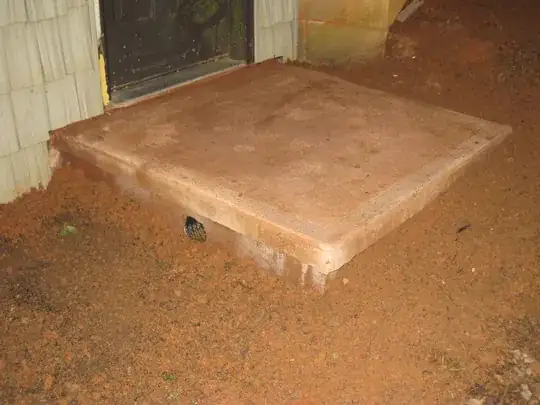
A proper concrete slab should be resting on footings that go fairly deep into the ground (the further north, the deeper). Have a look at this image to see what I mean: enter image description here

Note how the slab itself sits on a concrete wall? We can't tell how deep it goes from the photo but it should go at least a foot. This is done around the edges, usually, but alternatively, just like with a paver patio, you could dig out a much larger hole - a foot or more all the way down - and then fill with gravel, covered with cloth covered with sand (compacted at every layer) and the concrete poured on that. The purpose of that type of foundation is to give adequate drainage underneath so that what little water remains beneath in a freeze/thaw/freeze cycle has room to expand around the gravel rather than heaving it out of the way. So in short, there's no easy solution to your problem - and no amount of 'sealing' will fix it - water in the ground will get under that porch slab from all edges and continue to lift and move it as it freezes.

Sorry. :(

The Evil Greebo
  • 25,781
  • 16
  • 88
  • 124
4

Are you sure the slab has shifted and it wasn't simply poured that way? The gap appears to be the width of a 2x4 form. Some theories:

  • a form was used along the foundation to pour the slab leaving the gap

  • the house used to have older (thicker) siding/sheathing that was replaced with the vinyl (increasing the visual gap)

  • the gap was put there purposefully.

I say that as it appears that your patio looks great and frost heaving would typically introduce all sorts of other issues (cracked patio, buckled foundation wall). It also looks like the edge along the house is finished (bullnosed).

It's good that the slab isn't attached to your foundation (you don't want that as the slab and foundation will settle independently and crack your patio).

If the slab is properly sloped away from your house, I'd suggest aluminum flashing. Get some prepainted stuff to match your siding and tack it up under the drip edge of your siding overlapping the foundation.

Alternatively, the gap appears wide enough that you could pour a sloped concrete border. Be sure to physically separate this from the house and the existing slab and strike control joint in the border every so many feet. Fill the gap with polymeric sand or caulk.

DA01
  • 24,095
  • 27
  • 73
  • 142
  • 1
    I'm positive it has shifted. When I bought the house it was about 1.5" wide on the North and 2" wide on the south. Today it is about 4.5" wide on the North and 6" on the south. (I should have put a tape measure in the photo for scale.) – cabbey Oct 12 '11 at 03:10
  • that seems excessive for a freeze/thaw issue. Sounds like the slab is sliding down a hill! – DA01 Oct 12 '11 at 03:13
  • or worse...maybe it's your house sliding down the other side! (I hope not!) – DA01 Oct 12 '11 at 03:14
  • Yeah, they are both sliding down the hill. The entire back side of the house has settled a couple inches more than the front. (it's on a bluff, so the other side is level thankfully, not down the other side of the hill!) – cabbey Oct 12 '11 at 03:34
  • Time to give serious thought to retaining walls – The Evil Greebo Oct 12 '11 at 15:40
  • yea, now that you've mentioned the distance you know it's traveled, I fear there's something MUCH worse going on. I'd definitely recommend getting an engineer out to start looking at things. This sounds like something much bigger than ice heave. – DA01 Oct 12 '11 at 15:55
  • Yeah the estimates (see updated Q if you haven't lately) started with retaining walls, it's their engineers that are saying the slab is moving due to freeze/thaw. The retaining walls "won't stop it continuing to migrate away from the house." – cabbey Oct 12 '11 at 17:35
  • REading your question again, it sounds like the slab is thicker on the downhill side than uphill side. If that's true, that means the downhill side is a) heavier and b) has a base pointing downhill. I think it's inevitable that the slab will slide that way with a minimum amount of ice pressure. Sound like the slab may not have been put on a level base (which seems very odd). – DA01 Oct 12 '11 at 17:39