7

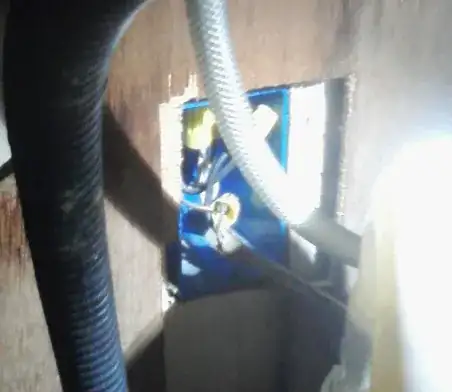
My vegetable sprayer line broke yesterday, which led me underneath my sink. It wasn't until I was kneeling in a large puddle of water with the line draining on me and the floor that I realized how bad the wiring was for my garbage disposal:

Shocking finding under my sink

This obviously needs to be addressed. My question is which of the following approaches will solve my problem and won't kill the next tenant?

  • Cover the J-box with a plate that has a hole and let the romex come through
  • Wire in an outlet (half-hot) and convert the romex to a 3-prong plug
  • Wire in a GFCI outlet (half-hot) and convert the romex to a 3-prong plug
  • Something else?

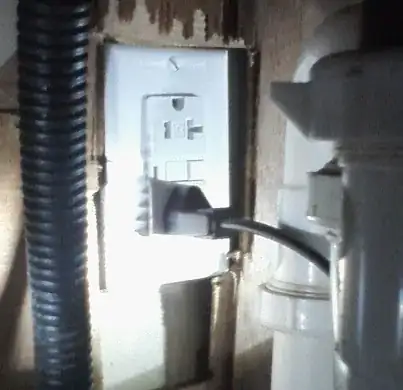
Completed project:

All tidied up, likely not to kill me

user7116
  • 488
  • 2
  • 7
  • 19
  • Do you know if that circuit already has a GFCI on it? – Niall C. Jul 29 '11 at 15:26
  • The breaker box has a "GFCI protected" sticker on the label panel...but I've yet to find said outlet. – user7116 Jul 29 '11 at 15:32
  • 1
    That's odd; there are GFCI circuit breakers, but the protection is actually better (and cheaper) at the outlet itself. See if there's a three-prong outlet on the same circuit, and plug in an outlet tester with a GFCI test button to verify the disposal will cut out with a ground fault. – KeithS Jul 29 '11 at 16:26
  • There are no GFCI outlets on the circuit as far as I can tell. – user7116 Jul 29 '11 at 16:34

3 Answers3

4

The answer to your question depends completely on whether this node in the circuit is GFCI-protected. GFCI protection is an absolute must for your disposer; it's a high-amperage electric motor hooked up to your kitchen drain.

Since this J-box doesn't have a standard 3-prong outlet, you'll need to find another outlet on the same circuit; look for a countertop outlet nearby. Plug in an outlet tester (like the one below, available for $5-10 from your local big-box home improvement store), turn on the disposer, and hit the black button on the tester to short hot to ground, inducing a "ground fault".
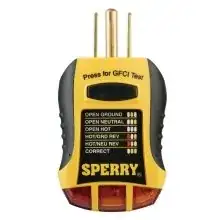
enter image description here

If the disposer has GFCI protection, it will cut out, and you're golden as far as circuit safety. If not, you definitely need to rewire this J-box with a GFCI outlet.

Even if the disposer is GFCI protected, you have other problems. The outlet is in a "wet" place; you hope that the under-sink area never leaks, but there is always, always, a plumbing emergency at the kitchen sink at some point. To avoid a continuous ground fault through contact with standing water in the J-box (which would prevent you from resetting the GFCI until the whole area dried out), you should seal this area as best you can. A little adhesive spray foam to fill the gap between the wall and the back of the cabinet, followed by a layer of silicone adhesive caulk to waterproof the spray foam (people think spray foam is waterproof, but it really isn't), and a child-resistant outlet and plate with a rubber or neoprene gasket (and/or another dab of silicone) should keep the water out in any situation less than a full flood.
KeithS
  • 14,037
  • 7
  • 42
  • 73
  • Excellent, I have an outlet tester but it does not come with GFCI testing. If it's GFCI protected, would it be worth wiring in a normal outlet half-hot (top switched, bottom hot) and switching the disposal to a cord? – user7116 Jul 29 '11 at 16:48
  • 2
    IMO, yes. Any licensed electrician will look at the hack-job that was done to this setup and insist that it be properly terminated in an outlet and plated. Depending on local code he may also require some sort of water seal to keep drips and sprays out of the J-box. Since this is apparently your own house, you can get away with just plating over the wire-nutted connection in terms of it working and not being a total shock hazard, but as a proud homeowner if this were my house I'd do the job right. – KeithS Jul 29 '11 at 16:55
  • It's my landlord's place, but he works with me on rent if I fix problems (I've already replaced a good number of outlets/switches that were fire hazards). Game plan is outlet, switch to cord, weatherproof plate. – user7116 Jul 29 '11 at 17:07
  • The disposal should not be connected to the countertop "appliance" receptacles, it's likely the disposal is on it's own branch circuit. – Tester101 Jul 29 '11 at 17:30
  • Depends on the age of the house; it's been perfectly acceptable for a long time. In my house built in '80, a countertop outlet, the disposer and an outlet on the island are on one circuit, then the fridge, microwave and the second countertop outlet are on another circuit. No problems electrically (though I did have to make sure the fridge and microwave outlets *weren't* GFCI protected along with the countertop), until you start mixing in arc fault circuit breakers, at which point the big electric motor may need a non-AFCI breaker when ordinary outlets require an AFCI by current code. – KeithS Jul 29 '11 at 17:36
  • NEC 210.52(B)(2). This section covers "Appliance" branch circuits, you can supply microwaves, toasters, etc ("portable" appliances). but not disposals, dishwashers, etc ("fixed" appliances). – Tester101 Jul 29 '11 at 18:07
  • Yes, that's current code. It didn't always used to be that way, just like AFCIs and even GFCIs weren't always necessary. The OP's question relates to a repair of existing work that doesn't require tearing out the existing circuit, so it's grandfathered. – KeithS Jul 29 '11 at 18:17
  • Found the NEC revision history. The rule you state was not added to the code until 1996, along with the GFCI requirements, so if the OPs house was built before 1/1/1996 it's perfectly legal to include the disposer in an appliance branch circuit. See here: http://www.mikeholt.com/technical.php?id=nec/unformatted/96sum&type=u&title=1996%20National%20Electrical%20Code%20Changes%20-%20Summary – KeithS Jul 29 '11 at 18:27
  • The house is ~110 years old, with the last work done in my kitchen by pro's in the 1970's. Last work done by laypersons looks to be mid 90's given the box's condition. My guess is they were unaware of these things called "electrical code". – user7116 Jul 29 '11 at 18:31
  • I'm not disagreeing with you at all here, I'm simply adding extra information for others who may find this page. – Tester101 Jul 29 '11 at 18:33
  • At first glance, I thought the pictured outlet tester was labeled "sparky". Maybe I should avoid wiring for a while. – BMitch Jul 29 '11 at 21:44
  • Updated with the completed project, since it wasn't GFCI I went ahead and added one. Put in a gasket as well. Many thanks. – user7116 Jul 30 '11 at 20:10
4

If you don't have the GFCI tester that KeithS mentioned, they are cheap and good to have. But until then, just hit the test button on the GFCI outlet in the kitchen and see what turns off.

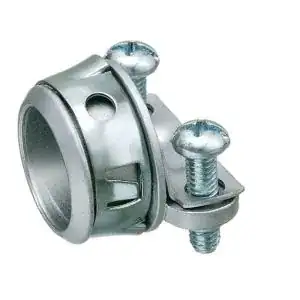
As far as wiring coming straight out of the box like that, I suspect it's against code. Every wire should go through a knockout in the back of the outlet in a secure way, either using the plastic tabs or a securely screwed knockout clamp:

wire clamp

With the current setup, there's a risk of pulling on the wires and loosening the connection. Even putting a blank plate with the wire coming through doesn't secure the cable and connections. But as the fellow DIYers below point out, you can get a box cover with a knockout and use that to clamp the wire in (and also shield it from some water or physical contact):

box cover with knockout

BMitch
  • 42,463
  • 14
  • 91
  • 196
  • What about a [Box cover with a knockout](http://www.google.com/products/catalog?q=box+cover+with+knockout&hl=en&prmd=ivns&bav=on.2,or.r_gc.r_pw.&biw=1006&bih=584&um=1&ie=UTF-8&tbm=shop&cid=12900437149993390676&sa=X&ei=_fsyTp6pL5DCsQL3_rmVCw&ved=0CGIQ8wIwBQ)? – Tester101 Jul 29 '11 at 18:30
  • 1
    Are there any code issues with a "plugged in" disposal? – Tester101 Jul 29 '11 at 18:35
  • Something like [this plastic cover w/ screwouts](http://www.google.com/search?sourceid=chrome&ie=UTF-8&q=CARLON +4"+Rectangle+Plastic+Electrical+Box+Cover)? – user7116 Jul 29 '11 at 18:45
  • I actually went searching for a box cover with a knockout, but with slightly different terms, and didn't see it. Thanks guys! – BMitch Jul 29 '11 at 20:22
  • @Tester101, great question. Don't know of any myself, but perhaps Sherlock will chime in. – BMitch Jul 29 '11 at 20:27
  • Thanks for your confidence BMitch. I'll give it a shot! lol – shirlock homes Jul 29 '11 at 20:58
4

Pretty good advice so far.

If it were a new install, then it would not be "J" boxed under the sink, but direct to the switch and GFI protected.

But with the situation you have now, unless you want to fish wires up the wall to the switch, let's make it safe.

  1. Install a tamper proof GFI receptacle into the box as pictured and install a gasketed cover.

  2. Install a 3 prong plug to the cord from the disposal. It should be a 3 wire cord if made or installed in the last 20 years. You can also find plugs with a rubber bushing that will fit snug around the existing cord. If it is not 3 wire, open the hatch on the disposer and install a new 3 wire piece of SO or SJTO cord with a molded plug already attached.

Even if the circuit is already GFI protected, a second GFI at the point of power will not hurt, and give you more protection in a future geyser blast!

All this is assuming that the feed romex is actually a true 3 wire circuit, hot, neutral, ground.

Jay Bazuzi
  • 11,658
  • 32
  • 94
  • 143
shirlock homes
  • 57,962
  • 3
  • 83
  • 166
  • Fixed up the formatting of the post; hope you like it. – Jay Bazuzi Jul 29 '11 at 21:12
  • @sixlettervariables: It can be difficult to make sure that the 3 wires are correct as shirlockhomes specifies. Specifically if neutral and ground are not separate conductors all the way back to the main panel, a plug tester won't tell you that. – Jay Bazuzi Jul 29 '11 at 21:15
  • +1 for "giving it a shot" :) I like to take a step back to the pros my lack of knowledge on the NEC risks giving bad advice. – BMitch Jul 29 '11 at 21:42
  • 2
    Don't forget the drip loop. You don't want water running down the cord and into the receptacle. [This article](http://freshaquarium.about.com/od/equipmentquestions/f/driploop.htm) has a good explanation (it's talking about one for an aquarium, but the same principle applies). – Tester101 Jul 29 '11 at 21:54
  • @BMitch: Unless it is a serious safety hazard, old work and repairs have to be done to a "Common Sense" standard. No one is going to inspect, or care about NEC current codes as long as it is safe and meets codes of the past. As much as I would like to bring everything to current code, it isn't always possible. – shirlock homes Jul 29 '11 at 22:16
  • Updated with the completed project, since it wasn't GFCI I went ahead and added one. Put in a gasket as well. 3-prong'd the romex. Many thanks. – user7116 Jul 30 '11 at 20:11
  • @ sixletters :Finished product looks good. Great job, enjoy. – shirlock homes Aug 01 '11 at 21:42