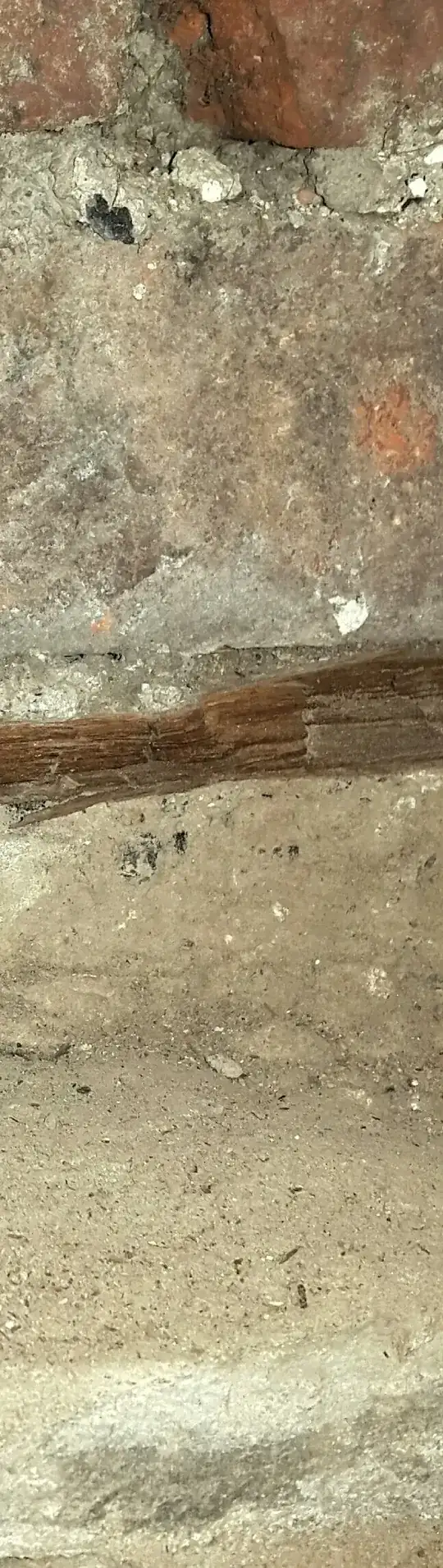
My guess about these planks are that a builder made outer walls (that are carrying the loads) first, as well as interior support walls (if any present) and then laid a wooden floor. Just then, he(she?) managed to place internal walls that were not for supportive matters (dividing into rooms) on this floor. Years passed, loads made under-wall-planks to go deeper, while floor lasted on the same level. (all that I said was assuming that builder knew better; I'm afraid that past-technologies and construction commons were less sophisticated)
No matter what was the reason, it will be nice to do something about that. Leaving this as it is may or may not cause any problems in a near future, but making a reconstruction with that good access is tempting to solve this now.
Aloysius Defenestrate put an advice in his comment about wood consolidation epoxies. It may work, though I would hesitate to use it if the plank can be accessed to water/is totally rotten. Still, given a proper support from epoxy producer, it can be worthwhile.
Another way of 'replacing' that plank (or what is left of it) is putting concrete instead of it. It is something done in monuments or to make a less-harming change within older buildings' structure. You can replace the plank with concrete partially, say - by 20cm of plank per 1m of a wall. The wall will lose some of it's support (for a short time), but I guess it will handle that at ease. After some 1-2 weeks make another 20cm replace and so on. It's best if done by a specialist and I would advise consulting these distances (20cm replace per 1m of a wall), but I think that it will make this repair more solid.