10

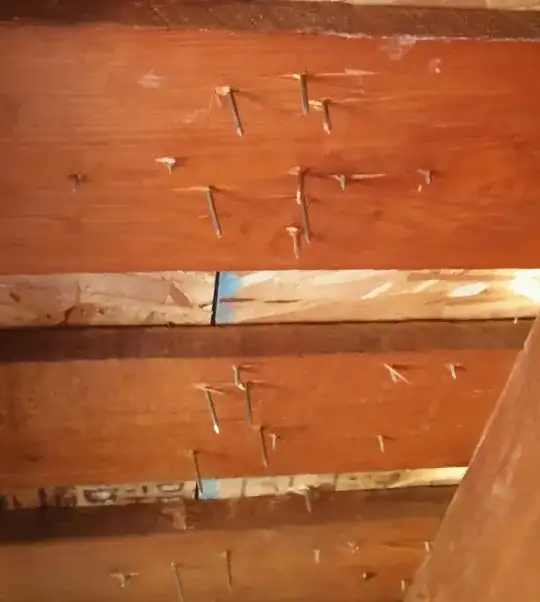
I have a colonial built in 1913 and I live in NYS. My roof was just completed today and I have exposed nails across the entire roof!

image of roof nails

It was not like this before. When I asked the contractor about it, he said this is normal, but I'm having a difficult time accepting this answer. I have included a picture to show what the entire roof looks like from the inside of the attic.

Darrick Herwehe
  • 378
  • 1
  • 11
lea
  • 101
  • 1
  • 1
  • 3
  • My house in Florida has very long nails too. They say it's preferred for hurricanes. I even got a discount on insurance. (just thought I would share even seeing you don't live in Florida) – Richard Dev Jan 14 '21 at 13:51
  • @RichardW11 your insurance policy specifies roof nail length??? – jay613 Jun 19 '21 at 22:38
  • 1
    @jay613 not sure... I know when I bought the house and made a comment, they said it's a part of the wind mitigation Florida insurance companies' discount. – Richard Dev Jun 20 '21 at 16:45

7 Answers7

17

That's perfectly normal. I would have preferred to see the vertical joints in the sheathing line up with the rafters, but that's about it. Roofing nails actually should come through about a quarter inch - I'd be more concerned if they didn't.

Comintern
  • 6,875
  • 1
  • 15
  • 22
  • It looks like a majority of the nails are coming through 3-4". Is that also normal? – Darrick Herwehe May 08 '15 at 12:49
  • 1
    @DarrickHerwehe - The nails coming through 3-4" are for the sheathing (thus I would have preferred them going into rafters). It certainly won't harm anything unless as Tyler Durden mentioned, you stand up suddenly. – Comintern May 08 '15 at 12:53
  • 1
    It is better to have too much nail than not enough. – DMoore May 08 '15 at 12:57
  • 2
    It would be difficult at best to hit every rafter while roofing. It's possible they used longer nails because they needed them at one point in the project and rather than worry about where to change the nails they just used them for the whole project. As stated there's nothing wrong with the nail poking through a bit extra. – Dano0430 May 08 '15 at 15:18
  • This roof was originally wood shingled over spaced furring strips. They've laid OSB sheeting on top to handle standard asphalt shingles. The nails you show are probably 10 penny, driven through to attach the sheeting to the spaced furring strips that wood shingles are normally attached to. The rafter is that thick piece of wood to the right of the picture that the furring strips are laid across.. – Fiasco Labs Jun 18 '16 at 06:17
  • @Dano0430 it's not that difficult considering rafters are evenly spaced and you know where the first one is since you start at an edge. – TylerH Jan 15 '21 at 11:26
  • @TylerH perhaps but by the time you are putting roofing on there is at least one layer of under layment like felt paper. You won’t know where seems are if they’re covered up. – Dano0430 Aug 30 '21 at 01:12
  • @Dano0430 I'm referring to the sheathing nails, not the roofing shingle nails. Most of the nails in the picture are not roofing shingle nails; they're *way* too long to be that. A few that are only poking through a quarter of an inch or so are roofing nails, and you're right, it's harder to line those up with rafters (and sometimes impossible depending on when your piece of roofing shingles ends... but that's one reason *why* sheathing is put down under asphalt roofing shingles). – TylerH Aug 30 '21 at 14:24
  • @TylerH sure I agree when you put the plywood on the trusses or rafters you should mostly hit it their purpose is a waste. Those nails hold the plywood to the structure. Then the nails that hold the shingles will go through the plywood because their job is to hold shingles to the ply. If you look closely at the picture the roof has osb on top of planks. The osb seems line up with the nails. This is fine as mentioned. Thanks – Dano0430 Aug 30 '21 at 14:30
6

Most sheathing now is 1/2 to 3/4 at most and a shingle is only about an 1/8 so with that being said the distance with synthetic is about an inch. If you're using a nail gun, which most roofers do, then your coils are 1-1/4 inch long at a low end (they don’t make smaller). So, unless you're hand nailing, yes there will be about 1/4 inch showing. It is normal for this to happen; it is unlikely for there to be no nails showing unless your roof is made of planks, in which case they won’t show.

isherwood
  • 119,766
  • 7
  • 148
  • 349
Nick
  • 61
  • 1
  • 1
1

Looks to me like someone was too lazy to go to the hardware store to get proper length nails or the hardware store was out of the desired size or they didn't want to pay the price for a full box of roofing nails...or buy a full box of roofing nails...and the nail gun was broken. This length and type of nail used is just wrong on multiple levels. They just used whatever they had on hand.

DAS
  • 893
  • 3
  • 15
  • Most of the nails we're seeing aren't even roofing nails. The vertically grouped nails on either side of the OSB joint are actually framing nails holding the OSB sheathing down to the original skip-sheathing that was, I'm sure, applied to the house when it was built in 1913. The nails, in horizontal rows, sticking through about 1/4" are the roofing nails, and they seem to be just about perfectly sized. – FreeMan Jan 14 '21 at 12:25
  • With that much experience you should know that roofing nails are _required_ to extend through the sheathing in many cases. – isherwood May 17 '21 at 21:10
  • @isherwood, if you read my comment carefully I did say TYPE of nail – DAS Jun 19 '21 at 21:38
0

I think there is a big problem with nails extending through the sheathing into the attic space. When the temperature falls below 32 degrees the humidity in the air will condense on the nails (frost). Above 32 degrees, the frost melts and water soaks back up into the wood (capillary action) and over a few winters you will have a moist wood surface - and a mold problem. That is the cause of my problem, I think. I know proper attic ventilation - air flow - is suppose to eliminate humidity but humidity is in all the outside air. The humidity is increased by improper ventilation from bathrooms etc, but air flow does not eliminate or reduce humidity in the air. Temps around 32 and humidity around 70 to 90 will result in frost and water and mold. Nails extending through the sheathing seem to be source of a serious problem in my attic. Other opinions most welcome.

Steve A
  • 11
  • 4
    Although your idea sounds logical it is quite normal for nails to protrude. – Ed Beal Dec 19 '16 at 14:05
  • It does sound logical but if this was really a big problem, someone what have invented an anti-nail-tip-condensation contraption and hired lobbyists to make it code-mandatory everywhere. – jay613 Jun 19 '21 at 22:37
-2

Once you fully nail through the roofing wood to the other side you end up with a stress fracture for moisture from both sides.nails should nit reach the full thickness to the floor roofing material and if its a new home structure as it makes the electricians and heating /cooling people work slower at times too.

Bob
  • 1
-3

This is not normal nor correct. It is common because most people who install roofing systems have no idea what they are doing. The roof deck should be 1 inch or thicker ply wood and the nail should be 3/4 inch nails, with 3/8th inch heads, galvanized and coated. When the nails are driven too deep, they supply a water channel which causes mold to grow on the roof and eventually destroy the whole house. Once the house is infested with mold, you will have to burn it down just to get rid of the mold. That mold could kill your family. Eventually the mold will show outside on the roof and grow under the areas where the nails are penetrating the roof deck. The reason this nail penetration is common is to save the labor of changing the nail pack in the nail gun, and the extra cost of using real roofing nails. It only saves about 100 dollars / house. Some contractors also substitute particle board for plywood which grows mold even faster. Google images for mold on roof.


This is a copy of the code that is about the same in all 50 states. The code states that the nails only penetrate when the roof deck thickness is below 3/4 of an inch. To hold snow, ice, and withstand wind, it has to be at least one inch thick plywood. So if you can see the nail heads and the right nails were used, the roof is too cheap to last anyway. The correct way to do this is with 1 inch or thicker ply wood for the roof deck/sheeting, and 3/4 inch galvanized nails with 3/8th inch heads. Also, the building codes are ridiculously outdated. They should not allow the roof sheeting/decking to be less than one inch or less than 3/4 inches when made of wood, especially in areas with snow.

https://up.codes/viewer/north_carolina/irc-2009/chapter/9/roof-assemblies#R905.2.5

R905.2.5 Fasteners

Fasteners for asphalt shingles shall be galvanized steel, stainless steel, aluminum or copper roofing nails, minimum 12 gage [0.105 inch (3 mm)] shank with a minimum 3/8-inch (10 mm) diameter head, ASTM F 1667, of a length to penetrate through the roofing materials and a minimum of 3/4 inch (19 mm) into the roof sheathing. Where the roof sheathing is less than 3/4 inch (19 mm) thick, the fasteners shall penetrate through the sheathing. Fasteners shall comply with ASTM F 1667.
Niall C.
  • 20,709
  • 17
  • 90
  • 131
  • While a 1" plywood roof sheathing would be nice (if the roof is built to support it), I'd like to see a code reference that _requires_ it as you imply. I would agree that the nails in the OP's post do _not_ look like they are properly galvanized roofing nails, nailing through the sheathing is pretty common. Also, got a reference for "burn it down" once you've got some mold in the roof? That seems pretty dog-gone extreme, considering there are a number of common household chemicals that will easily & safely kill mold... – FreeMan Jan 13 '21 at 19:04
  • Mold contributes to over 400,000 respiratory illness deaths / year. I would like to know if you would risk the lives of your family on a cheap roof that could be done right. I don't see the lives of my family as trivial and the 1" roof decking should be a minimum standard to protect families. There is nothing that can completely remove mold from wood once it is infected. As far as supporting weight, the roof must support the weight of the roof and a calculated amount of snow, rain and wind force. If it won't hold 1" plywood, it probably won't meet the other standards either. – Thalen Kane Jan 13 '21 at 19:09
  • You say, "1" roof decking _should be_ a minimum standard" - is that your opinion or is that in the IBC somewhere? Also, yes, I put a roof on my garage nearly 30 years ago, I live in the very rainy mid-west US, and no, I've never had a bit of mold growing on the underside of the roof, so I'm quite comfortable with the arrangement. Again, I ask for code references for your assertions, not opinions. That is the way here at the StackExchange sites. If you'd care to take the [tour], you'll see what's expected of in an answer here. – FreeMan Jan 13 '21 at 19:14
  • Now, I'd agree with you 100% on not using particle board on a roof. It's not very strong at all and would not support someone walking on it or a branch falling on it at all. If, however, you mean OSB, I'll agree with you somewhat. I did use OSB on my roof, and now kinda wish I hadn't, since I've had branches puncture it when they've fallen off our trees. Plywood would be more resistant to the damage. However, the OSB makes the damage much more readily apparent leading to a faster repair - I might not notice shingle only damage until much later... – FreeMan Jan 13 '21 at 19:16
  • 1
    Also, please edit your new answer into this existing one. While writing up 2 answers is acceptable here, these two really need to be combined. – FreeMan Jan 13 '21 at 19:19
  • 2
    This just isn't correct. Shorter nails would still provide a water channel into the wood itself, instead of just through it -- but the nails shouldn't be getting hit with much water anyway based on the way the shingles are laid on top of them. And having nails go all the way through is common and I've never heard of it causing mold unless there was also something else wrong. – Nate S. Jan 13 '21 at 19:21
  • Also, note that the vertically grouped nails sticking through ~2" on either side of the OSB joint are framing nails that are holding the OSB down to the original skip-sheathing and were, I'm sure, applied before the shingles/felt went down. The horizontally aligned nails, on either side of the framing nails are the roofing nails and they appear to extend about 1/4" through the OSB/skip sheathing combo and look to be just about right to me. – FreeMan Jan 14 '21 at 12:27
-4

Nails should never go through the plywood, water does go under the shingles and rust the nail thus making it thinner, more water to go through, the correct nail length should be the sum of the shingle thickness plus the underlying materials minus 1/4 inch...it is strange that protruding nails are thought to be normal! it is a common error in American building construction methods...you will not find this elsewhere in the world!

Adam
  • 1
  • 2
    Sorry, [this is simply wrong](https://structuretech1.com/wp-content/cache/page_enhanced/structuretech1.com/short-shingle-nails/_index.html_gzip), and it doesn't meet code in most of the country. – Comintern Jan 18 '19 at 18:10