4

Here is a picture of the top of my uninsulated basement wall. The foundation is poured and from early 1970s. For orientation to the photo: the white in the lower left corner is the vertical face of the wall. The horizontal board is the sill plate. Attached to the sill plate is some mortar. In this photo it has separated from the top of the wall. (Edit: the picture happens to be in a location directly above a basement window, and the mortar has separated from the frame above the window. However, there are places along this wall where the mortar has indeed separated by a fraction of an inch from the poured foundation wall. An eighth to as much as a quarter of an inch, except above windows where it's more like 1/2")

I am in the process of insulating the rim joists. I'm using rigid foam board instead of spray foam, and I'm using caulk instead of Great Stuff / expanding spray foam. As part of the job I am trying to seal the gap between the sill plate and the foundation wall. In the places where the mortar has not separated from the wall, it's easy enough to just run caulk along between the mortar and the sill plate. However, where it has separated, I need a better solution. How can I do that?

If the gap between the sill plate and the wall was a little smaller, I could just run caulk in it. However, since it's maybe 1/2 an inch, would it be better to shove a narrow strip of wood into the insulation to give the caulk something to adhere to? Or I could cut a narrow strip of wood (say, 1" by 1/4") and staple that to the front of the sill plate in a fashion that covers up the insulation gap and then caulk along where that strip meets the foundation wall and also where it meets the sill plate.

Is there a better option you'd recommend?
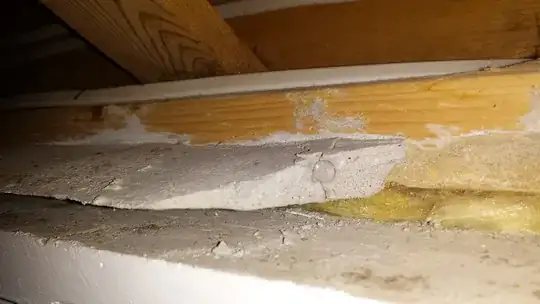
top of wall

That's my main question, but here are another couple of questions if you have interest or time.

Below is a stretch of wall where I removed the mortar that had separated from the top of the wall. You can see that the mortar on the right side of the photo has not separated from the top of the foundation wall. What the heck is the purpose of the nail that is sticking into the sill plate? It was buried in the mortar that I removed. You can see the head of another nail in the mortar in the image above. Seems weird to me...though I have never done this type of work. enter image description here
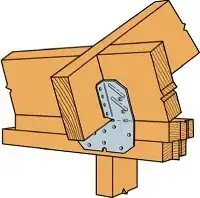
What is the yellow insulation that is underneath the sill plate called? Why is the gap so tall? I would expect the sill plate to be basically right on top of the foundation wall with only a tiny gap.

And what is the purpose of the mortar along the top of the wall in the first place? Is it basically an attempt to stop air infiltration?

Edit: as follow-up to a comment I made, here's a picture of an anchor bolt in the sill plate. enter image description here
susie derkins
  • 1,342
  • 5
  • 21
  • 34
  • 1
    How old is this building structure? – Michael Karas Dec 20 '14 at 18:10
  • I believe that before you put huge effort into sealing the rim joists and trying to seal up space between the sill plate and sill plate insulation that you should find out why the the structure and/or foundation have moved by an amount that appears to be close to a half of an inch. This movement could be indicative of some type of longer term serious problem. – Michael Karas Dec 20 '14 at 18:20
  • 3
    My guess is that the nails were put in there as some type of silly scheme to hold the sill plate and sloped mortar together. "Silly" because it obviously did not work!! – Michael Karas Dec 20 '14 at 18:24
  • There is another possibility regarding the nails. The original builder may have laid the sill plates and the applied the nails and sloped mortar as a scheme to keep everything in place while further construction happened above the sill plate. They may have done that work one day and then come back to place joists a day or so later. The bogus thing about this is that there should have been anchor bolts cemented right into the foundation that passed up through the sill plate. These should have then been washered and nutted and to hold the sill plate in place as joists were slid into place. – Michael Karas Dec 20 '14 at 18:32
  • Is this a poured, or block foundation? Based on the existence of the mortar, I'd guess it's a block foundation. – Tester101 Dec 20 '14 at 19:30
  • Thank you. This is a poured foundation from the early 1970s. @MichaelKaras - how would i go about determining structure/foundation movement? I just went down and looked more closely, and it's only on one wall where the mortar has separated from the top of the foundation wall. That picture I took is in the worst spot (most separation). In fact, the surface visible directly below the mortar in the first picture is part of the frame around a window - I didn't realize that or would have mentioned it originally. Though the mortar is separated from actual concrete wall in other places. – susie derkins Dec 20 '14 at 19:50
  • @MichaelKaras How far apart should the anchor bolts be spaced? There are a couple in this sill plate, though they're 10-12 feet apart. Also, the nuts are not tightened down - I could jiggle the washers but not tighten the nuts by hand (I think because they've rusted). The sill plate itself is visibly not quite level - it's slightly higher on the interior and lower on the exterior. Not by much, but it is noticeable. – susie derkins Dec 20 '14 at 19:59
  • @MichaelKaras Building on your hypothesis: is it possible they put the sill plates and mortar to hold everything in place. Came back later to put the joists in, and in the process of doing that, the sill plate tipped a little bit toward the exterior? This could have lifted the mortar and caused the separation. Problem with that theory, though, is that the surface area of mortar on the wall is greater than on the sill plate...i'd think the mortar would have separated from the sill plate rather than from the wall. Maybe it adhered better to wood for some reason...? – susie derkins Dec 20 '14 at 20:05
  • There are standards for spacing of anchor bolts but I do not recall right off how far it is. Years ago when I used to help build garages in Minnesota we used to put anchor bolts every four feet. They were carefully planned on placement so that they did not conflict with the positioning of a stud or joist. It seems almost inexcusable that the original builder never tightened down the anchor bolt nuts. – Michael Karas Dec 20 '14 at 23:49
  • There is a good possibility that separation along the one wall is due to foundation settling. Take a look if there are cracks in the foundation on that side to see if just part of the wall has settled. The sill plate above and the house wall may be held up simply because the sheathing on the walls keeps it triangulated and straight. Particularly if it is still sitting firmly on the foundation at the corners. – Michael Karas Dec 21 '14 at 02:43
  • I don't see any obvious cracks. Though half of the wall has been painted on the interior with some sort of fairly thick paint which could hide small cracks, I suppose. Are there other things you would suggest looking at as far as settling goes? And I wonder what explanations there might be that are *not* settling but something else. In any case, it's odd to me that the mortar would have remained adhered to the sill plate and not to the top of the wall... – susie derkins Dec 21 '14 at 04:42
  • What, if anything, did you end up doing about this? I have very similar construction, only cinder block and there's no insulation inside... – autonomy Jan 18 '19 at 02:36

5 Answers5

2

Remove ALL the mortar throughout.

Fill gap with Great Stuff / expanding spray foam.

Let cure and then cut off square.

Drywall the face of the sill plate to cover the foam for fire safety.

Mazura
  • 13,169
  • 1
  • 17
  • 54
1

It appears that originally the sill plate met the foundation and as the years went by the foundation either sank in places and/or the wood shrank as it lost moisture creating the gap. Someone later attempted to seal that gap by applying cement but the receding continued afterward creating a new gap. This could be approached in 2 ways:

  1. Lifting the home off the foundation and re-applying a new sill plate. The problem with this is that it may separate again as time goes by if it is local to one side of the house where the ground under that side is moist and shifting.
  2. Damage control. A short-term fix by spraying expanding foam into the gap. This will seal better than fiberglass and as long as the foundation doesn't shift more it will be sufficient to keep out cold air.
Rohit Gupta
  • 2,494
  • 2
  • 16
  • 26
David V C
  • 11
  • 1
0

I would peel back the onion and take a better pic of the whole wall, you mentioned a window , then I would consider the window potentially leaking to where nails pulled due to warping moisture , peel back the onion and expose the concern.. as for the nail sticking out, it was probably due to laziness and not taking it out and covering it up with mud.. reinforcing the mud probable but then there would be more along the joint my two cents

Edward
  • 66
  • 2
0

The yellow looks like standard spray-foam poly insulation (available under multiple brandnames). It's a compound chemically related to superglue which (a) expands and (b) cures upon contact with moisture. It's reasonably easy to apply and provides a decent air seal, so it's often used to fill cracks around doors/windows/foundations that would otherwise let air leak through. It's a perfectly reasonable gap filler and a moderately decent adhesive... so using it to fill in damaged portions of that mortar wedge seems pretty reasonable to me.

(There's a professional spray-foam sealant/insulation which can be used to achieve a much more serious/durable air seal around the sill/foundation joint. But that's a different chemical and tends to be tan rather than yellow. My place had a band of that applied as part of a general air-sealing upgrade shortly after I moved in.)

keshlam
  • 22,920
  • 5
  • 43
  • 79
  • Thanks, but it's not spray foam - it's a fibrous insulation of some sort. I'm assuming fiberglass. I should have been more explicit in my question - I was wondering more what the term is for insulation that is underneath a sill plate. I've come across "sill gasket" but that doesn't quite seem what this is. – susie derkins Dec 20 '14 at 20:11
  • Yellow and fibrous: Yes, almost certainly fiberglass. Note that fiberglass doesn't produce a very good air seal (a stadard joke among builders is that unless the enclosure is sealed on both sides fibreglass may do nothing but filter the air that's leaking through) so you might want to consider applying spray foam over it. Quick test: Hold a damp hand in front of the gap and see if you feel a draft. – keshlam Dec 20 '14 at 20:18
  • Thanks - I'm assuming there is a draft, though I'll have to check more carefully. I'd like to seal it without spray foam. What do you think of the idea in my post of covering the gap with a thin strip of wood and then caulking the seams of that strip? – susie derkins Dec 20 '14 at 21:01
-1

As an answer to a question: how to fill that gap between sill plate and foundation wall?, I would advise to use self-levelling concrete (or whatever You call it). It's most often used to level the floor before putting anything else (if the floor base is concrete and not level or the surface is not 'mild' enough to place a carpet or something.

To make it correct do the following:

  1. empty all gaps (all 'insulation' and mortar must be taken out), clear the foundation and sill plate surfaces from mortar particles and remnants of the insulation)
  2. use simple planks to make shuttering/formwork (top level of future concrete will be like 1-3mm above the bottom of foil under the sill plate)
  3. wrap bottom side of sill plate with some kind of continuous foil (water/moisture insulation)
  4. lay the self-levelling concrete, be sure that the concrete fills all the space
  5. after a week take off the shuttering, make some finishing (if needed) and continue with Your work (if You plan anything more)

Additionally, here are some short answers to other questions.

  • Former 'insulation' - most likely, the guy that was making this foundation wall did not his job well, so the top of it wasn't properely levelled; the sill plate is vertical so the gaps emerged; to seal these gaps fiber glass (mineral wool - name of similiar material name in place where I live) was used
  • Former 'mortar' - the fiber glass wasn't enough OR the builder wanted to ensure that 'fiber glass layer' will not be destroyed/frayed/... in any way ---> poured that mortar
  • Nails - as was stated in some comments, these were (most likely) acting like something that will force the mortar to stay in place (think of it as a crude 'mortar reinforcing' to keep it with a sill plate)

At the end some explanations:
- why self-levelling concrete? - it can bear the loads from sill plate and deliver it to the fountation wall (obviously better than fiber glass...)
- why continuous foil under the sill plate? - that will assure that the moisture will not pass to and corrupt the sill plate if the concrete basement wall will be wet (whatever the reason)

Marek Oleszczuk
  • 525
  • 3
  • 12
  • 1
    Self-leveling material is not the right solution here. It'll run everywhere, and it's brittle and chalky. That's not what it was designed for. – isherwood Feb 14 '23 at 13:45