0

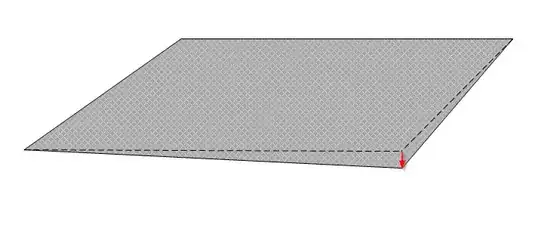
I have a rectangular patio which I would like to drain toward one of its corners. Is there any subtlety that the installer needs to know in order to create a proper grade for this? Do you need to install your pavers in a specific way?

I have seen this a lot done in Downtown Toronto where pavers where installed on walk ways and the walkway was installed to allow disabled people to go on or off the walkway with their carts. I have also seen it in large areas around buildings that where built on slopes

I need to do something less complicated than the above, something like in the picture below.

enter image description here

Niall C.
  • 20,709
  • 17
  • 90
  • 131
MiniMe
  • 3,255
  • 14
  • 74
  • 113
  • 2
    I don't understand your edit. That's a very different problem than the sloped flat patio. I think you're way overthinking this project. That said, in general, the main benefit of using pavers is that they are a rather flexible option for dealing with surface variants. If you had to do the latter, you'd prep the base and lay the pavers just as you would on a flat patio. The big difference is you'd have to do some crazy custom cuts in the latter. They actually make paver sets for handling circles and radii that are precut (though not sure specifically for elevated spiral patios...) – DA01 Jan 30 '15 at 21:49
  • (BTW, overthinking projects is one of my biggest problems too. I tend to over plan and still screw something up, so I've slowly gotten in the habit of spending less time planning, more time trying, and worse case, I just have to try twice to fix it. :) – DA01 Jan 30 '15 at 21:53
  • 1
    Right now that is all I can do about this project: think! My patio is covered in snow :D – MiniMe Jan 30 '15 at 23:40
  • Ha! True. Ok, so the latest edit, that's yet another variation. I think this question is getting a bit too broad at this point. Anyhow, that last example is actually more similar to your first example then second. Though the surface is on a curve and changes level, it's still laid in a square pattern. There's nothing really special you need to do there other than keep your lines straight. It's a gradual enough change in level that you're not going to have worry about the joints much at all. Some will naturally be a bit wider, but likely not noticeable visually. – DA01 Jan 30 '15 at 23:45
  • 1
    possible duplicate of [How would you grade this patio?](http://diy.stackexchange.com/questions/52670/how-would-you-grade-this-patio) – Ecnerwal Jan 31 '15 at 01:33
  • nope. this question came after that one was clear. That one refers to "what to do" and this one refers to "How to do it" – MiniMe Jan 31 '15 at 01:37
  • @user2059078 I do think you have a few too many questions on the same topic. It seems like we can't always give you the answer you need because there's more details in a different question that we aren't aware of. – DA01 Jan 31 '15 at 01:47
  • I think these two questions can be merged into one. – DA01 Jan 31 '15 at 01:49
  • when I had everything in one piece with questions listed and numbered it was deleted. :-| – MiniMe Jan 31 '15 at 02:15
  • 1
    How to do it is answered at the question I referenced. I see no point in rehashing it. – Ecnerwal Jan 31 '15 at 03:38
  • @user2059078 Don't drastically change the question after people have taken the time and trouble to provide an answer. If you've decided that you now want a curved paved area, ask a new question about that. Also, do you have a link to that deleted question you mentioned? I don't see it in your user profile. – Niall C. Jan 31 '15 at 15:58
  • Since it was deleted (as far as I can remember) I guess it will be impossible to find it. It was among the very first questions that I posted. You might check the revisions of the existing questions around that time, I don't remember if it was entirely deleted or partially edited and I was clearly advised to divide the issue in smaller questions. I might be wrong about the deletion but I stand correct for what the moderator told me at that time – MiniMe Jan 31 '15 at 16:19

2 Answers2

1

For low-cost leveling, use flexible plastic tubing and fill it with water and food coloring. This will allow you to level the forms at each corner, or, in this case, to an offset of your choosing.

user90964
  • 11
  • 1
0

Stake out the four corners. Find a way to mark each stake at the same height. A laser level would be easiest. If you don't have one of those, you can get string-line levels that hang from a string between each stake.

Once you have 4 level marks, you can now figure where the mark should be on the high end. Figure out where you want the top of the patio to be, then subtract the height of the brick. This will be where the sand base has to come up to. Now measure from that point to the original level mark you made. Let's say that's 4".

Now figure out the slope you need for the two adjoining corners. Most say you want the slop to be 1/8 - 1/4" per foot.

So if this is a 10' patio, and we want 1/4" per foot, that'd be a total slope of 2.5". Mark these two corners at 6.5" below your level mark. (4 + 2.5).

Now for the last corner (opposite the first) we'd mark that at 9" below level (6.5 + 2.5).

You now have the 4 corners marked at the proper slope.

After you get your grave base compacted, bring in the sand, and put down screed guides to line up with each of these points. I like using conduit for this. Not too pricey and comes in long lengths. Lay your screed on these as you go along to keep a consistent slope to the sand base.

Now, with this example, the outside edge of the patio is 9" lower than the high end of the wall. That's a pretty big difference. You may want to stick with a 1/8" slope (at least along the direction parallel to the house) but either way, keep in mind that height difference before laying the patio so that the outside edges are still above grade to allow full water run-off.
DA01
  • 24,095
  • 27
  • 73
  • 142
  • Water level, a piece of plastic tubing taped to two stakes, and filled with water is very easy to use. Example: http://www.wikihow.com/Use-a-Water-Level – Wayfaring Stranger Jan 30 '15 at 04:13
  • @WayfaringStranger I've used that before too. Might be a bit tricking being so close to the ground, but could work too. – DA01 Jan 30 '15 at 04:17
  • thanks to both of you for the suggestions but I was looking for tips on how to combine the bricks together, I have seen it done in a very nice way in DownTown Toronto, it is remarkable how smooth the slope is considering that it was done manually. I do realize that going on a slope with the pavers is challenging because you need to adjust the spaces and the angles between the bricks. The bedding is crucial in this but you have to be careful how you lie the bricks in order to have uniform gaps between them. Any tips for doing that ? – MiniMe Jan 30 '15 at 16:37
  • @user2059078 I'm not following your concern. You may be over thinking this. If you screed the sand using the guides, it's a flat plane. The bricks will fit together just fine. There's no real need to lay them in any particular pattern. Also, most patio paver blocks are designed with built in spacers. It's hard to *not* have uniform space. – DA01 Jan 30 '15 at 17:54
  • so you are saying that there is no special technique required to lie pavers on a surface like this ? http://www.revitcity.com/forum_files/42741_REVIT_Surface_Fill_Patterns_On_Warped_Floor.PNG – MiniMe Jan 30 '15 at 21:37
  • @user2059078 all paver patios are (or at least, should be) sloped so this is pretty normal. Once the sand is screeded you just start laying down the bricks in whichever pattern you prefer. The built in spacer allow you to simply abut each brick to the next and retain the proper joint gap. It's sort of like putting a jigsaw puzzle together. Just be sure that the joint between the house and the patio has some space for expansion. No special technique needed other than the standard way. – DA01 Jan 30 '15 at 21:39
  • If you go on a warped surface like the above illustrated there is no way in this world you can maintain the pavers with equal distance between them In order to run the pavers on a curved line you need to change the angles and that changes the distances between parallel pavers – MiniMe Jan 30 '15 at 23:27
  • 1
    @user2059078 right...but why are we talking about warped spiral patios now? I thought you were laying a flat square patio? You keep moving the goal posts on us. – DA01 Jan 30 '15 at 23:41
  • It is kind of like that. I am a little busy I don't have the time to search the archive here but I posted about my problem; the patio is a rectangle but I need to drain it on one corner and away from the house. Everything must go toward that corner .but.there is rectangular deck in the middle of the edge of the patio, the deck is raised and attached to the house and I don't want to remove it so I will have to warp the surface and take the deck position into the equation. I was told not to post complicated designs with multiple questions in one post hence this apparently out of context question – MiniMe Jan 31 '15 at 00:32
  • @user2059078 not trying to be argumentative...sincerely trying to help here...but I do think you are over-thinking things. If there's no water problems under the deck (I'd definitely confirm that) you can probably leave that section alone but still handle the rest of the project as I stated in my answer. Essentially do the exact same thing but you'd simply cut a square out of one corner of your work. As long as you are sloped away from that section, you'll be fine. Pavers are forgiving. There's wiggle room. That's one of the nice things about using them. – DA01 Jan 31 '15 at 01:46
  • OK I will try to do that. The other option is to redo the deck and deal with the who thing (I would still leave the pillars in position) – MiniMe Jan 31 '15 at 02:17