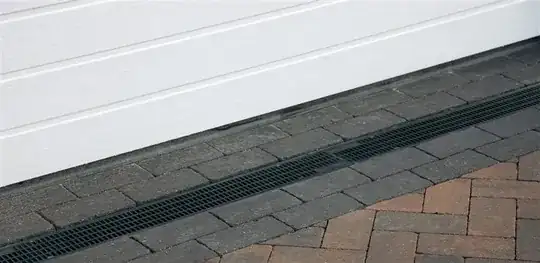
If water collects there because of a roof with out a gutter, it would be wise to add a French drain. If you did go that route, the saturation of water in that area would never make iot to the wall to the degree that you may think. The French drains that I built where graded to daylight, lined with a continuous piece of heavy gage plastic, so any water entering would not get to the wall, it could only go where the slope dictated it to go.
If you case it is only water migrating back to the wall from a backwards grade due to settling, and the grade of the patio is sloped enough to rid the area of enough water so none stands in any area for a time, then raising the sunk pavers is all you would need.
All that said, the biggest issue you will face is reinstallation. Cleaning the pavers will be crucial. If the pavers do not go in as tight as they did before, well, you will not like it. Making sure all goes in as tight as possible is important. Another precaution, IMO, and in my experience make the area you remove 2 ft. bigger than you need, it will help trying not to crowd the work space. Use plywood or wide 2X material at the edges to keep from dislodging the pavers you wish to keep in place.
If your 3D drawing is really accurate in detail and the pavers are laid as you have drawn, you would do well to start pulling the pavers up at corner 4, removing them diagonally so that you remove them back towards corner 1 and 3. If you added enough sand to raise corner 4 level with corner 1, essentially making a level line where the patio meets the house on the long wall. This depends of course if the grade beyond will support the pavers being raised at all. If it does, this will help insure that there is plenty of fall without changing everything. Also if the pavers don't quite run as tight as the original setting, it is just an adjustment of the edge. A simpler fix than cutting pavers.
Last note, I have only used special sand in the joints, not as the setting bed. I call it special sand because I have not used polymeric sand. I have used a bone dry mix of masonry cement and fine sand, broomed in and tamped over the faces of the pavers. Broomed in again and watered. The paver surfaces must be absolutely dry to make this work and only after all visible traces of the sand mix is gone, is it watered.
Polymeric sand is a simpler process, but this was done way before I knew about that stuff.