5

I'm scratching my head over how to layout some new flooring in relationship to our walls vs. hearth.

This is an engineered floor with somewhat wide boards (about 4.5")

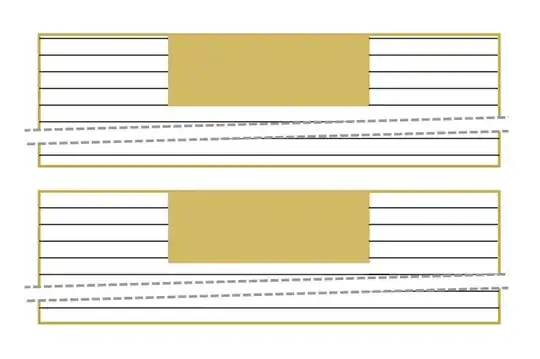
As it happens, I could lay them out and not need to rip any of the boards as they'd fit wall-to-wall (see bottom image). However, if I do that, I'd need to notch-out a few to go around the tile hearth (top image).

Is this just an aesthetic decision I need to make or is there a general rule of thumb? My initial thought was that having a nice line across the front of the hearth would be better, as that seems like a dominant element in the room. But that would leave two uneven slivers of full boards on either side of the room and maybe that would look even more odd?

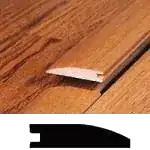
I should also note that around the hearth, there will be a beveled wood trim piece as the flooring is about a half inch lower than the hearth. I don't know if that would change things or not (would that hide the notch or accentuate it?)
enter image description here

Top image: floor laid out with seam lining up with front of hearth. This leaves two different sized partial strips on either end of the room.

Bottom image: floors laid out evenly wall-to-wall. Needs to be notched to fit around hearth.

Tester101
  • 130,386
  • 77
  • 314
  • 605
DA01
  • 24,095
  • 27
  • 73
  • 142
  • Are both pics supposed to be the same? Do you have a pic of the room? Not sure why the hearth is on an angle. – DMoore Jun 10 '13 at 17:23
  • @dmoore the dotted lines are just a break line--the room is much wider than shown. Tan=hearth. Black lines=floor seams. Note the differences in the black lines. – DA01 Jun 10 '13 at 17:25
  • But...if you can't see a difference, perhaps that's the answer: it doesn't matter because it's not all that noticeable either way. ;) – DA01 Jun 10 '13 at 17:27
  • 1
    I'd trim the hearth like a picture frame. Then supposing the picture frame is within the tan area, I'd go with first drawing. http://i.imgur.com/rhnBssU.jpg – mike Jun 10 '13 at 17:33
  • A thin strip of flooring may be very difficult to work with, so you may find that notching around the hearth is your only option. – Tester101 Jun 10 '13 at 17:38
  • @mike it will be 'framed' in that I have to add a bevel trim piece all around anyways. As for images, I can't find any showing wider-planked floors. But I'm now thinking that this is less of an aesthetic issue and more of a 'whatever is easier to install' issue. – DA01 Jun 10 '13 at 17:44
  • 3
    You may be thinking about this like a programmer/developer who *needs* order. Lines don't always have to line up. – Tester101 Jun 10 '13 at 17:45
  • @Tester101 ha! Absolutely! I'm notorious for over-drawing/designing things. Sounds like another vote for 'whichever is easier to install' ;) – DA01 Jun 10 '13 at 17:46
  • @mike thanks, mike. I do see lots of perpendicular floors in fireplace rooms. They look nice. That said, I'm following the rule-of-thumb that the flooring should go in the direction of the widest room wall. Not sure if that matters either. – DA01 Jun 10 '13 at 17:55
  • i agree with parallel to long wall. here is one with wide planks ... looks awesome! http://i.imgur.com/eCeN0RN.jpg ... and another http://i.imgur.com/khA3qe5.jpg – mike Jun 10 '13 at 17:57
  • That is a good picture. Alas, they *do* line up perfectly with the hearth so now I'm back to second-guessing myself. ;) That said, those are extremely wide planks, so likely makes a lot more sense (and I guess they were installed WITH the hearth so that was an easier task) – DA01 Jun 10 '13 at 18:14
  • I wouldn't worry about inside corners here. It is an area that will hardly ever see pressure - especially given the extra padding with the riser. – DMoore Jun 10 '13 at 20:05

2 Answers2

2

Most installs I have done we have trimmed around the fireplace. There are several ways to do it. If your fireplace hearth sits on flat ground we try to meet even - which is almost impossible unless you did the floor and hearth all in one install.

Most of the time we trim around the fireplace first and then cut to the trim. This is very very very time consuming because you will potentially have a lot of boards meet the trim and they need to be within 1/32".

An easier way to do this, especially if the hearth material is not as even, is to add a riser then maybe an optional board (or partial board). So you would layout your wood and just get as close as you can to fireplace then nail down the riser around the fireplace. The corners take some work but this is pretty easy. This looks really good if it is brick and you can get (or notch) the riser so its back sits in a mortar line.

enter image description here

And a note on floating - I would probably use a riser. Because you could set the floating wood 1/4 inch from fireplace, giving it a proper gap, and then staple the riser just to the underlying floating wood. It would still be floating then.

DMoore
  • 47,296
  • 15
  • 79
  • 187
  • yep. This is the plan. I'm going to use a riser around the hearth. So, since that overlaps a good part of the floor boards, the whole 'lining up exactly with the front of the hearth' issue is perhaps moot. – DA01 Jun 10 '13 at 17:56
  • 2
    I personally wouldn't line it up. Because if there are any issues then it looks off. Also not lining it up look more natural - that is just my opinion though. The only kind of lining up we ever do is to make sure - for example - we don't have a sliver of a piece in front of fireplace. If your line is off 1/4 of an inch from side to side you will notice it (no one else will) if one of the sides "match" but if one is at 2 inches and the other at 2.25 inches you don't notice. – DMoore Jun 10 '13 at 17:59
  • 1
    that last bit is actually an excellent point. I doubt the hearth is perfectly square to the wall and, as such, lining the floor to it might be an impossible task. Better to be purposefully off by a wider margin! – DA01 Jun 10 '13 at 18:13
  • 1
    I like the riser idea for expediency, though they create another 'corner' that will capture dirt. As far as 1/32 goes, not if you start your run there and end it at a wall. – mike Jun 10 '13 at 18:54
  • Good point to start your run at the trim. Not sure how you leave an expansion gap without a riser for floating though. – DMoore Jun 10 '13 at 18:56
  • Also if you had about 2 inches in front of fireplace on a run - that 2 inch piece would hardly ever be walked on. The major issue with a floating floor in this situation is the last piece being pushed by foot into fireplace. Over time there is a chance glue bonding would be broken down by constant pushing. With a smaller piece you are allowing the pressure to be spread more because hitting the second row should push to more planks (given they are staggered). – DMoore Jun 10 '13 at 20:19
0

The simplest is just to do as others have pointed and to use trim around where the wood and hearth meet. On our fire place I didn't want to use any wood trim so I took an angle grinder with a mason grinding pad and ground the bottom of the hearth on all sides deep enough so the floating floor wood would slip under it. It's messy and loud but the results are I feel more aesthetically pleasing. With this approach there is no trim around the hearth and if the hearth isn't square, which ours wasn't, there is no gap that may need to be contended with.

Micah Montoya
  • 856
  • 4
  • 7