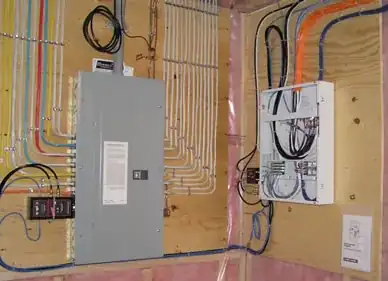
Let's take this one question at a time.
Does it matter what screws I put my ground and neutral in?
This answer, and this answer provide quite a bit of information, so I'll simply summarize for your specific situation.
As long as this is a Main service entrance, you can connect grounding (ground) and grounded (neutral) conductors to either bus bar. As long as:
- The grounded (neutral) bus bar is properly bonded.
- Only one grounded (neutral) conductor can be under a screw terminal.
- Multiple grounding (ground) conductors can be under a screw terminal, if the terminal is rated for multiple conductors (check manufacturer documentation).
If I flip the main power breaker does that mean I can't get shocked
when attaching new breaker?
Flipping the main breaker deenergizes both ungrounded (hot) bus bars, but does not deenergize the main lugs or the ungrounded (hot) feeders. Even with the main breaker off, there is still a risk of shock. If you're not comfortable with this, please seek the assistance of a local licensed Electrician.
I only have one entry hole left for the breaker box on top. Well I
need to put a few more lines in. It is in a basement so everything is
coming from the top. What is the code for going around the bottom to
enter in a hole there? Not sure I can run the wire behind the box - so
can I just wrap the wire around box? Really want this done right. What
do you suggest?
There are way too many applicable rules to cover them all here, so I'll focus on the one that I think might be most useful to you.
National Electrical Code 2008
ARTICLE 110 Requirements for Electrical Installations
110.3 Examination, Identification, Installation, and Use of Equipment.
(B) Installation and Use. Listed or labeled equipment shall be installed and used in accordance with any instructions included in the
listing or labeling.
What this means, is that if you can figure out who made the cable clamps at the top of the panel, and can locate the datasheet on these clamps. You may discover that the clamps are actually approved to accept multiple cables. If this is the case, you can simply use the existing clamps to secure both the new and existing cables. If you can't find the data, you could always purchase new clamps that are known to accept multiple cables. Replace the old clamps with the new clamps, and use them to secure both the new and existing cables. If you're working with nonmetallic sheathed cable, you should be able to locate clamps that accept 2 cables. So rather than running extra cable all over the place, I'd explore this avenue first.