5

I have a Maytag model LD69806AAE clothes dryer. Since our tenants in our town home have moved in July 2012. They have pointed out that the dryer takes about 3 hours to dry a load of clothes. The dryer is about 10 years old but was not used that much. The previous owner (my wife's GF) hardly used it. My wife bought the place in 2006, and before I moved in when we got married in 2009 it was hardly used. She had two roommates at separate times but they only stayed for months at a time. The dryer is located in the center area of the first floor. There is about 28 feet of flex corrugated dryer vent duct work. It is routed to the outdoor patio. There are about 3 elbows in the duct run. The duct ended at a louver/grill at the exterior patio wall. Here’s a list of things we have done.

  1. Had Sears replace the heating solenoid valve.
  2. My brother-in-law and I vacuumed the inside of the dryer and ductwork at the point of connection to the dryer.
  3. Replace the outside termination to a typical wall cap. Remove some excess flex duct close to the outside termination.
  4. Had Coit Services Clean out the dryer vent ductwork

After the cleaning of the duct by Coit, our tenants mentioned the dryer time is better but still longer than expected (maybe 2.5 hours)

Now we are considering re-routing (21 feet approx.) the ductwork with straighter runs and less elbows and provide smooth dryer vent ductwork and possibly increasing the duct from 4” to 6” at areas where possible. Will this make any difference?

Niall C.
  • 20,709
  • 17
  • 90
  • 131
mguzman72
  • 109
  • 2
  • 3
  • 6
  • 1
    How big of a load are they trying to dry at once? – ElefantPhace Mar 29 '13 at 00:16
  • 4
    And how dry are the clothes, is it possible the washer isn't spinning them dry enough. I'd also verify that the dryer is properly heating, it could be one of the elements is out. – BMitch Mar 29 '13 at 02:29
  • Are you sure that's the correct model#? – Tester101 Mar 29 '13 at 12:00
  • 2
    All the discussion of exhaust duct are correct, but it seems to me that there's a quick way to assess that in _very_ rough terms. Run the dryer with an ordinary damp load. Go outside and feel the exhaust output. After warmup time, say 10 minutes into the cycle, the exhaust should feel warm and very damp. This quick assessment might be best if you can compare with a different dryer that works well, just so you have some mental image of what "normal" feels like. This could help you gauge both the flow and the temp, though with that duct run, I bet you're losing a lot of heat before the outlet. – Tim B Mar 29 '13 at 13:00
  • 1
    Addtional Notes to comments: After #2 I had maytag tech come out and check the dryer. They said dryer was shutting off the heating because there was too much back pressure (clogged dryer vent. I can feel the warm air at the termination but still takes a while to dry clothes. When I used the dryer I would leave it on when we were asleep. So I really didn't know how long it took to dry. Also our tentants said they even just put 3-4 wet shirts from the washer into the dryer and it still look while to dry. Thanks to all for responses. – mguzman72 Mar 29 '13 at 19:31
  • Maytag tech may be right, but should back up observation with a specific pressure reading expressed in water column inches. – Bryce Jan 06 '14 at 22:24

4 Answers4

4

Your duct is probably too long, and not constructed properly. Installing a proper exhaust system may increase the dryers performance, though this is not guaranteed.

Vent length and installation requirements will vary slightly from manufacturer to manufacturer, but International Residential Code (IRC) gives us a conservative starting point.

International Residential Code 2009

Chapter 15 - Exhaust Systems

Section M1502 Clothes Dryer Exhaust

M1502.1 General. Clothes dryers shall be exhausted in accordance with the manufacturer's instructions.

M1502.4 Dryer exhaust ducts. Dryer exhaust ducts shall conform to the requirements of Sections M1502.4.1 through M1502.4.6.

M1502.4.1 Material and size. Exhaust ducts shall have a smooth interior finish and shall be constructed of metal a minimum 0.016-inch (0.4 mm) thick. The exhaust duct size shall be 4 inches (102 mm) nominal in diameter.

M1502.4.3 Transition duct. Transition ducts used to connect the dryer to the exhaust duct system shall be a single length that is listed and labeled in accordance with UL 2158A. Transition ducts shall be a maximum of 8 feet (2438 mm) in length. Transition ducts shall not be concealed within construction.

M1502.4.4 Duct length. The maximum allowable exhaust duct length shall be determined by one of the methods specified in Section M1502.4.4.1 or M1502.4.4.2.

M1502.4.4.1 Specified length. The maximum length of the exhaust duct shall be 25 feet (7620 mm) from the connection to the transition duct from the dryer to the outlet terminal. Where fittings are used, the maximum length of the exhaust duct shall be reduced in accordance with Table M1502.4.4.1.
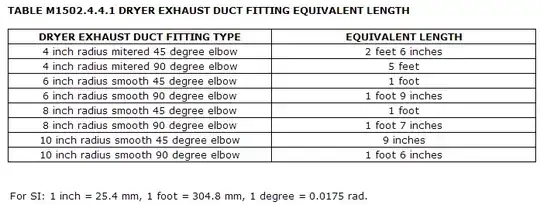
Table M1502.4.4.1

M1502.4.4.2 Manufacturer's instructions. The size and maximum length of the exhaust duct shall be determined by the dryer manufacturer's installation instructions. The code official shall be provided with a copy of the installation instructions for the make and model of the dryer at the concealment inspection. In the absence of fitting equivalent length calculations from the clothes dryer manufacturer, Table M1502.4.4.1 shall be used.

Basically what all this means, is that in general the overall length of the duct can be 33'. 25' of the duct system; measured from the exhaust hood to the dryer connection, must be 4" rigid metal duct. You can then have an 8' section of "transition duct", which can be flexible duct, but must be UL listed and labeled for the use. For each elbow, subtract the value from Table M1502.4.4.1 from the overall 25' length.

When you use flexible "transition duct", make sure the duct is fully extended and trimmed to fit. Don't leave the duct compressed and coiled.

Manufacturers Installation Instructions

If you look at the Maytag installation instructions (PDF), they tell you what type of exhaust hoods you can choose from.

Exhaust hood choices

The instructions then provide a table to determine the maximum duct length, based on the hood used and the number of bends.
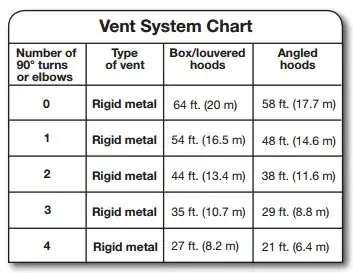
Vent System Chart


Gas dryers need gas to dry, so make sure the gas is on before you spend too much more time or money on repairs. It might also be useful to make sure it's not user error, by making sure the tenants know how to use the dryer properly. Don't forget to make sure the tenants aren't overloading the dryer.

Tester101
  • 130,386
  • 77
  • 314
  • 605
  • 1
    My understanding is that they tried 3-4 t shirts straight from the washer and it took while to dry. Thanks for the response! – mguzman72 Mar 29 '13 at 19:35
  • Also make sure they know to clean out the lint trap ... I had some friends who got an apartment and couldn't figure out why it kept taking longer and longer for their clothes to dry. (the lint trap was *stuffed*) – Joe Mar 25 '14 at 21:14
3

Smooth duct will help. Fewer 90 elbows will help! (each 90 elbow is a 5 ft equivalent). The reccomended (maximum) 35 ft unassisted duct run gets eaten up quickly by elbows. Even using 2 45s would help

Some HVAC discussions suggest flex duct has a 50% flow reduction compared to smooth.

Update On the Maytag checklist for your dryer, Takes too long to dry , is a cycling thermostat...

The complete breakdown for your dryer is here

HerrBag
  • 12,066
  • 1
  • 19
  • 37
  • I want to try replacing the cycling thermostat. Is this something I can do? – mguzman72 Mar 29 '13 at 19:37
  • Absolutely.. Sensor replacement doesn't get any easier than this one.. checkout the video on the first link.. – HerrBag Mar 29 '13 at 20:38
  • thanks! I'll order the part.. questions.. if this thermostat isn't working... does that mean clothes don't dry at all.. or there is no heat? or just drys longer? I wonder why both techs didn't really check this out... – mguzman72 Mar 29 '13 at 22:25
  • ok i'm an idiot.. where's the link to the video? – mguzman72 Mar 29 '13 at 22:50
  • http://www.partselect.com/PS344510-Whirlpool-3387134-Cycling-Thermostat.htm?SourceCode=12&SearchTerm=LDG9806AAE&ModelNum=LDG9806AAE – HerrBag Mar 30 '13 at 04:58
  • thanks. Would there be a place to buy this locally? in los angeles.. – mguzman72 Apr 01 '13 at 18:34
  • so i was reading more on that first link you gave me.. it looks like some people also bought thermal fuse and hi limit thermostat.. but again they probably have a different dryer... any thoughts? – mguzman72 Apr 01 '13 at 18:40
  • Those are all possibilities, the cycling 'stat is the easiest to change, the others may be harder. The fuse is easily testable with a continuity tester or ohmmeter. The hi limit similarly should be closed at room temp. – HerrBag Apr 01 '13 at 20:36
  • Check your local directory for "Appliance parts" Many of these parts cross to many other brands. Just give them the model and they will do what the Part Select site did. – HerrBag Apr 02 '13 at 23:29
  • I *could* shop for you, but you'd have to send me a airplane ticket, to verify the proper installation technique ;-) – HerrBag Apr 02 '13 at 23:31
  • thanks Herrbag.. I saw this site which is close to work..hopefully they will have it.. http://www.coastparts.com/locations/LA – mguzman72 Apr 03 '13 at 04:45
  • Herrbag... so i checked the cycling thermostat and thermal fuse.. both had continuity..i had the parts in hand but didn't install them... should I have just installed the new part and see what happens? – mguzman72 Apr 16 '13 at 15:44
  • No, not if they have continuity. What about the hi-temp one? Be an easy mad-science experiment with an ohmmeter and an oven. If it opens below 200F, nothing will dry properly (which is to say I don't know it's rated trip temperature, I'll check and post). – HerrBag Apr 16 '13 at 22:13
  • thanks Herrbag.. I can't tell from the breakout images where the Hi limit thermostat is.. I will find out today.. It was easy to get to the thermal fuse and cycling thermostat ( thru the front panel) – mguzman72 Apr 16 '13 at 22:49
  • so I was able to find the hi limit thermostat.. I only check the continuity at room temp wasn't able to do that stove test because I was in a rush...i asked the tenants to test the dryer again..it looked like something was rusting at the back of the cone (item#20) in gas valve diagram... i guess i should check coils?.. without clothes in the dryer.. i tested it out and there was heat – mguzman72 Apr 18 '13 at 16:00
  • ok... the renter said there hasnt been any improvement since the last cleaning ( 3hours down 2 hours). would a booster fan help out? – mguzman72 Jul 30 '13 at 22:12
2

Check the inside of the dryer drum for dryer sheets plastered over the interior vents. I went through all the hassle of the above posts, checking vents for clogs, removing the ductwork and cleaning it totally out, and so on. Then it finally ocurred to me to look inside the drum. And voila!! There was the culprit...a full dryer sheet was covering the holes on the largest interior vent. I removed it and just like that problem solved, dryer immediately started working perfectly. No more wet lint and three hour loads.

Jo Yale
  • 21
  • 1
0

I would start your repair process by running a very temporary hose out a window and comparing the dry time of a damp towel (wash two, dry one and hold the other in a plastic bag for your test). Separate out the possibility of a bad sensor from the duct issues.

For running the duct: hard duct is better than flexible, and long sweep elbows (e.g. dryer-ell brand) are better than typical elbows. You'll have to give us pictures if you want help routing the duct.

Your Maytag technician should not have speculated about back pressure on the ducts, but rather measured it and given you a number. A lint alarm on the dryer is a good idea for rental property, and those will give you some rough indication of back pressure, but nothing particularly calibrated.

Bryce
  • 10,586
  • 12
  • 64
  • 107
  • So I did a test where I unhooked the vent duct to the dryer and basically vented to the inside of the townhome. I brought in a load of wet clothes and it took about half hour for the clothes to dry. At house house the dryer is located to an exterior wall with half about 6-8 inches of vent duct to the outside. It usually takes about 30-30 minutes for dryer. I offered to clean the vent and one more time. I want to tell her that's how long is going to take because of the length of duct run. For all I know she could have had her previous dryer close to an exterior wall. – mguzman72 Jan 06 '14 at 21:23
  • Duct length at reasonable lengths has only a minimal effect. You should compare dry time of two identical wet towels two ways: with and without the duct. Based on your description I suspect a duct problem. – Bryce Jan 06 '14 at 22:22
  • At the termination at the outdoors can I can feel hot air coming out. What kind of duct problems do you think I am having? leakage? – mguzman72 Jan 06 '14 at 23:08
  • Backpressure. That's why you try the wet towel two ways. Your dryer may be unusually wimpy also, contributing to the issue. – Bryce Jan 07 '14 at 05:27