4

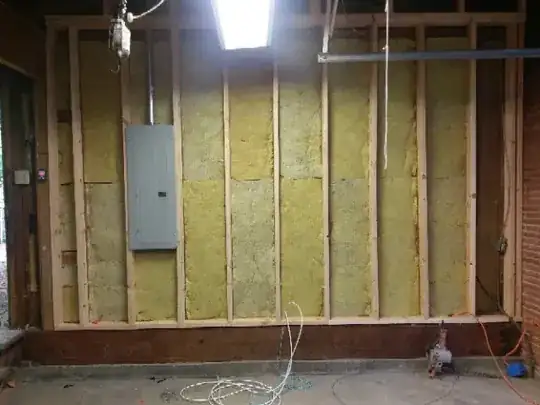
We are building a shear wall by adding structural-1 plywood or OSB to the existing framing and nailing according to a nailing schedule. The wall is 13'x8'.

What is the best way to orient the plywood for the best shear strength and nail retention?

  • Vertical?
  • Horizontal?
  • Horizontal in a brick-lay pattern?
  • Other?

Garage Wall for Seismic Retrofit

KJ7LNW
  • 1,025
  • 5
  • 17
  • 2
    A good shear wall starts with the studs, your wall studs need to be stuffed up a lot, including diagonals or brackets. See if you can get details from searching online, or consult with an engineer. – r13 Oct 10 '21 at 00:54
  • 3
    Horizontal. Brick pattern – Kris Oct 10 '21 at 00:59
  • @r13 doesn't that depend on the required shear strength? How did you conclude that bracing etc.. is required? Segmented or perforated walls are common. – P2000 Oct 10 '21 at 04:57
  • 1
    Strongest is the the sheets rotated 45 degrees and tiled squarely, because all the sloping blocking you'll need to add for that arrangement will also function as diagonal bracing. this is overdoing it. – Jasen Oct 10 '21 at 10:28
  • The sheet can't take much of force if your studs deforms. you can hole the diagonal corners of a towel to image the deformation of the wall during an earthquake. Then you will realize what is the most important and effective means to resist such action. – r13 Oct 10 '21 at 14:26
  • @P2000 Here is an anecdotal observation: I grew up in California, and whenever I saw a house being framed, there were always a diagonal 2x4 across the studs. Here in Texas I don't think I've seen that. – Mark Stewart Oct 10 '21 at 18:00
  • @MarkStewart are you sure that wasn't temporary bracing before the sheathing goes on? To hold up against earthquakes during construction? (IDK) – P2000 Oct 10 '21 at 18:02
  • 2
    Back to your original concern, the board installed horizontally will be more stable than the other way around, because it has a lower geometric aspect ratio V/H (vertical length vs horizontal length) in direction of the shear force due to the seismic event. The brick pattern has the advantage over the butt-jointed boards, depending on the arrangement of the studs. https://www.woodworks.org/wp-content/uploads/TX-Wind-Workshops-Hour-3-Shearwalls-and-Diaphragms.pdf – r13 Oct 10 '21 at 23:09
  • 1
    @P2000 Yes, the vertical 2x4s were notched to allow the diagonal 2x4 to sit flush; this was in the 1960s. Our house built in 1965 still had the diagonal 2x4s there. (No drywall in the garage, so I could see them.) – Mark Stewart Oct 11 '21 at 13:56

2 Answers2

5

the wall is 13x8 and the boards are 4x8, the simplest way is to put the 8 dimesnion of the boards on the 8 dimension of the wall.

As the boards need to be nailed all round the perimeter, if you lay the boards horizontally you'll need to add blocking to catch the edges of the boards.

If you stand them vertically you'll need a stud where the edges of the boards meet. It looks like you have 16" spacing for your studs, so you'll only need to cut the end boards (and a hole for the electrical panel id that needs to be accessible from the side you are boarding)

When properly nailed both orientations are equal in strenngth
Jasen
  • 17,695
  • 1
  • 19
  • 31
  • Your answer addresses the puzzling part; could you also comment on the best orientation in terms of shear strength? – P2000 Oct 10 '21 at 04:51
  • 1
    See wiki entry on [plywood](https://en.wikipedia.org/wiki/Plywood) *This alternation of the grain is called cross-graining and has several important benefits: it reduces the tendency of wood to split when nailed at the edges; it reduces expansion and shrinkage, providing improved dimensional stability; and it **makes the strength of the panel consistent across all directions**.* – user2448131 Oct 10 '21 at 15:26
  • @user2448131, yes that might be correct for shear strength (I don't know), which is what the OP asked about (but it is worth mentioning that in *general*, esp. for tensile strength in a floor assembly, the "strength axis of plywood" does matter). I think it would be helpful if you could qualify that, and perhaps even submit it all as an answer since it nails (!) the OP's question. – P2000 Oct 10 '21 at 15:45
  • Plywood is stronger than OSB. You could also go belt and suspenders; put steel strapping diagonals on the studs before plywood. – blacksmith37 Oct 10 '21 at 15:57
  • @P2000 Sorry, anyone who wished to include it in their answer can do so, then flag to delete my comment. Not enough for a good answer... – user2448131 Oct 10 '21 at 16:01
  • 1
    @blacksmith37, according to this document on PDF page 48, OSB is stronger than plywood: https://www.woodworks.org/wp-content/uploads/TX-Wind-Workshops-Hour-3-Shearwalls-and-Diaphragms.pdf . OSB is known to be stronger for shear forces because the laminate layers are randomly oriented, not orthogonal. There is a bit of controversy on the subject, but I think the studies on the subject have worked that out. – KJ7LNW Oct 11 '21 at 02:01
  • Why not add your earlier comment "strongest is the the sheets rotated 45 degrees and tiled squarely" here in the answer, it addresses the OP's specific question. – P2000 Oct 11 '21 at 15:08
  • nobody seriously reccomends that, it's cheaper to just use thicker boards, – Jasen Oct 11 '21 at 20:04
2

Are you trying to solve a specific problem with the structure? If so, you might indeed want to engage an engineer.

If you are simply trying to add a little rigidity to your building, plywood is a good choice. It will work in either orientation, but horizontal brick pattern is most typical. Consider tying the ends (and sides) together with sheathing brackets, like this:

https://www.strongtie.com/clipsandties_miscellaneousconnectors/pscl-psca_productgroup_wcc/p/pscl.psca

They will add a great deal of shear resistance at a minimal cost.

oldVermonter
  • 437
  • 1
  • 3
  • "It will work in either orientation" +1 for addressing the specifics of OP's question (and that peaked my interest too...) – P2000 Oct 10 '21 at 15:46
  • Thank you for pointing out the sheathing clips. Two questions: (1) How frequently should they be placed? (2) Do you have any documentation about the increase in sheer resistance? – KJ7LNW Oct 11 '21 at 02:10
  • Every AHJ is different, but I can't imagine how H clips make better edge fasteners than solid blocking. To the OP: proceed carefully with information you get off the internetz for free. – Aloysius Defenestrate Oct 11 '21 at 02:40
  • I'm adding the comment from @r13 here because it addresses the strength question of which pattern is strongest: "The board installed horizontally will be more stable than the other way around, because it has a lower geometric aspect ratio V/H (vertical length vs horizontal length) in direction of the shear force due to the seismic event. The brick pattern has the advantage over the butt-jointed boards, depending on the arrangement of the studs: https://www.woodworks.org/wp-content/uploads/TX-Wind-Workshops-Hour-3-Shearwalls-and-Diaphragms.pdf " – KJ7LNW Oct 20 '21 at 01:04