EQUILIBRIUM OF HETEROGENEOUS SUBSTANCES.
261
where and denote the volumes of the masses of the phases and which are replaced. Now by (500),


| ,and | (565) |
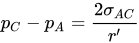
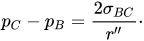
We have also the geometrical relations



By substitution we obtain
| (567) |
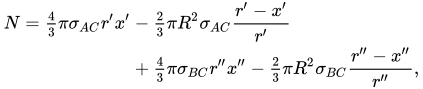
and by (561),
| (568) |

Since
| |
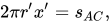
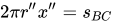

we may write
| (569) |

(The reader will observe that the ratio of and is the same as that of the corresponding quantities in the case of the spherical mass treated on pages 252–258.) We have therefore


| (570) |

This value is positive so long as

since
,and


But at the limit, when
we see by (561) that
| and |


and therefore

It should however be observed that in the immediate vicinity of the circle in which the three surfaces of discontinuity intersect, the physical state of each of these surfaces must be affected by the vicinity of the others. We cannot, therefore, rely upon the formula (570) except when the dimensions of the lentiform mass are of sensible magnitude.
We may conclude that after we pass the limit at which becomes greater than and (supposed equal) lentiform masses of phase will not be formed until either , or becomes so great that the lentiform mass which would be in equilibrium is one



