< Page:Elementary Principles in Statistical Mechanics (1902).djvu
This page has been proofread, but needs to be validated.
52
AVERAGE VALUES IN A CANONICAL
the 's. The integrals may always be taken from a less to a greater value of a .
and for the average of the whole kinetic energy, , as before.
which shows that the value of the Jacobian is independent of the manner in which is divided into a sum of squares. We may verify this directly, and at the same time obtain a more convenient expression for the Jacobian, as follows.
It will be observed that since the 's are linear functions of the 's, and the 's linear functions of the 's, the 's will be linear functions of the 's, so that a differential coefficient of the form will be independent of the 's, and function of the 's alone. Let us write for the general element of the Jacobian determinant. We have

The general integral which expresses the fractional part of the ensemble which falls within any given limits of phase is thus reduced to the form
| (134) |

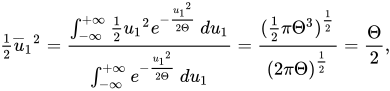
For the average value of the part of the kinetic energy which is represented by whether the average is taken for the whole ensemble, or for a given configuration, we have therefore

| (135) |

The fractional part of the ensemble which lies within any given limits of configuration, is found by integrating (184) with respect to the 's from to . This gives


| (136) |



This article is issued from Wikisource. The text is licensed under Creative Commons - Attribution - Sharealike. Additional terms may apply for the media files.