< Page:Elementary Principles in Statistical Mechanics (1902).djvu
This page has been proofread, but needs to be validated.
AND THEORY OF INTEGRATION.
29
ing constant (), is also a quadrature, since the equation to be integrated may be expressed in the form
and and are given in terms of by the differential equations of motion. When we have obtained integral equations, we may regard and as known functions of and . The only remaining difficulty is in integrating this equation. If the case is so simple as to present no difficulty, or if we have the skill or the good fortune to perceive that the multiplier
or any other, will make the first member of the equation an exact differential, we have no need of the rather lengthy considerations which have been adduced. The utility of the principle of conservation of extension-in-phase is that it supplies a 'multiplier' which renders the equation integrable, and which it might be difficult or impossible to find otherwise.
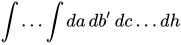
Therefore the multiple integral


Now, apart from any such considerations as have been adduced, if we limit ourselves to the changes which take place in time, we have identically



| (79) |

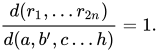
It will be observed that the function represented by is a particular case of that represented by . The system of arbitrary constants has certain properties notable for simplicity. If we write for in (77), and compare the result with (78), we get


| (80) |
| (81) |
This article is issued from Wikisource. The text is licensed under Creative Commons - Attribution - Sharealike. Additional terms may apply for the media files.