THEORY OF INTEGRATION.
27


| (72) |

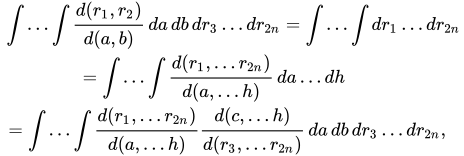
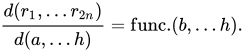
Moreover, since and are independent functions of , the latter variables are functions of the former. The Jacobian in (71) is therefore function of , and , and since it does not vary with it cannot vary with . We have therefore in the case considered, viz., where the forces are functions of the coördinates alone,


| (73) |
Now let us suppose that of the first integrations we have accomplished all but one, determining arbitrary constants (say ) as functions of , leaving as well as to be determined. Our finite equations enable us to regard all the variables , and all functions of these variables as functions of two of them, (say and ,) with the arbitrary constants . To determine , we have the following equations for constant values of .


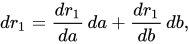
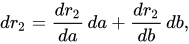
| (74) |