< Page:Elementary Principles in Statistical Mechanics (1902).djvu
which substituted in (34) will give
The determinant in this equation is therefore a constant, the value of which may be determined at the instant when , when it is evidently unity. Equation (33) is therefore demonstrated.
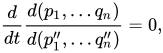
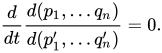
If we suppose the limits specified by values of , a system initially at the limits will remain at the limits. The principle of conservation of extension-in-phase requires that an extension thus bounded shall have a constant value. This requires that the determinant under the integral sign shall be constant, which may be written
This equation, which may be regarded as expressing the principle of conservation of extension-in-phase, may be derived directly from the identity
in connection with equation (33).
This page has been proofread, but needs to be validated.
EXTENSION-IN-PHASE.
15

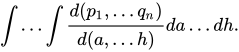
Again, if we write for a system of arbitrary constants of the integral equations of motion, , , etc. will be functions of , and , and we may express an extension-in-phase in the form


| (35) |
| (36) |
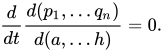

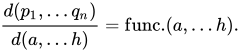
Since the coördinates and momenta are functions of , and , the determinant in (36) must be a function of the same variables, and since it does not vary with the time, it must be a function of alone. We have therefore
| (37) |
This article is issued from Wikisource. The text is licensed under Creative Commons - Attribution - Sharealike. Additional terms may apply for the media files.