< Page:Elementary Principles in Statistical Mechanics (1902).djvu
This page has been proofread, but needs to be validated.
SYSTEMS COMPOSED OF MOLECULES.
195
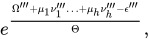
The probability-coefficient of a generic phase in the third ensemble, which consists of systems obtained by regarding each system of the first ensemble combined with each of the second as forming a system, will be the product of the probability-coefficients of the generic phases of the systems combined, and will therefore be represented by the formula
where , , , etc. It will be observed that , etc., represent the numbers of particles of the various kinds in the third ensemble, and its energy; also that is a constant. The third ensemble is therefore canonically distributed with respect to generic phases.
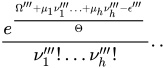
In fact, however, the probability-coefficient of any specific phase which occurs in the third ensemble is
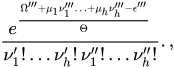
which we get by multiplying the probability-coefficients of specific phases in the first and second ensembles. The difference between the formulae (514) and (515) is due to the fact that the generic phases to which (513) relates include not only the specific phases occurring in the third ensemble and having the probability-coefficient (515), but also all the specific phases obtained from these by interchange of similar particles between two combined systems. Of these the proba-
| (513) |


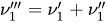


If all the systems in the same generic phase in the third ensemble were equably distributed among the specific phases which are comprised in the generic phase, the probability-coefficient of a specific phase would be

| (514) |
| (515) |
This article is issued from Wikisource. The text is licensed under Creative Commons - Attribution - Sharealike. Additional terms may apply for the media files.