< Page:Elementary Principles in Statistical Mechanics (1902).djvu
This page has been proofread, but needs to be validated.
174
THERMODYNAMIC ANALOGIES.
between and temperature would be complete, as has already been remarked. We should have
when the energy is a quadratic function of the 's and 's, and similar equations with , , , instead of , , , when the energy is a quadratic function of the 's alone.
which corresponds to the thermodynamic theorem that the distribution of energy between the parts of a system, in case of thermal equilibrium, is such that the temperatures of the parts are equal.
where the variables are connected by the equation
The greatest value of this expression, for a constant infinitesimal value of the difference , determines a value of , which we may call its most probable value. This depends on the greatest possible value of . Now if , and , we shall have for the least possible value of





More characteristic of are its properties relating to most probable values of energy. If a system having two parts with separate energies and each with more than two degrees of freedom is microcanonically distributed in phase, the most probable division of energy between the parts, in a system taken at random from the ensemble, satisfies the equation

| (488) |
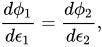
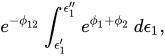
To prove the theorem, we observe that the fractional part of the whole number of systems which have the energy of one part () between the limits and is expressed by





This article is issued from Wikisource. The text is licensed under Creative Commons - Attribution - Sharealike. Additional terms may apply for the media files.