MAXIMUM AND MINIMUM PROPERTIES.
133


Theorem VI. The average value in an ensemble of systems of (where denotes as usual the index of probability and any function of the phase) is less when the ensemble is so distributed that is constant than for any other distribution whatever.


Theorem VII. If a system which in its different phases constitutes an ensemble consists of two parts, and we consider the average index of probability for the whole system, and also the average indices for each of the parts taken separately, the sum of the average indices for the parts will be either less than the average index for the whole system, or equal to it, but cannot be greater. The limiting case of equality occurs when the distribution in phase of each part is independent of that of the other, and only in this case.
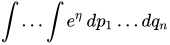
Let the coördinates and momenta of the whole system be , of which relate to one part of the system, and to the other. If the index of probability for the whole system is denoted by , the probability that the phase of an unspecified system lies within any given limits is expressed by the integral



| (431) |
| (432) |

| (433) |
