< Page:Elementary Principles in Statistical Mechanics (1902).djvu
This page has been proofread, but needs to be validated.
THE CANONICAL DISTRIBUTION.
111
where denotes the value of for the modulus . Since the last member of this formula vanishes for , the less value represented by the first member must also vanish for the same value of . Therefore the second member of (359), which differs only by a constant factor, vanishes at the upper limit. The case of the lower limit remains to be considered. Now
The second member of this formula evidently vanishes for the value of , which gives , whether this be finite or negative infinity. Therefore, the second member of (359) vanishes at the lower limit also, and we have
or
This equation, which is subject to no restriction in regard to the value of , suggests a connection or analogy between the function of the energy of a system which is represented by and the notion of temperature in thermodynamics. We shall return to this subject in Chapter XIV.
We thus obtain the following equations:


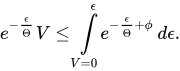


| (362) |


If , the second member of (359) may easily be shown to vanish for any of the following values of viz.: , , , , where denotes any positive number. It will also vanish, when , for , and when for . When the second member of (359) vanishes, and , we may write



| (363) |

If ,
| (364) |

This article is issued from Wikisource. The text is licensed under Creative Commons - Attribution - Sharealike. Additional terms may apply for the media files.